
Choosing the right cabbage processing line is important for businesses that need to process fresh cabbage efficiently and consistently. The ideal system depends on production capacity, final product, processing requirements, available space, and the desired level of automation.
Instead of selecting equipment based only on price, buyers should consider the complete production process. A properly designed cabbage processing line can reduce labor, improve product consistency, and provide a more efficient workflow for commercial production.
Determine Your Required Processing Capacity
The first step is to determine how much cabbage you need to process per hour or per day.
A small food processing operation may only need a compact semi-automatic system, while a large vegetable processing plant may require a continuous high-capacity production line.
Before contacting a manufacturer, determine:
Required capacity per hour
Daily production volume
Expected future production growth
Number of working hours per day
Choosing a line with the appropriate capacity helps avoid both over-investment and insufficient production capacity.
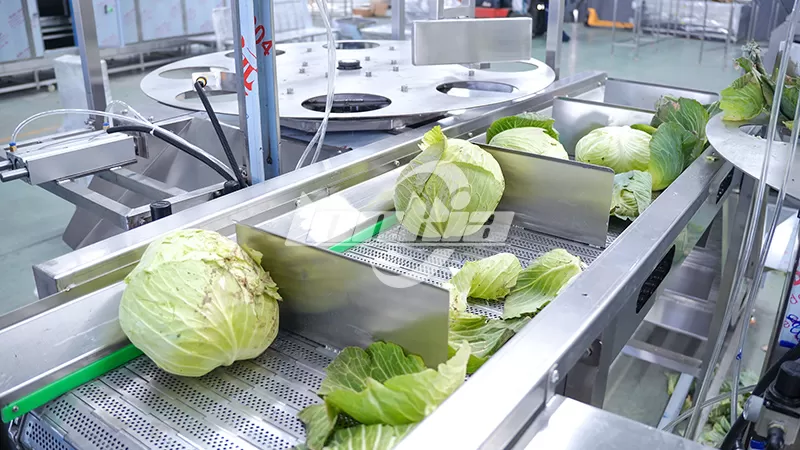
Consider Your Final Cabbage Product
The type of cabbage product you plan to produce will directly affect the equipment configuration.
For example, different products may require different cutting and processing methods, such as:
Whole or trimmed cabbage
Sliced cabbage
Shredded cabbage
Fresh-cut cabbage
Cabbage for salads and coleslaw
Cabbage for fermented or prepared foods
The cutting size, washing requirements, drying process, and packaging method should all be considered when designing the line.
Choose the Right Level of Automation
Another important decision is whether to choose a semi-automatic or fully automatic cabbage processing line.
A semi-automatic system may be suitable for smaller operations where some manual handling is acceptable. A fully automatic line is generally more suitable for high-volume production where continuous processing and reduced labor are important.
Automation can include automatic feeding, conveying, cutting, washing, dewatering, inspection, weighing, and packaging.
Check the Processing Equipment
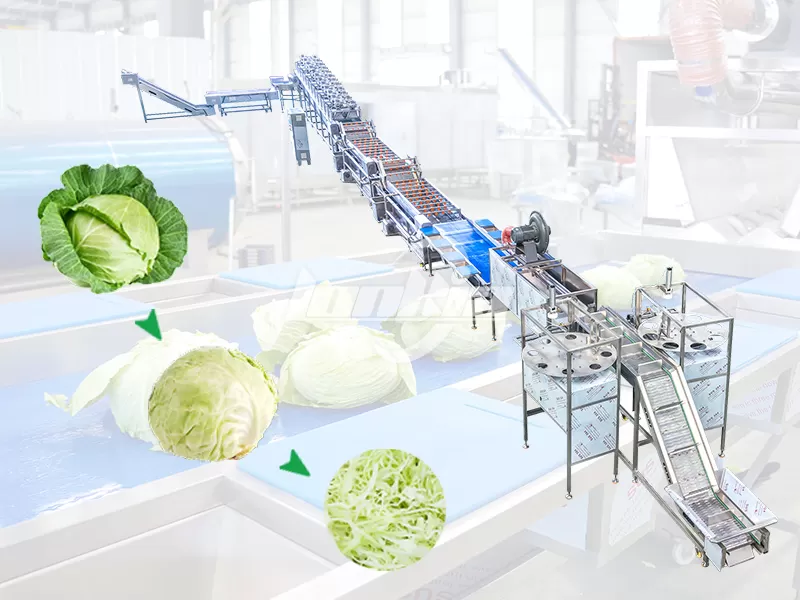
A complete cabbage processing line may contain several types of equipment. The exact configuration should be based on the production process rather than simply adding more machines.
Common equipment includes:
Feeding and conveying systems
Cabbage trimming equipment
Cabbage cutting or shredding machines
Vegetable washing machines
Dewatering equipment
Inspection conveyors
Weighing and packaging systems
A well-designed production line connects these stages efficiently and minimizes unnecessary manual handling.
Consider Food Hygiene Requirements
Cabbage processing equipment is used directly with food products, so hygiene should be an important consideration.
Look for equipment designed with food-grade materials, easy-to-clean surfaces, accessible components, and a suitable drainage and cleaning structure.
Stainless steel construction is commonly used in commercial food processing equipment because it is durable, hygienic, and suitable for regular cleaning.
Consider Factory Space and Layout
The available factory space can also affect the design of a cabbage processing line.
Before purchasing equipment, consider:
Available installation area
Equipment length and width
Material flow direction
Operator access
Cleaning and maintenance space
Raw material and finished product areas
A compact and logically arranged line can improve workflow and make daily operation and maintenance easier.
Compare Total Operating Costs
The lowest purchase price is not always the lowest overall cost.
When comparing different cabbage processing lines, consider labor requirements, electricity and water consumption, maintenance, spare parts, production capacity, and expected service life.
A slightly higher initial investment may provide better efficiency and lower operating costs over the long term, depending on the production situation.
Ask About Customization and After-Sales Support
Every cabbage processing plant has different production requirements. A reliable manufacturer should be able to adjust the equipment configuration according to capacity, product specifications, factory layout, and automation requirements.
It is also important to understand what technical support, installation assistance, spare parts, and after-sales service are available before placing an order.
Why Choose LONKIA Machinery?
LONKIA Machinery provides customized food processing machinery and complete processing solutions for vegetable processors. Cabbage processing lines can be configured according to production capacity, product requirements, automation level, and available factory space.
From cutting and washing to dewatering, conveying, inspection, and packaging, the equipment can be combined according to the customer's actual production process.
Conclusion
Choosing the right cabbage processing line requires more than comparing equipment prices. Production capacity, final product, automation level, equipment configuration, hygiene, factory layout, and operating costs should all be considered before making a purchase.
For businesses planning to expand cabbage processing capacity, working with an experienced manufacturer can help create a production line that matches current requirements while allowing room for future growth.