
For customers planning to build a garlic processing plant, once the equipment has been selected, another issue that must be addressed in advance is: How much factory space is required for the garlic processing line? In practical planning, it is not enough to simply calculate the length and width of the equipment itself; one must also consider space for raw material storage, material transfer between equipment, manual operations, finished product collection, and daily maintenance. A reasonable layout ensures a smooth flow of garlic from feeding to the completion of processing, while also facilitating subsequent operations and equipment maintenance.
What Space Is Required for a Garlic Processing Line?
A complete garlic processing line typically includes equipment such as clove separators, garlic peelers, washers, conveyors, and sorters, configured according to processing objectives. If the production of garlic slices, garlic paste, or garlic powder is also required, corresponding value-added processing equipment can be integrated into the line. LONKIA's garlic peeling line utilizes a pneumatic peeling mechanism, achieving a peeling rate of over 95%, and can be customized to meet different product requirements.
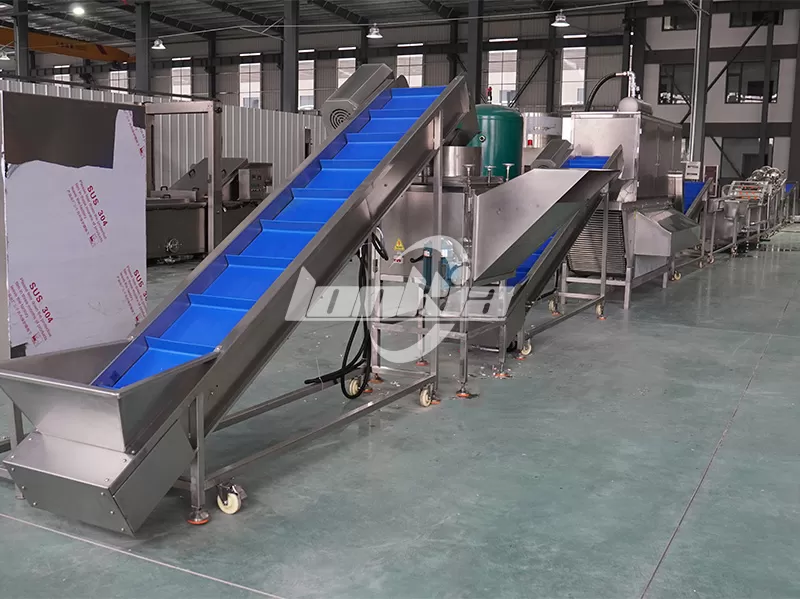
1. Raw Material Feeding Area
The raw material area should be located near the garlic production line entrance to temporarily store garlic awaiting processing and ensure a continuous feed. Space must be reserved not only for the machine feed inlets but also for storage bins, hoppers, and the operational space required for forklifts or manual handling. If raw materials need to be stored centrally, a separate storage area should be planned to prevent stockpiles from interfering with production line operations.
2. Equipment Installation and Operating Area
Equipment footprint is the foundation of factory layout planning, but machines should not be placed "back-to-back" based solely on their dimensions. A reasonable distance must be maintained between the clove separator, garlic peeler, washing equipment, and conveyor systems to allow for continuous material transfer while enabling operators to monitor equipment operation.
In particular, since the peeling equipment is a core component of the garlic processing line, space for feeding, unloading, maintenance, and cleaning should be planned in advance. LONKIA garlic processing lines feature a modular design, with some components being removable to facilitate daily cleaning and maintenance.
What Factors Should Be Considered When Calculating Factory Floor Space?
Space for Equipment Maintenance Must Be Considered
After a period of operation, equipment requires cleaning, inspection, and replacement of parts. If the distance between machines is too small, installation may be possible initially, but maintenance later on could be extremely inconvenient. Therefore, when determining factory dimensions, operational space on the sides of the equipment, as well as at the feed and discharge ends, should be taken into account.
Consider the Material Flow of the Entire Production Line
A well-designed garlic processing line should be arranged in the following sequence: raw material input → clove separation → peeling → washing → sorting → further processing → finished product output. Minimizing unnecessary backflow and cross-contamination reduces material handling distances and makes it easier for operators to manage the entire processing workflow.
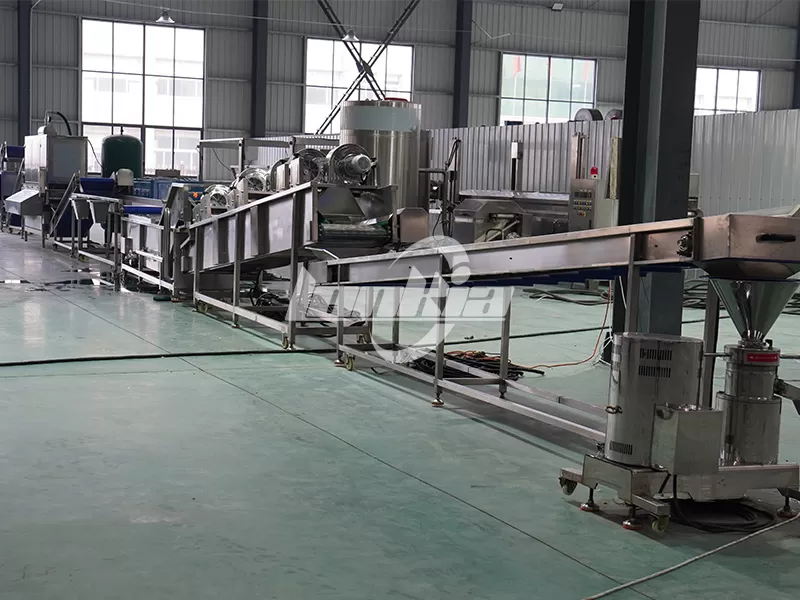
How Can You Determine the Appropriate Facility Space in Advance?
Before purchasing equipment, it is recommended to provide the equipment supplier with the facility's length, width, height, door locations, and details of existing equipment, while also specifying the garlic varieties to be processed, raw material sizes, target production capacity, and final products. Based on this information, the supplier can determine the number of machines, conveyor directions, and overall layout, rather than having to make reactive adjustments after the facility has been finalized.
It is important to note that there is no one-size-fits-all figure for facility area. This is because production line configurations vary depending on production capacity, processing steps, and final products. Rather than simply pursuing a larger facility, it is better to first determine the process flow and equipment combination, and then plan the space based on the actual layout.
Conclusion
Facility planning is an aspect that is often overlooked when purchasing a garlic processing line. Key considerations include the integration between equipment, material flow, operating space, cleaning and maintenance, and future expansion. Determining these conditions in advance can ensure a smoother production line installation and reduce the cost of retrofitting later on.
If you have already determined your garlic processing capacity and final product, LONKIA can provide corresponding production line configurations and layout solutions based on raw material characteristics, processing procedures, and facility conditions, helping you plan your production space more accurately before purchasing equipment.