
In industrial vegetable processing, blanching is not a cooking step but a controlled pre-treatment designed to stabilize raw materials before further processing. Whether vegetables are frozen, dried, or incorporated into ready-to-eat products, untreated raw vegetables deteriorate rapidly in color, texture, and flavor.
A vegetable blancher provides the thermal control required to standardize this pre-treatment. Without blanching, downstream processes such as freezing or dehydration cannot deliver consistent product quality or predictable shelf life.
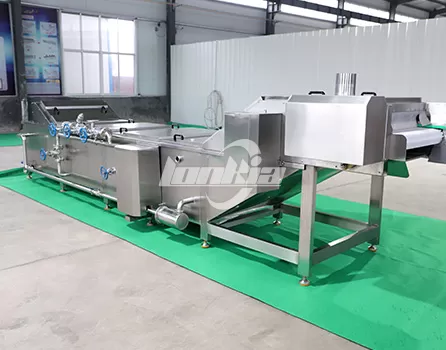
1. What Is a Vegetable Blancher?
A vegetable blancher is an industrial machine that applies controlled heat—using hot water, steam, or a combination of both—to vegetables for a precisely defined time. Unlike simple boiling, blanching is engineered to achieve specific biochemical and physical effects while minimizing quality loss.
In modern processing lines, the vegetable blancher serves as the bridge between raw material preparation and long-term preservation.
2. Purpose of a Vegetable Blancher in Food Processing
2.1 Enzyme Inactivation and Quality Stabilization
The primary purpose of blanching is enzyme inactivation. Fresh vegetables contain enzymes such as polyphenol oxidase (PPO) and peroxidase (POD), which remain active even at frozen temperatures.
If not inactivated:
Color degradation occurs during frozen storage
Off-flavors develop over time
Texture softening becomes uncontrolled
A vegetable blancher applies sufficient heat to denature these enzymes, effectively “locking in” the vegetable’s initial quality state.
2.2 Color, Texture, and Flavor Preservation
Controlled blanching enhances visual and sensory quality rather than degrading it. Properly blanched vegetables exhibit:
Brighter, more stable color
Uniform softening that improves bite consistency
Reduced bitterness caused by enzyme-driven reactions
Over-blanching, however, can lead to excessive softening and nutrient loss, highlighting the importance of precise control.
2.3 Improving Downstream Process Efficiency
Blanching improves the performance of subsequent processing steps. For example:
Frozen vegetables freeze more uniformly after blanching
Dried vegetables lose moisture more predictably
Cutting and portioning operations generate less breakage
By standardizing raw material behavior, vegetable blanchers reduce variability across the entire production line.
2.4 Food Safety and Process Stability
Although blanching is not a sterilization step, it significantly reduces surface microbial load. This creates a more hygienic starting point for freezing, drying, or packaging operations and lowers the risk of quality defects during storage.
In industrial contexts, blanching also stabilizes batch-to-batch performance, making production outcomes more predictable and controllable.
3. How a Vegetable Blancher Works
3.1 Fundamental Blanching Principle
Vegetable blanchers operate based on controlled heat transfer. Heat penetrates vegetable tissue through conduction and convection, raising internal temperature to levels sufficient for enzyme inactivation without fully cooking the product.
The effectiveness of blanching depends on:
Vegetable size and cut thickness
Temperature of the heating medium
Exposure time
These variables must be precisely coordinated to achieve consistent results.
3.2 Main Blanching Methods Used in Industrial Blanchers
Hot Water Blanching
Vegetables are immersed in circulating hot water. This method provides uniform heat transfer and is widely used for dense vegetables such as carrots and beans.
Steam Blanching
Vegetables are exposed to saturated steam. Steam blanchers typically reduce water usage and nutrient leaching, making them suitable for leafy greens and delicate products.
Combined Systems
Some industrial blanchers use steam heating followed by water stabilization to balance efficiency and product quality.
3.3 The Blanching Cycle Explained
A typical vegetable blanching cycle consists of three controlled stages:
Feeding and Distribution
Vegetables are evenly distributed on conveyors or baskets to ensure uniform heat exposure.Thermal Treatment
Heat is applied at a fixed temperature for a defined residence time. Conveyor speed or immersion duration determines treatment intensity.Discharge and Transfer
Blanched vegetables exit the blancher and move immediately to cooling systems to halt further thermal effects.
Each stage is designed to minimize variability and prevent localized over-processing.
3.4 Key Process Parameters and Control Logic
Effective vegetable blanching requires precise control of:
Temperature stability
Residence time accuracy
Product layer thickness
Water or steam circulation
Industrial vegetable blanchers use automated controls to maintain these parameters, ensuring repeatability across production runs.
3.5 Integration with Cooling and Further Processing
Blanching is always paired with rapid cooling. Cooling prevents over-softening and preserves texture. A well-integrated blancher-cooler system ensures a seamless transition from pre-treatment to freezing, drying, or packaging.
4. Main Types of Vegetable Blanchers
4.1 Batch Vegetable Blanchers
Batch vegetable blanchers process a fixed quantity of vegetables per cycle. Products are loaded, blanched, discharged, and then the next batch begins.
Key characteristics:
High flexibility for multiple vegetable types
Easier parameter adjustment
Lower initial investment
Limitations:
Inconsistent throughput
Higher labor involvement
Less suitable for large-scale continuous production
Batch blanchers are typically used in pilot plants, small-scale processors, or facilities handling frequent product changes.
4.2 Continuous Vegetable Blanchers
Continuous vegetable blanchers operate with constant feeding and discharge, making them the standard choice for industrial-scale processing.
Advantages:
Stable and predictable output
Consistent blanching quality
Seamless integration with upstream and downstream equipment
Typical applications:
IQF vegetable lines
High-capacity dehydration plants
Ready-to-eat vegetable processing
For high-volume operations, continuous systems offer superior efficiency and lower unit processing costs.
4.3 Water Blancher vs Steam Blancher
Water blanchers provide excellent temperature uniformity and are well suited for dense or irregularly shaped vegetables.
Steam blanchers minimize nutrient leaching and water consumption, making them preferable for leafy or delicate products.
The choice depends on product characteristics, water availability, and energy efficiency goals.
5. Applications of Vegetable Blanchers
5.1 Frozen Vegetable Processing
Blanching is a prerequisite for most frozen vegetables, including broccoli, carrots, peas, and spinach. It stabilizes color and texture, ensuring products retain quality throughout frozen storage.
5.2 Dehydrated and Dried Vegetables
In dehydration, blanching improves moisture diffusion and reduces drying time. Proper pre-treatment results in better rehydration characteristics and consistent final texture.
5.3 Ready-to-Eat and Fresh-Cut Vegetables
Blanching enables partial cooking while maintaining structural integrity. This is particularly important for mixed vegetable products and pre-cooked meal components.
6. Common Blanching Challenges and Practical Solutions
6.1 Under-Blanching
Enzymes remain active
Leads to discoloration during storage
Solution: Increase residence time or temperature within acceptable limits.
6.2 Over-Blanching
Excessive softening
Nutrient loss
Solution: Optimize conveyor speed and layer thickness.
6.3 Water and Energy Consumption
High operational costs
Solution: Use heat recovery, steam blanching, or water recirculation systems.
6.4 Product Inconsistency
Uneven blanching across batches
Solution: Improve product distribution and process control.
7. How to Choose the Right Vegetable Blancher
When selecting a vegetable blancher, processors should evaluate:
Vegetable type and cut size
Required throughput
Continuous vs batch production
Integration with cooling and freezing systems
Long-term maintenance and operating costs
A properly selected blancher aligns with both current production needs and future scalability.