
1. Why Rotary Retort Is Transforming Modern Food Sterilization
The global demand for canned and ready-to-eat (RTE) foods continues to grow rapidly. Consumers expect longer shelf life, improved texture, premium taste, and consistent safety—without preservatives. For food manufacturers, this creates a technical challenge: how to achieve commercial sterility without overprocessing the product.
Traditional static retorts have been widely used for decades. While effective in achieving microbial lethality, they often present limitations:
Uneven heat penetration
Overcooking at product surfaces
Long cycle times
Texture degradation
Inconsistent F₀ values
This is where the industrial rotary retort provides a measurable advantage.
2. What Is a Rotary Retort?
2.1 Definition of Rotary Retort Technology
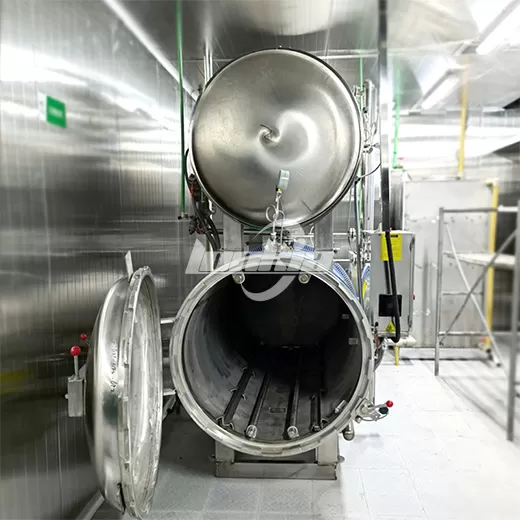
A rotary retort is a pressure vessel sterilization system designed to thermally process packaged food products while continuously rotating them during the heating and cooling cycles.
Unlike static retorts—where containers remain stationary—rotary retort systems agitate products through controlled rotation. This agitation improves convective heat transfer inside the package.
Rotary retorts are especially effective for:
Canned soups with particulates
Meat in gravy
Beans and legumes
Pet food
High-viscosity sauces
Ready-to-eat meal trays
The key engineering principle is simple but powerful: movement enhances heat penetration.
2.2 How a Rotary Retort Machine Works
An industrial rotary retort operates under controlled temperature and pressure conditions, typically using steam, water spray, or steam-air mixtures.
The process cycle generally includes:
Loading – Baskets or cages filled with packaged product are placed inside the pressure vessel.
Sealing and Pressurization – The chamber is sealed and brought to sterilization pressure.
Heating Phase – Steam or heated water raises the temperature to the target sterilization level (commonly 115–121°C for low-acid canned foods).
Rotation Phase – Containers rotate at a controlled speed, promoting internal convection.
Holding Time – The system maintains temperature to achieve the required F₀ value.
Cooling Phase – Controlled cooling under pressure prevents package deformation.
The rotational motion causes internal product mixing, which:
Reduces cold spots
Shortens heat penetration time
Improves F₀ uniformity
Minimizes overprocessing at the outer layers
2.3 Key Components of an Industrial Rotary Retort
A high-performance rotary retort machine includes the following major systems:
Pressure Vessel
Constructed according to pressure vessel standards (e.g., ASME), the chamber must withstand high temperature and pressure conditions safely.
Rotating Cage or Basket System
Specially engineered cages hold containers securely during rotation. Design must prevent:
Can deformation
Seal damage
Uneven rotation
Drive Motor and Speed Control System
Variable frequency drives (VFD) allow precise adjustment of rotation speed depending on:
Product viscosity
Container size
Heat penetration requirements
Typical rotation speeds range from 4 to 12 RPM, though this varies by application.
Steam and Water Distribution System
Uniform distribution is critical. Advanced systems include:
Steam spreaders
Spray manifolds
Circulation pumps
Uniform heating prevents localized temperature variation.
PLC Control and F₀ Monitoring
Modern rotary retorts integrate programmable logic controllers (PLC) with:
Temperature sensors
Pressure monitoring
Real-time F₀ calculation
Data logging for regulatory compliance
Accurate F₀ control ensures safety without excessive thermal load.
3. Rotary Retort vs Static Retort: Technical Comparison
When evaluating sterilization systems, comparing rotary retort vs static retort is essential.
3.1 Heat Penetration Speed
Static retorts rely primarily on conduction for viscous products. This creates slower heat penetration toward the product center.
Rotary retorts introduce internal convection through agitation, significantly accelerating heat transfer.
Result:
Shorter processing cycles
Lower total thermal exposure
Improved throughput
3.2 F₀ Value Control Accuracy
In static retorts, cold spots may develop inside containers, requiring longer holding times to guarantee safety.
Rotary retort systems improve uniformity, allowing more precise F₀ targeting without excessive safety margins.
This means:
Better microbial lethality control
Reduced quality degradation
Lower variability between batches
3.3 Product Quality Retention
One of the main advantages of a rotary retort is improved product texture.
Static systems often cause:
Protein overcoagulation
Vegetable softening
Sauce separation
Continuous rotation minimizes thermal gradients, preserving:
Structure
Mouthfeel
Visual appearance
3.4 Processing Time Reduction
Because agitation increases heat transfer efficiency, rotary retort machines often reduce total cycle time by 10–30% depending on product characteristics.
This leads to:
Increased production capacity
Lower energy consumption per batch
Higher equipment utilization rate
3.5 Energy Efficiency
Shorter sterilization cycles translate into:
Reduced steam consumption
Lower cooling water usage
Decreased operating cost
While initial investment in a rotary retort is typically higher than static systems, operational efficiency often offsets this over time.
4. Why Rotary Retort Is Ideal for Canned and Ready-to-Eat Foods
4.1 Canned Meat and Poultry Products
Meat-based canned foods often contain:
Solid protein pieces
Gravy or sauce
Fat content
These heterogeneous systems benefit significantly from agitation sterilization. Rotary retort motion ensures uniform heating of both solids and liquid phases.
Result:
Reduced surface overcooking
Improved tenderness
More consistent texture
4.2 Canned Vegetables and Legumes
Beans, chickpeas, lentils, and mixed vegetables are susceptible to:
Texture breakdown
Over-softening
Uneven heating
Rotary retort technology reduces localized overheating, helping maintain firmness while achieving full sterilization.
4.3 Soups and Sauces with Particulates
Products containing suspended particulates in liquid matrices benefit the most from rotary retort systems.
Agitation prevents:
Particle settling
Thermal stratification
Cold spots in dense regions
This makes rotary retort machines especially valuable in premium ready-to-eat soup production.
5. Processing Parameters in Rotary Retort Sterilization
To fully leverage a rotary retort, manufacturers must understand how processing parameters interact with product characteristics.
5.1 Temperature Range
Most low-acid canned foods require sterilization temperatures between 115°C and 121°C, though some formulations may demand higher setpoints depending on:
Product pH
Water activity
Viscosity
Container size
Target microorganism (e.g., Clostridium botulinum)
Because a rotary retort enhances heat transfer, target lethality can often be achieved at slightly shorter holding times compared to static systems.
5.2 Pressure Control
Pressure is essential to:
Prevent container deformation
Maintain structural integrity of pouches and trays
Control boiling point of product contents
Modern rotary retort machines use automated pressure balancing systems that synchronize:
Steam injection
Compressed air (in steam-air systems)
Cooling water pressure
Precise pressure control is particularly important for flexible packaging formats.
5.3 Rotation Speed and Its Impact
Rotation speed directly influences internal convection patterns.
Low viscosity products require moderate agitation.
High viscosity or particulate-heavy products benefit from optimized RPM settings.
Excessive rotation may cause product shear or structural damage.
Typical speeds range from 4–12 RPM, but optimization trials are necessary during process validation.
The key is balancing agitation intensity with product integrity.
5.4 F₀ Calculation and Validation
F₀ value represents cumulative microbial lethality at a reference temperature of 121.1°C.
In a rotary retort system:
Faster heat penetration shortens come-up time.
Uniform internal heating reduces variability.
Accurate temperature probes and data logging enable precise lethality tracking.
Process validation includes:
Heat distribution studies
Heat penetration testing
Worst-case scenario verification
Regulatory documentation
This validation ensures compliance with low-acid canned food regulations.
5.5 Low-Acid Food Safety Compliance
For products with pH above 4.6, sterilization must meet strict safety standards to control spore-forming pathogens.
An industrial rotary retort must support:
Documented process schedules
Calibrated instrumentation
Batch traceability
HACCP integration
Regulatory bodies may require recorded proof of each sterilization cycle.
6. Production Efficiency and Cost Analysis
Although a rotary retort machine represents a higher capital investment than a static retort, operational gains often justify the cost.
6.1 Batch Time Reduction
Improved heat transfer reduces total cycle time. Depending on the product, manufacturers may achieve:
10–30% shorter processing cycles
Faster cooling phases
Increased daily production capacity
This directly improves line utilization.
6.2 Increased Throughput
Shorter cycles allow:
More batches per shift
Reduced bottlenecks
Better alignment with upstream filling lines
For high-demand RTE production, throughput gains are critical.
6.3 Energy Consumption
Although rotary retorts require mechanical rotation energy, total steam consumption per batch may decrease due to reduced processing time.
Energy savings derive from:
Shorter holding time
Faster heat penetration
Reduced reprocessing due to quality failure
6.4 Reduction in Product Waste
Static retort systems often require conservative safety margins, leading to overcooking.
Rotary retort precision allows:
Tighter process windows
Reduced texture rejection
Lower spoilage risk
Less waste improves overall profitability.
6.5 Return on Investment (ROI)
ROI depends on:
Production volume
Product category
Quality positioning
Energy cost structure
For high-viscosity or premium RTE products, ROI is typically favorable within a few production cycles due to quality consistency and yield improvement.
7. Common Processing Challenges and How Rotary Retort Solves Them
7.1 Overcooking in Static Retorts
Problem: Excess surface heating while center remains cold.
Solution: Rotary agitation distributes heat more evenly, reducing temperature gradients.
7.2 Inconsistent Heat Penetration
Problem: Variability between containers.
Solution: Continuous movement ensures uniform convective flow within each package.
7.3 Product Separation
Problem: Sauce and solids separate during heating.
Solution: Controlled agitation minimizes settling and stratification.
7.4 Texture Degradation
Problem: Vegetables and proteins lose structural integrity.
Solution: Shorter exposure time preserves structure while maintaining safety.
7.5 Shelf-Life Stability Issues
Problem: Uneven lethality leads to spoilage risk.
Solution: Improved F₀ consistency enhances long-term shelf stability.
8. How to Choose the Right Rotary Retort Machine
Selecting the appropriate rotary retort requires structured evaluation.
8.1 Define Product Characteristics
Consider:
Viscosity
Solid-to-liquid ratio
Fat content
Container geometry
High-particulate products benefit most from agitation.
8.2 Evaluate Packaging Format
Rotary retort compatibility varies with:
Metal cans
Glass jars
Retort pouches
CPET trays
Packaging strength must withstand rotation and pressure.
8.3 Determine Required Capacity
Assess:
Batch size
Daily output
Future expansion plans
Oversizing increases capital cost; undersizing limits growth.
8.4 Automation Level
Modern industrial rotary retort systems may include:
Fully automated loading systems
Recipe management
Data traceability
Remote diagnostics
Automation reduces labor and improves consistency.
8.5 Supplier Evaluation Checklist
Choose a manufacturer that provides:
Pressure vessel certification
On-site installation support
Process validation assistance
Spare parts availability
After-sales service
Technical expertise is as important as machine quality.
9. Regulatory and Safety Standards
A rotary retort machine must comply with:
ASME pressure vessel standards
CE or regional safety directives
FDA low-acid canned food regulations (if exporting to US)
HACCP process validation
Documentation, calibration, and maintenance schedules must be strictly controlled.
10. Future Trends in Rotary Retort Technology
Emerging innovations include:
Energy recovery systems
Hybrid steam-air rotary systems
Smart IoT monitoring
Continuous rotary retort development
Advanced heat modeling software
Digitalization enables predictive maintenance and real-time performance optimization.