
The global demand for shelf-stable foods continues to grow as food supply chains become longer and more complex. Ready meals, canned foods, retort pouches, and pet food products all rely on thermal processing technologies that ensure microbiological safety without continuous refrigeration.
Among these technologies, the retort machine plays a central role. It enables food manufacturers to achieve commercial sterility—eliminating pathogenic and spoilage microorganisms while preserving product integrity. Understanding what a retort machine is and how it works is essential for anyone involved in food processing, quality assurance, or production planning.
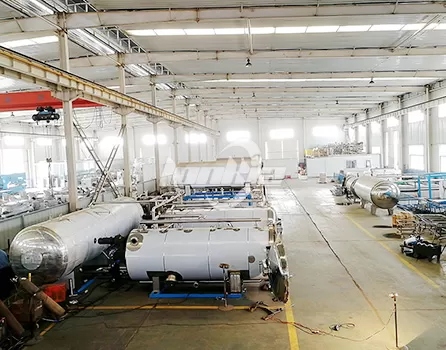
1. What Is a Retort Machine?
1.1 Definition and Core Purpose
A retort machine is an industrial pressure vessel designed to thermally process packaged foods under controlled temperature and pressure conditions. Its primary purpose is to achieve commercial sterility, allowing food products to be stored safely at ambient temperature for extended periods.
Unlike simple cooking or heating equipment, a retort machine is engineered to:
Inactivate heat-resistant microorganisms, including spores
Control pressure to protect package integrity
Deliver repeatable, validated thermal processes
The retort machine functions as both a food safety system and a quality preservation tool.
1.2 How a Retort Machine Differs from Ordinary Heating Equipment
A common misconception is that retort processing is equivalent to boiling or steaming food. In reality, retort machines operate under conditions that go far beyond conventional thermal treatment.
Key differences include:
Pressurized environment: Allows temperatures above 100°C without boiling
Validated thermal lethality: Processes are designed around microbial destruction targets rather than cooking time
Packaging-aware operation: Pressure control prevents deformation or rupture of sealed packages
These characteristics distinguish retort machines from kettles, ovens, or pasteurizers.
1.3 Foods Commonly Processed Using Retort Machines
Retort machines are widely used for products that require long shelf life without refrigeration, including:
Canned vegetables, meats, and seafood
Retort pouch meals and sauces
Shelf-stable soups and broths
Ready-to-eat rice and grain dishes
Pet food in cans or flexible packaging
Each product type imposes specific thermal and mechanical requirements, influencing retort design and process parameters.
2. How a Retort Machine Works
2.1 Thermal Processing and Microbial Inactivation
The fundamental function of a retort machine is thermal sterilization. Heat is applied to packaged food to destroy microorganisms capable of growing under ambient storage conditions.
This process relies on:
Heat penetration: The transfer of heat from the heating medium through the package and into the product core
Microbial lethality: The cumulative effect of temperature over time on microorganisms
The effectiveness of a retort process is commonly expressed using the F₀ value, which represents the equivalent time (in minutes) at 121.1°C required to achieve a specified level of microbial destruction.
2.2 The Role of Temperature, Time, and Pressure
A retort machine controls three interdependent variables:
Temperature:
High temperatures accelerate microbial inactivation. However, excessive temperatures can degrade food texture, color, and nutritional value.
Time:
Sufficient holding time ensures that the coldest point in the product reaches the target lethality.
Pressure:
Pressure is applied to counteract internal package pressure generated during heating. This prevents pouch swelling, container deformation, or seal failure.
Balancing these variables is central to effective retort processing.
2.3 Heating, Holding, and Cooling Phases
A typical retort cycle consists of three stages:
Heating phase:
The retort chamber temperature rises as steam, hot water, or a combination of both transfers heat to the product.Holding phase:
Temperature is maintained for a calculated duration to achieve the required lethality.Cooling phase:
Rapid and controlled cooling halts thermal degradation while maintaining package integrity.
Each phase is precisely monitored and documented to ensure compliance with food safety requirements.
2.4 Why Pressure Control Is Essential in Retort Processing
In sealed packages, internal pressure increases as product temperature rises. Without external pressure compensation, packaging may deform or rupture.
Retort machines use compressed air or pressurized water to:
Balance internal and external pressures
Maintain seal integrity
Enable the use of flexible and lightweight packaging formats
Pressure control is especially critical for retort pouches and plastic trays.
3. Key Components of a Retort Machine
Although retort machines vary in design, most systems include:
A pressure-rated chamber
Heating and cooling systems
Temperature and pressure sensors
PLC-based control and data recording
These components work together to deliver consistent and verifiable thermal processing.
4. Main Types of Retort Machines Used in Food Processing
4.1 Batch Retort Machines
Batch retort machines operate by loading a defined number of packages into the chamber, processing them through a complete thermal cycle, and unloading before the next batch begins. This design allows for precise control of individual production runs.
Batch retorts are commonly used when:
Production volumes are moderate or variable
Multiple product types or packaging formats are processed
Frequent recipe or process adjustments are required
Their flexibility makes them suitable for diversified product portfolios, pilot production, and contract manufacturing environments.
4.2 Continuous Retort Machines
Continuous retort machines are designed for uninterrupted processing. Products move through different thermal zones on conveyors, rotating carriers, or hydrostatic columns.
These systems are typically applied when:
High, stable production volumes are required
Product specifications are standardized
Integration with automated filling and packaging lines is essential
Continuous retorts offer consistent throughput and reduced labor intervention but require careful process design and validation.
4.3 Still vs Rotary Retort Machines
Still retorts keep products stationary during processing. Heat transfer relies solely on conduction and convection within the package.
Rotary retorts gently rotate or agitate containers during heating, improving heat distribution and reducing cold spots. This allows for:
Shorter processing times
Improved product quality
More uniform thermal exposure
Rotary systems are especially effective for viscous or particulate-containing foods.
5. Retort Processing Methods
Different retort processing methods are selected based on product characteristics, packaging, and quality objectives.
Steam Retort
Steam retorts use saturated steam as the heating medium. They are efficient and simple but require careful pressure control to protect flexible packaging.
Water Immersion Retort
Products are fully submerged in hot water, providing uniform heat transfer. This method is suitable for fragile packaging and products requiring gentle heating.
Water Spray Retort
Hot water is sprayed over packages while air pressure maintains package integrity. This approach offers precise temperature control and faster cooling.
Steam-Air Retort
Steam-air systems combine steam heating with compressed air for pressure balance. They are widely used for retort pouches and plastic containers.
Each method presents trade-offs between heating efficiency, process control, and packaging compatibility.
6. Packaging Considerations in Retort Processing
Material and Structural Requirements
Packaging used in retort processing must withstand:
High temperatures
Elevated pressure differentials
Moisture and thermal stress
Common materials include metal cans, multilayer retort pouches, and high-temperature plastics.
Interaction Between Packaging and Process Design
Retort machines are not packaging-agnostic. Heating rates, pressure profiles, and cooling strategies must be tailored to the packaging format to prevent:
Seal failure
Delamination
Container deformation
Close coordination between packaging design and retort process development is essential.