
Industrial frying is a critical thermal process that directly influences product texture, color, oil uptake, shelf life, and production efficiency. As food manufacturers scale up, the choice between a batch fryer and a continuous fryer becomes a strategic decision rather than a simple equipment preference.
While both systems can produce acceptable fried products, their operational logic, level of process control, and long-term suitability for industrial production differ significantly. Selecting the wrong fryer type often results in inconsistent quality, unstable throughput, or excessive operating costs.
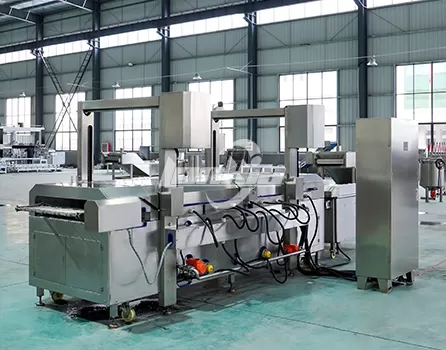
1. Overview of Industrial Frying Systems
1.1 What Is a Batch Fryer?
A batch fryer is an intermittent frying system in which products are loaded into the fryer, cooked for a predetermined time, and then unloaded before the next batch begins. Each frying cycle is a discrete operation.
Typical characteristics include:
Manual or semi-automatic loading and unloading
Fixed frying time per batch
Oil temperature recovery between batches
Batch fryers are commonly used in small to medium-scale operations or in facilities producing multiple product types in short runs.
1.2 What Is a Continuous Fryer?
A continuous fryer is designed for uninterrupted production. Products are conveyed through the oil bath at a controlled speed, with frying time determined by belt speed and fryer length rather than batch duration.
Key features include:
Continuous product feed and discharge
Stable oil temperature through constant thermal load
Integration with upstream and downstream processing lines
Continuous fryers are widely used in high-volume industrial food production where consistency and throughput stability are essential.
2. Production Capacity and Throughput Comparison
2.1 Output Consistency
- Batch fryers inherently produce output in cycles. Even when multiple batch fryers operate in parallel, product flow remains discontinuous. This can complicate synchronization with cooling, seasoning, or packaging systems.
- Continuous fryers deliver a steady output rate once operating conditions are stabilized. This uniformity simplifies line balancing and reduces downstream accumulation or starvation.
From an industrial engineering perspective, consistent output is often more valuable than peak batch capacity.
2.2 Suitability for Different Production Volumes
Batch fryers are well suited for:
Low to moderate daily volumes
Frequent product changeovers
Short production runs
Continuous fryers perform best when:
Daily production volumes are high
Product specifications are standardized
Long, uninterrupted production runs are required
Factories targeting national or international distribution typically benefit from the scalability of continuous systems.
3. Product Quality and Process Control
3.1 Temperature Stability and Frying Uniformity
- Oil temperature stability is a critical determinant of frying quality. In batch fryers, the introduction of cold product causes an immediate temperature drop, followed by gradual recovery. Variability in recovery time can lead to uneven color and texture across batches.
- Continuous fryers maintain more stable oil temperatures due to constant product loading and heat input. This stability promotes uniform frying conditions and reduces variability between individual pieces.
3.2 Repeatability and Standardization
- Batch frying relies more heavily on operator timing, loading consistency, and manual adjustments. Even with standard operating procedures, human variability can affect repeatability.
- Continuous fryers rely on mechanical parameters such as belt speed, oil depth, and controlled heat zones. Once set, these parameters deliver repeatable results with minimal operator intervention, supporting standardization at scale.
4. Oil Management and Operating Efficiency
4.1 Oil Degradation and Turnover Rate
In batch systems, oil is exposed to repeated heating and cooling cycles, accelerating oxidation and polymerization. Product crumbs often remain in the oil longer, further degrading oil quality if filtration is insufficient.
Continuous fryers typically incorporate:
Continuous or automatic oil filtration
Controlled oil circulation
Higher oil turnover rates
These features help extend oil life and maintain consistent frying performance over long production runs.
4.2 Energy Utilization
Batch fryers consume significant energy during repeated heat-up cycles, particularly in operations with frequent start-stop patterns. Energy efficiency decreases when production is irregular.
Continuous fryers operate at steady-state conditions, allowing more efficient energy use over time. Although initial energy input is higher, sustained operation often results in lower energy consumption per unit of finished product.
5. Flexibility vs Scalability
Product Changeover and Recipe Adjustments
- Batch fryers provide strong flexibility. Adjusting frying time, temperature, or product type is relatively straightforward, making them suitable for facilities producing multiple SKUs or running frequent product trials.
- Continuous fryers prioritize stability over flexibility. Recipe changes require coordinated adjustments across conveyor speed, oil temperature, and sometimes mechanical components. While modern systems allow parameter storage, changeovers still demand planning and downtime.
Long-Term Scalability
Scaling batch frying operations typically involves adding more units, increasing labor, and expanding floor space. This approach can become inefficient as production volume grows.
Continuous fryers scale more efficiently. Throughput can often be increased by adjusting belt width, fryer length, or operating speed. Modular designs also allow incremental expansion without fully redesigning the production layout.
For factories with long-term growth plans, scalability is a decisive advantage of continuous systems.
6. Cost Structure and Total Cost of Ownership (TCO)
Initial Investment Considerations
Batch fryers generally require lower upfront investment and simpler installation. This makes them accessible for startups or pilot-scale production.
Continuous fryers involve higher capital expenditure, driven by:
Larger equipment footprint
Advanced control systems
Integration with conveyors and auxiliary equipment
However, initial cost alone does not reflect long-term economic performance.
Operating and Maintenance Costs
Over time, batch fryers may incur higher operating costs due to:
Increased labor requirements
Higher energy consumption per unit
More frequent oil replacement
Continuous fryers, while more complex, often deliver lower cost per unit of output through:
Reduced labor intensity
Improved energy efficiency
More controlled oil management
Evaluating TCO requires analyzing performance over the full equipment lifecycle rather than focusing on purchase price.
7. Typical Application Scenarios
When a Batch Fryer Is the Better Choice
Batch fryers are typically preferred when:
Production volumes are low or variable
Multiple product types are processed daily
Flexibility and experimentation are priorities
They are common in R&D facilities, specialty food producers, and seasonal operations.
When a Continuous Fryer Is More Suitable
Continuous fryers are generally better suited for:
High-volume, standardized production
Products requiring tight quality tolerances
Fully automated processing lines
They are widely used in snack foods, frozen potato products, coated meats, and prepared foods for large-scale distribution.
8. Common Mistakes in Fryer Selection
Choosing Based Solely on Capacity
High nominal throughput does not guarantee operational efficiency. Ignoring consistency, oil quality, and integration often leads to underperforming systems.
Underestimating Change Management
Transitioning from batch to continuous frying alters workflows, staffing, and maintenance routines. Without adequate training and process alignment, expected efficiency gains may not materialize.
Ignoring Future Production Needs
Selecting equipment based only on current demand can limit future expansion. Fryer selection should reflect not just present requirements but realistic growth scenarios.
9. How to Make the Right Choice for Industrial Production
Rather than asking which fryer is “better,” decision-makers should evaluate:
Required daily and hourly output
Product uniformity expectations
Labor availability and skill levels
Integration with existing or planned processing lines
Long-term operational cost targets
A clear understanding of these factors enables a rational, defensible equipment selection.
10. Conclusion
Batch fryers and continuous fryers serve distinct roles in industrial food processing. Batch systems excel in flexibility and low initial investment, while continuous systems deliver consistency, scalability, and efficiency at high volumes.
The optimal choice depends on aligning frying technology with production reality, not on generalized assumptions or short-term cost considerations. When evaluated from a system-level perspective, fryer selection becomes a strategic investment in long-term operational performance.