
The global demand for processed mango products continues to rise, driven by growth in fresh-cut fruit, frozen fruit ingredients, dried snacks, and fruit-based beverages. At the same time, mango remains one of the most labor-intensive fruits to process due to its irregular shape, large stone, and delicate flesh.
Traditional manual processing struggles to deliver consistent quality, stable yields, and reliable throughput at scale. Variations in operator skill, fatigue, and hygiene practices often result in uneven cuts, higher waste, and unpredictable output. These challenges explain why mango automatic processing lines are increasingly viewed not as optional upgrades, but as foundational infrastructure for modern fruit processing factories.
Choosing the right mango automatic processing line, however, requires more than selecting individual machines. It involves understanding how each processing module interacts with the raw material and with downstream operations.
1.What Is a Mango Automatic Processing Line?
Definition and Functional Scope
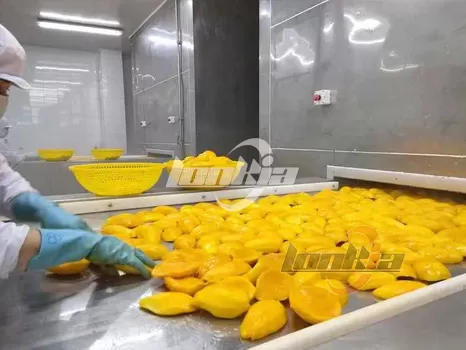
A mango automatic processing line is an integrated system of machines designed to handle mangoes continuously from raw fruit intake to finished or semi-finished products with minimal manual intervention. Automation may range from assisted operations to fully synchronized, PLC-controlled systems, depending on production scale and product format.
Unlike standalone machines, a true mango automatic line emphasizes:
Continuous product flow
Consistent handling regardless of size variation
Controlled processing parameters at each stage
The objective is not simply to reduce labor, but to standardize quality and improve yield predictability.
Typical Product Outputs
A well-designed mango automatic processing line can support multiple product formats, including:
Fresh-cut mango slices or cubes
Frozen mango portions
Dried mango products
Mango pulp or puree
Each product type imposes different requirements on cutting precision, oxidation control, and downstream handling, which must be considered during line selection.
2.Understanding the Core Challenges in Mango Processing
Variability in Size, Shape, and Ripeness
Mangoes vary significantly in geometry and firmness, even within the same batch. Automated systems must be able to handle:
Size variations without frequent mechanical adjustment
Differences in skin thickness and ripeness
Irregular orientation during feeding
Processing lines that lack adaptability often compensate by increasing trimming margins, which directly reduces yield.
Sensitivity of Mango Flesh
Mango flesh bruises easily and oxidizes rapidly once cut. Excessive mechanical force or prolonged exposure to air can degrade product appearance and texture. Automation systems must therefore combine precision with gentle handling to maintain product integrity.
3.Core Modules of a Mango Automatic Processing Line (Key Focus)
A mango automatic processing line is best understood as a sequence of specialized modules, each responsible for a distinct function. The effectiveness of the line depends not only on individual machine performance, but on how well these modules work together.
3.1 Raw Material Handling, Feeding, and Washing
The line begins with raw material handling. Poor feeding and washing design often causes instability throughout the entire system.
Key functions include:
Controlled feeding to avoid congestion and fruit damage
Preliminary sorting to remove damaged or undersized mangoes
Thorough washing to remove dirt, latex residue, and field contaminants
Advanced systems use water flow design and soft conveying methods to stabilize fruit orientation and prepare mangoes for downstream automation.
3.2 Automatic Mango Peeling and Destoning
Peeling and destoning represent one of the most technically demanding stages in mango automatic processing.
Because mango stones vary in size and position, effective systems must:
Accurately locate the stone relative to the flesh
Remove the peel without excessive flesh loss
Separate edible flesh cleanly from the stone
Different technologies are used depending on product format, but the key performance metrics remain yield preservation and cut accuracy. Poorly designed peeling systems are a primary source of waste and rework.
3.3 Precision Cutting and Portioning Systems
Once peeled and destoned, mango flesh must be cut into uniform portions. Cutting systems must balance speed with precision, particularly for shoestring-style strips, cubes, or slices.
Critical design considerations include:
Knife geometry and material
Feed stability to prevent tearing
Minimal generation of fines and fragments
High-quality cutting modules directly influence downstream freezing or drying efficiency and final product appearance.
3.4 Anti-Browning and Quality Preservation Modules
Oxidation is a major challenge in mango processing. Exposure of fresh-cut surfaces leads to discoloration and quality degradation.
Anti-browning modules typically integrate:
Controlled dipping or spraying systems
Time-managed exposure to treatment solutions
Seamless transfer to packaging or freezing
The effectiveness of this module often determines whether fresh-cut mango products meet market quality expectations.
3.5 End-of-Line Handling and Packaging Preparation
The final module prepares mango products for packaging, freezing, or further processing.
Key elements include:
Gentle conveying to avoid deformation
Weight control and portion consistency
Compatibility with downstream packaging formats
Automation at this stage reduces handling variability and preserves the quality achieved earlier in the line.
4.Why the Modular Approach Matters in Line Selection
Understanding these modules individually allows decision-makers to evaluate whether a mango automatic processing line is truly fit for purpose. Lines designed without proper balance between modules often exhibit bottlenecks, excessive waste, or quality degradation.
A modular, well-integrated approach ensures:
Stable throughput
Consistent product quality
Scalable expansion potential
These factors ultimately define the success of an automatic mango processing investment.
5. Determining the Right Level of Automation for Your Factory
Not every factory requires full automation, and over-automation can be as problematic as under-automation. The correct level of mango automatic processing depends on operational realities rather than aspirational capacity targets.
Production Volume and Throughput Stability
Factories with fluctuating seasonal volumes may benefit from semi-automatic systems that allow flexible staffing. In contrast, high-throughput plants supplying retail or foodservice channels typically require continuous, fully synchronized lines to maintain consistency.
Key questions include:
What is the average and peak daily throughput requirement?
How stable is raw mango supply throughout the year?
Are production runs short and frequent, or long and standardized?
Answering these questions helps determine whether automation should prioritize flexibility or efficiency.
Labor Availability and Skill Level
In regions where skilled labor is scarce or turnover is high, automation stabilizes production quality. However, automated lines still require trained technicians for setup, monitoring, and maintenance.
Factories should assess:
Availability of operators with mechanical or electrical aptitude
Training resources for line supervision
Local technical support infrastructure
Automation reduces dependency on manual cutting skills but increases reliance on process management capabilities.
6. Integration with Existing Facilities and Downstream Processes
Layout Compatibility and Line Expansion
Many factories retrofit automation into existing buildings rather than constructing new facilities. Equipment footprint, elevation changes, and material flow must align with current constraints.
Key considerations include:
Floor space availability
Ceiling height for vertical modules
Future expansion potential
A well-planned line allows for modular upgrades without disrupting existing operations.
Compatibility with Freezing, Drying, or Packaging Lines
A mango automatic processing line should not be evaluated in isolation. Its output must match the requirements of downstream processes such as IQF freezing, drying tunnels, or packaging systems.
Mismatch in throughput or handling methods often creates bottlenecks that negate automation benefits upstream.
7. Common Mistakes When Choosing Mango Automatic Processing Lines
Prioritizing Speed Over Product Quality
Higher throughput does not automatically translate into better performance. Excessive speed can increase mechanical stress, damage fruit flesh, and raise waste levels.
Sustainable productivity balances speed with precision and gentle handling.
Ignoring Raw Material Variability
Some systems perform well only with narrowly defined fruit sizes and ripeness ranges. Factories sourcing mangoes from multiple regions should ensure that equipment can accommodate variation without constant recalibration.
Underestimating Training and Change Management
Transitioning from manual to automatic processing alters workflows and responsibilities. Without proper training and internal alignment, factories may struggle to realize the full benefits of automation.
8. Evaluating Equipment Suppliers from a Technical Perspective
Rather than focusing on marketing claims, factories should evaluate suppliers based on engineering competence and long-term support capability.
Key evaluation criteria include:
Demonstrated experience with mango-specific applications
Transparency in yield and performance data
Availability of after-sales technical support
Customization capability for different mango varieties and products
Requesting process simulations or trial data can significantly reduce selection risk.
Conclusion
Choosing the right mango automatic processing line is a strategic decision that affects product quality, operational stability, and long-term profitability. The most successful projects begin with a clear understanding of processing challenges, realistic automation goals, and a system-level perspective.
By focusing on modular design, yield preservation, and integration with existing operations, factories can select automation solutions that address real production needs rather than theoretical efficiencies.
A well-chosen mango automatic processing line does not merely replace manual labor—it establishes a scalable, repeatable process foundation capable of supporting future growth.