
In today’s food industry, commercial autoclaves—also known as retorts—play a critical role in ensuring the safety, shelf stability, and quality of packaged foods. Whether it’s canned vegetables, ready-to-eat meals, or vacuum-sealed soups, thermal sterilization inside an autoclave helps eliminate harmful microorganisms and extend product shelf life without relying on preservatives.
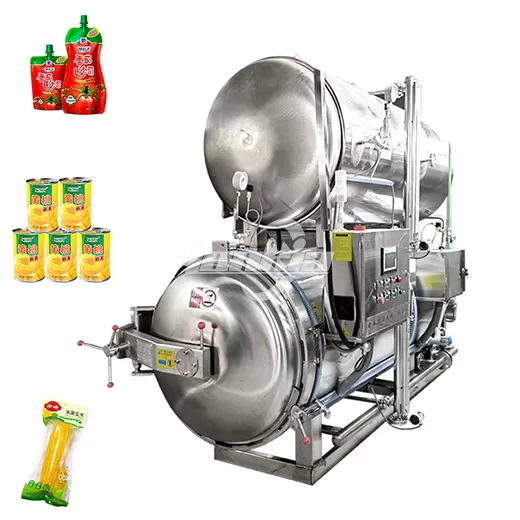
What Is a Commercial Autoclave?
A commercial autoclave is an industrial-grade pressure vessel designed to sterilize food products that are sealed in containers—such as cans, pouches, glass jars, or plastic trays—through controlled exposure to pressurized steam or hot water.
Unlike laboratory autoclaves, which are typically small units for sterilizing instruments, commercial versions handle large-scale production loads and operate under precisely regulated temperature and pressure conditions. Their main objective is to destroy all pathogenic and spoilage microorganisms, including heat-resistant bacterial spores, while preserving the product’s taste, texture, and nutritional value.
How It Works — The Thermal Sterilization Principle
At the heart of every commercial autoclave lies one fundamental concept — thermal sterilization. This process uses a controlled combination of heat, pressure, and time to destroy microorganisms that can cause food spoilage or illness. By precisely managing these parameters, autoclaves ensure food products remain safe, stable, and flavorful throughout their shelf life.
1. The Science Behind Thermal Sterilization
Thermal sterilization operates on a simple but powerful microbiological principle:
High temperatures denature proteins and enzymes in microorganisms, leading to irreversible cell damage and death.
In a commercial autoclave, the goal is to achieve a sterility assurance level (SAL) sufficient to eliminate even the most heat-resistant bacterial spores, such as Clostridium botulinum. These spores can survive normal cooking temperatures but are effectively destroyed when exposed to pressurized steam at 121°C (250°F) for a specific duration, typically 15–30 minutes depending on the product and packaging.
To quantify sterilization effectiveness, food scientists use the concept of the F₀-value — a standardized measure representing the equivalent time (in minutes) at 121.1°C required to achieve a desired level of microbial inactivation. Adjusting temperature, pressure, or time allows manufacturers to tailor the process for different food types while ensuring safety compliance.
2. Heat Transfer Mechanisms Inside the Autoclave
In food sterilization, it’s not just about reaching high temperatures — it’s about ensuring uniform heat distribution throughout every container and every layer of the product.
There are three main modes of heat transfer inside a commercial autoclave:
Conduction: Heat moves directly through solid or semi-solid foods (like canned meats or soups with thick consistency).
Convection: In liquid or semi-liquid products, the natural movement of fluid enhances heat transfer, allowing faster and more uniform sterilization.
Steam Condensation: When steam condenses on cooler surfaces, it releases a large amount of latent heat, rapidly increasing product temperature.
Advanced autoclave systems use steam-air mixtures, water sprays, or full water immersion to promote even heating, depending on the type of container (metal, glass, plastic pouch) and product viscosity. Continuous circulation fans or pumps inside the chamber help maintain temperature uniformity within ±0.5°C — a critical factor for consistent product quality.
3. The Role of Pressure in Autoclave Sterilization
While heat is responsible for microbial destruction, pressure ensures that water remains in a liquid or vapor phase at high temperatures and prevents container damage.
During sterilization:
Pressure inside the chamber typically ranges from 1.5 to 3 bar (150–300 kPa).
This elevated pressure allows the autoclave to achieve temperatures well above the normal boiling point of water.
For flexible packaging, counter-pressure is applied using compressed air to balance internal and external forces, preventing pouch or tray deformation.
Modern autoclaves are equipped with precision pressure sensors and automated control valves that maintain exact conditions throughout the cycle. This control is crucial for maintaining product integrity, especially for ready-to-eat meals, soups, and sauces sealed in thermoformed trays or pouches.
4. Stages of a Typical Sterilization Cycle
A complete commercial autoclave cycle typically consists of four distinct stages:
Pre-Heating and Loading:
The chamber is preheated, and steam lines are purged of air to ensure uniform temperature distribution. Air removal is vital because trapped air acts as an insulator and reduces heat transfer efficiency.Heating and Pressurization:
Steam or hot water is introduced into the chamber, rapidly raising temperature and pressure to the target setpoints. Sensors continuously monitor these parameters to ensure consistency across all containers.Holding (Sterilization) Phase:
Once the desired temperature (e.g., 121°C) is reached, it’s maintained for the specific holding time. During this phase, microbial spores are inactivated according to the validated process parameters (F₀ or D-value calculations).Cooling and Depressurization:
After sterilization, cooling water or air is introduced to lower the temperature gradually. Controlled depressurization ensures that packaging doesn’t collapse or crack. In overpressure systems, compressed air maintains external pressure during cooling to protect delicate containers.
Each stage is automatically managed by a programmable logic controller (PLC), ensuring accuracy, repeatability, and compliance with regulatory requirements.
5. Ensuring Uniformity and Safety — Thermal Mapping
To verify that every part of the load receives adequate heat exposure, manufacturers perform thermal mapping during process validation.
This involves placing multiple temperature sensors throughout the chamber and inside sample containers to identify potential cold spots. If any zones fail to reach the target F₀-value, process adjustments (like longer hold times or improved circulation) are made.
This step is essential for compliance with international standards such as FDA 21 CFR Part 113, ISO 22000, and HACCP guidelines for low-acid canned foods.
6. Balancing Safety and Quality
The challenge of commercial autoclave operation is finding the right balance between safety and food quality.
Excessive heat can cause nutrient loss, color fading, or texture changes, while insufficient processing risks contamination. That’s why modern autoclaves use smart control systems, real-time temperature feedback, and mathematical modeling to optimize sterilization parameters for each recipe.
Innovations like rotary autoclaves, which gently rotate containers during heating, and pulsed heating technology further enhance uniformity and reduce cooking damage.
Key Components of a Commercial Autoclave
To understand how a commercial autoclave operates, it helps to look inside. Each system contains several key components that ensure reliable heating, control, and safety.
1. Pressure Vessel and Chamber Design
The autoclave’s main body is a robust stainless steel pressure vessel designed to withstand temperatures above 130°C and pressures exceeding 2 bar. Most food-grade systems use SUS 304 or 316L stainless steel, offering high corrosion resistance and smooth internal surfaces for easy cleaning and sanitation.
The chamber can be horizontal (most common for food production lines) or vertical (compact or small-batch operations). It’s sealed with heavy-duty locking doors equipped with safety interlocks to prevent accidental opening during operation.
2. Steam or Heating System
Depending on the process type, heating may be achieved by:
Direct steam injection: Steam enters the chamber directly, rapidly heating the product.
Indirect heating: Steam circulates through coils or heat exchangers to warm circulating water, which transfers heat evenly to products.
Steam quality is vital. Only dry saturated steam ensures efficient heat transfer and avoids uneven sterilization. Wet steam or condensate buildup can lead to cold spots inside the chamber.
3. Circulation and Cooling Systems
Uniform heat distribution is critical. To achieve this, many autoclaves use fans, pumps, or rotating baskets to circulate steam or hot water around the packages.
After sterilization, cooling is applied using:
Water spray systems or
Air-water mixtures, which reduce temperature gradually and prevent pressure shock to the containers.
Proper cooling ensures product safety without compromising package integrity or labels.
4. Instrumentation and Control
Modern commercial autoclaves integrate advanced PLC or SCADA control systems. These record real-time data such as temperature, pressure, time, and F₀ values. Key sensors include:
Thermocouples or RTDs for accurate temperature readings
Pressure transducers
Data loggers for validation and traceability
Automation allows precise cycle control, data recording for audits, and alarms for deviations—helping manufacturers meet HACCP and FDA requirements.
5. Safety and Interlock Systems
Because autoclaves operate under extreme pressure, safety features are essential:
Door interlocks that prevent opening while pressurized
Pressure relief valves
Over-temperature sensors
Emergency stop buttons
Routine inspection and calibration of these components are critical for both operator safety and regulatory compliance.
Types of Commercial Autoclaves in Food Processing
Commercial autoclaves come in several configurations, each suited to specific food types, packaging, and production capacities. Understanding these differences helps you select the right system for your application.
1. Steam Retort (Saturated Steam Autoclave)
This is the most traditional design, used extensively for metal cans and glass jars. The chamber is filled with steam, and air is vented out to ensure uniform heating. It’s ideal for products that can withstand direct steam contact, such as canned vegetables, soups, and meats.
Advantages:
Simple operation and fast heat transfer.
Disadvantages:
Not suitable for flexible packaging (pouches, plastic trays).
Requires precise venting to avoid cold spots.
2. Water Spray or Water Cascade Autoclave
Here, water is sprayed or cascaded over the containers, with steam heating the circulating water. It provides more gentle and uniform heat distribution, making it suitable for flexible pouches, plastic trays, and glass jars.
Advantages:
Prevents thermal shock.
More versatile for delicate products.
Disadvantages:
Slightly slower heating rate.
Requires a more complex pump and nozzle system.
3. Steam-Air Mixture Autoclave
This type mixes steam with compressed air, circulated by fans to ensure even heating. It maintains chamber pressure using air, allowing precise control over packaging deformation.
Applications: Ideal for semi-rigid containers or products that can’t tolerate direct steam or full water immersion.
4. Rotary Retort (Rotary Autoclave)
The rotary retort gently rotates baskets during sterilization, keeping food in motion for homogeneous heating and texture consistency. It’s used for viscous or particulate products like baby food, sauces, or pasta dishes.
Advantages:
Shorter cycle times.
Prevents settling and uneven heating.
Disadvantages:
Higher mechanical complexity.
5. Continuous Autoclave Systems
For high-volume production, continuous systems use rotary or hydrostatic principles, allowing containers to move through different temperature and pressure zones continuously.
These systems offer maximum throughput and are often integrated into fully automated packaging lines.
Comparing Autoclave Types — Quick Reference Table
| Type | Heating Medium | Best For | Advantages | Limitations |
|---|---|---|---|---|
| Steam Retort | Saturated Steam | Cans, glass jars | Fast heat, proven method | Not for flexible packaging |
| Water Spray | Hot water + steam | Pouches, trays | Gentle on packaging | Slower heating rate |
| Steam-Air | Steam + air mixture | Semi-rigid containers | Prevents deformation | Complex air control |
| Rotary Retort | Steam or water | Sauces, soups | Even heating, short cycles | Mechanical complexity |
| Continuous | Multi-zone | Large-scale canning | High throughput | High cost, large footprint |
FAQ About Commercial Autoclaves in Food Processing
1. What types of food can be processed in a commercial autoclave?
Commercial autoclaves are ideal for low-acid foods (meat, seafood, soups, dairy) and high-acid foods (fruit juices, sauces) in cans, glass jars, or pouches.
2. What’s the difference between a batch and continuous autoclave?
Batch autoclaves handle one load at a time — ideal for flexible production and smaller volumes.
Continuous autoclaves operate nonstop, feeding and discharging containers automatically, suitable for large-scale production lines.
3. How often should an autoclave be validated?
Typically, validation should be performed annually, or whenever there is a significant process change, such as a new product, packaging format, or equipment upgrade.
4. Can commercial autoclaves save energy?
Yes. Many systems now include heat recovery systems that reuse steam condensate or exhaust heat, reducing overall energy consumption by 15–30%.
5. What certifications should an autoclave have for food use?
Look for equipment that complies with ASME, PED, CE, and FDA standards. These certifications ensure material safety and process reliability.