
In the potato chip processing industry, the potato chips frying machine is one of the core pieces of equipment in the entire production line. When selecting a model, many customers often focus solely on price or equipment size, overlooking the most critical factor: matching production capacity. Choosing the wrong capacity not only affects production efficiency but also directly increases operating costs. This article will help you select the right industrial frying machine more scientifically by examining the equipment structure and actual production requirements.
Why Is Choosing the Right Capacity So Important?
In a complete potato chips production line, the frying stage determines the final output speed. If the industrial deep fryer's capacity is insufficient, the following issues may arise:
- Backlogs in upstream slicing and washing equipment
- Material shortages in the downstream oil-draining and seasoning stages
- Decreased overall line efficiency
Conversely, if capacity is too high, it will result in equipment idling and energy waste. Therefore, selecting the appropriate capacity for the potato chips frying machine is key to ensuring production continuity and stability.
Common Capacity Ranges and Equipment Types
Based on their structure, potato chips deep fryers are primarily divided into the following two categories:
1. Batch-Type Fryers
These operate in batches, processing a fixed amount of material at a time.
- Suitable for users who need to adjust production pace flexibly
- Simple structure and intuitive operation
- More suitable for multi-product, small-batch production
2. Continuous-Type Fryers
These machines achieve continuous frying via a conveyor belt and are currently the mainstream configuration.
- Stable production capacity, suitable for long-term operation
- High degree of automation, reducing manual intervention
- More suitable for standardized, large-scale production
In practical applications, most food factories prefer continuous potato chips frying machines to ensure stable output and product consistency.
How to Select the Appropriate Production Capacity Configuration?
1. Determine Equipment Capacity Based on Target Output
It is recommended to first clarify daily or hourly production targets, then work backward to determine equipment specifications. For example:
- Clear target output → Select a fryer with corresponding processing capacity
- Avoid making decisions based solely on experience or price
2. Ensure Matching Capacity Across the Entire Potato Chips Production Line
As the core equipment, the industrial deep fryer's capacity should align with that of upstream and downstream equipment.
- Capacity should not be lower than that of the front-end processing
- Capacity should match the processing pace of the back-end
👉 Core Principle: Avoid situations where a single process step slows down the entire production line
3. Allow for Expansion
Given the significant order fluctuations in the food processing industry, it is recommended to slightly exceed current demand when configuring equipment.
Continuous-flow systems support long-term stable operation and are better equipped to handle future production growth.
Key Factors Affecting Actual Production Capacity
In addition to nominal specifications, the potato frying equipment's design itself also impacts actual production capacity:
1. Temperature Control System
A stable temperature control system ensures continuous and efficient operation during the frying process, preventing yield losses or uneven product quality caused by temperature fluctuations.
2. Oil Circulation and Filtration System
A well-designed oil circulation system can:
- Improve thermal efficiency
- Extend oil service life
- Ensure uninterrupted continuous production
3. Conveyor and Structural Design
A rational mesh belt structure ensures uniform heating of the product, preventing accumulation or floating, thereby enhancing overall production efficiency.
Selection Recommendations for Different Development Stages
From the perspective of actual customer operations, configurations can be tailored according to production stages:
- Start-up Phase: Select stable, continuous-operation equipment to prioritize product quality
- Stable Production Phase: Optimize oil circulation and control systems to improve efficiency
- Expansion Phase: Increase production capacity by extending equipment length or adjusting the structure
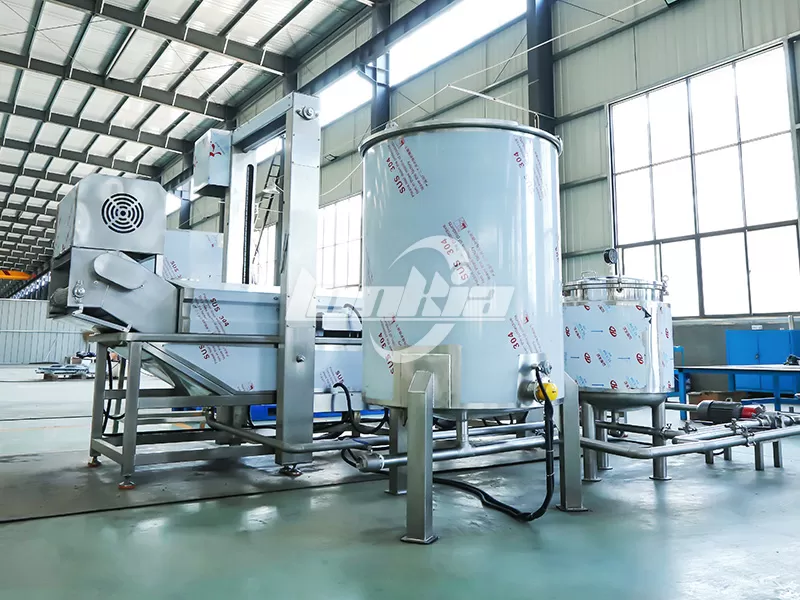
Equipment like the Lonkia potato chips frying machine supports various capacity customizations in its design. Combined with automatic temperature control and oil filtration systems, it meets production needs at different development stages and offers excellent stability and adaptability in practical applications.
Conclusion: Selecting the Right Capacity to Boost Long-Term Returns
For potato chips manufacturing plants, choosing the right industrial deep fryer is not merely a matter of equipment procurement but also a matter of production planning.
Reasonable capacity configuration can help you:
- Improve production efficiency
- Reduce operating costs
- Maintain product consistency
Rather than focusing solely on price, selecting potato chips frying machine that matches your specific needs is a more rational investment approach.