
1.Why Automated Tray Washing Matters
In food processing, logistics, and packaging industries, trays are indispensable. They are used to carry ingredients, store semi-finished products, or transport packaged goods across production lines. However, trays also represent one of the biggest contamination risks if not cleaned properly. Residues of fats, starch, proteins, or cleaning chemicals can accumulate, leading to hygiene violations, product recalls, or even customer health risks.
Traditionally, many factories relied on manual washing, but this approach is time-consuming, labor-intensive, and inconsistent. Moreover, global food safety regulations such as HACCP, IFS, and BRC have raised the bar for hygiene standards. As a result, investing in an industrial tray washing machine has become a strategic decision for companies that want to combine compliance, efficiency, and long-term cost savings.
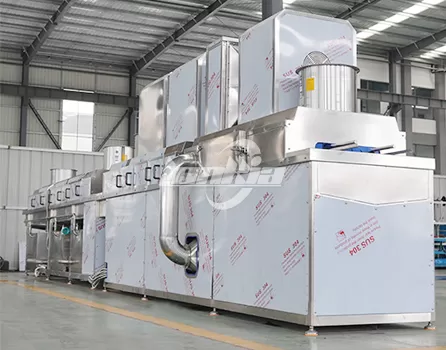
2. The Core Principles of Tray Washing
At its foundation, tray washing is about systematically applying four cleaning factors: time, temperature, mechanical action, and chemical agents—often referred to as Sinner’s Circle. Effective tray washer systems are designed to balance these factors for maximum cleaning performance while minimizing resource consumption.
Water temperature: Hot water accelerates the breakdown of fats and proteins, while warm cycles reduce energy costs for lightly soiled trays.
Mechanical force: High-pressure spray nozzles and carefully designed spray patterns ensure water reaches every corner, even on trays with ribbed or perforated surfaces.
Chemicals: Detergents and sanitizers are applied in controlled dosages to avoid residue and reduce chemical costs.
Time: The duration of each cleaning stage (pre-rinse, main wash, rinse, sanitization) is optimized based on contamination level.
Modern tray washers use closed-loop circulation systems, meaning water is filtered and reused multiple times before being discharged. This reduces both water consumption and environmental impact. Some machines also integrate ozone or UV sterilization as an additional barrier against bacteria and biofilm buildup.
3. Main Types of Tray Washer Systems and Their Applications
Industrial tray washers are not one-size-fits-all. Different facilities require different configurations depending on throughput, tray design, and hygiene requirements. Below are the most common system designs:
Batch or Rack Washers
Suitable for small to medium-scale operations.
Trays are loaded into racks or baskets, and a set cycle runs through pre-wash, wash, rinse, and sanitization stages.
Pros: Flexible, relatively compact footprint, lower upfront cost.
Applications: bakeries, butcher shops, central kitchens, or R&D facilities with limited tray volumes.
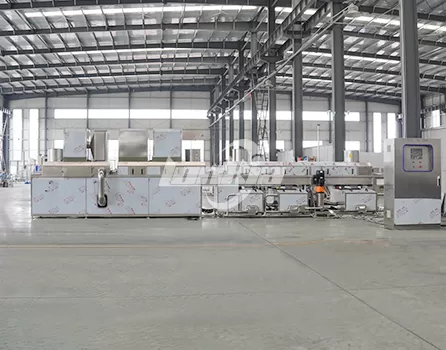
Conveyor or Tunnel Washers
Designed for high-volume industries where thousands of trays must be cleaned every hour.
Trays are fed continuously on a conveyor belt or chain-driven system, passing through sequential zones of cleaning.
Pros: High throughput, consistent results, easy integration with upstream/downstream automation.
Applications: dairy plants, large-scale meat processing, beverage bottling, logistics hubs.
Rotary or Carousel Systems
Compact solutions that clean trays on a rotating drum or carousel.
Pros: Space-efficient, continuous operation with lower water use.
Applications: facilities with limited floor space but moderate tray cleaning demand.
Fully Integrated Washing Systems
These machines are part of a complete cleaning line, often handling crates, pallets, and trays in the same system.
They are integrated with robotic loading, stacking, and drying stations.
Applications: advanced food processing plants, pharmaceutical packaging, and highly automated warehouses.
When evaluating options, managers should consider not only the number of trays per hour but also how the machine integrates into existing production lines. An industrial tray washer that fits seamlessly into automation workflows can deliver far more than hygiene—it can increase overall efficiency and reduce bottlenecks.
4. Key Components That Define Performance
The effectiveness of a tray washer machine depends largely on its internal components. Understanding these elements helps buyers compare models more accurately:
Pumps and Nozzles: The heart of any system. High-capacity pumps maintain pressure, while precision nozzles ensure uniform spray coverage. Adjustable nozzles help handle trays of different shapes.
Filtration Units: Multi-stage filtration removes food particles, oils, and residues, preventing recontamination and extending water life. Systems may include coarse filters, centrifugal separators, and fine mesh screens.
Heating Systems: Electric heaters, steam coils, or hybrid systems raise water temperature. Efficient insulation reduces energy losses.
Drying Units: High-speed blowers or air knives remove moisture after washing, ensuring trays are dry before storage or reuse.
Conveyors and Carriers: Guide trays through the machine with minimal damage. Adjustable carriers handle trays of different sizes.
Control Panels (PLC/HMI): Digital interfaces allow operators to set cycle parameters, monitor water quality, and track maintenance schedules.
The overall design must balance throughput, water consumption, and cleaning effectiveness. For example, a high-pressure pump paired with poor filtration will waste energy and quickly re-soil trays, while a system with strong filtration and optimized spray design will achieve superior hygiene with less effort.
5. Benefits of Upgrading to an Industrial Tray Washer
Switching from manual cleaning or outdated equipment to a modern tray washing machine brings multiple tangible benefits. These advantages extend beyond hygiene into cost control and operational reliability:
1. Hygiene and Compliance
Meets strict international food safety regulations (HACCP, BRC, IFS).
Reduces cross-contamination risks by ensuring consistent cleaning cycles.
Provides audit-ready data logging in advanced models.
2. Efficiency and Labor Savings
Cuts manual cleaning labor, allowing staff to focus on higher-value tasks.
Eliminates inconsistencies caused by human error.
Continuous systems can handle up to 3,000–5,000 trays per hour depending on configuration.
3. Resource Optimization
Water reuse systems cut consumption by up to 70%.
Integrated chemical dosing minimizes detergent costs.
Energy-efficient heating systems reduce overall operating costs.
4. Product Longevity
Gentle but effective washing reduces tray wear and prevents damage.
Uniform drying minimizes bacterial growth during storage.
5. ROI and Long-Term Value
Case studies show payback periods between 12–30 months depending on production scale.
Reduced downtime and fewer hygiene-related recalls further improve ROI.
These benefits make tray washers not just a hygiene investment but a profitability driver. In highly competitive markets, efficiency gains from a reliable washing system can determine whether a business stays ahead of its competitors.
6. Buying Guide: How to Select the Right Tray Washer
Investing in an industrial tray washer is a significant decision, especially for factories with high throughput. The right choice can reduce operating costs for years, while the wrong machine can become a bottleneck. Here are the most important factors buyers should evaluate before purchase:
Assessing Capacity and Throughput
Estimate the number of trays per hour your operation requires today and in the next 3–5 years.
Oversized systems waste resources, while undersized ones cause bottlenecks. Look for scalable solutions where capacity can be upgraded.
Tray Types and Compatibility
Trays vary by size, depth, and material (plastic, stainless steel, perforated).
Ensure the tray washer machine has adjustable carriers or modular guides.
For facilities handling multiple tray formats, request demonstrations with real samples.
Water and Energy Efficiency
Ask about water reuse systems and multi-stage filtration.
Compare heating methods (electric, gas, or steam). Steam heating is common in food plants already using boilers, while electric heaters may be better for smaller facilities.
Cleaning Validation and Hygiene Assurance
Advanced systems include temperature monitoring, chemical dosing controls, and data logging.
For regulated industries, confirm compliance with standards like FDA, EU Hygiene Directive, or ISO 22000.
Maintenance and Support
Evaluate the ease of cleaning machine interiors, especially filters and nozzles.
Ask the tray washer manufacturer about spare parts availability and service agreements.
A reliable after-sales service team often makes more difference than a slightly lower purchase price.
Budget and ROI
Initial cost is only part of the equation.
Consider operational expenses: electricity, water, chemicals, labor savings, and downtime reductions.
A well-designed system often pays for itself within 1–2 years.
7. Maintenance and Troubleshooting: Ensuring Longevity
Even the best-designed tray washer machines require proper maintenance. Neglecting cleaning and inspection can reduce efficiency and increase downtime.
Routine Maintenance Checklist
Daily: Inspect nozzles for clogs, clean filters, check water pressure.
Weekly: Sanitize tanks, verify detergent dosing, inspect conveyor belts.
Monthly: Check pump seals, inspect heating elements, lubricate moving parts.
Annually: Full inspection by service engineers, replacement of worn components.
Common Issues and Fixes
Inconsistent Cleaning Results
Cause: Blocked spray nozzles or insufficient water pressure.
Fix: Clean nozzles regularly, check pump performance.
High Detergent Usage
Cause: Faulty dosing system or poor filtration.
Fix: Calibrate dosing pumps, replace filters on schedule.
Excessive Water Consumption
Cause: Leaks, poor recycling system.
Fix: Inspect valves and seals, upgrade to a machine with a closed-loop system.
Tray Damage During Washing
Cause: Excessive mechanical force or misaligned carriers.
Fix: Adjust pressure settings, ensure trays are properly aligned.
Machine Downtime
Cause: Lack of preventive maintenance.
Fix: Implement a scheduled maintenance program with logs.
By training staff in proper machine use and establishing a preventive maintenance schedule, companies can extend machine life and ensure consistent hygiene.
8. FAQs: Addressing Buyer Concerns
Q1: What’s the difference between a crate washer and a tray washer?
A: While both machines share similar principles, tray washers are designed specifically for flat or shallow trays, often with smooth or perforated surfaces. Crate washers handle deeper, box-shaped containers. Some manufacturers offer hybrid systems for both.
Q2: Can a tray washing machine handle multiple tray sizes?
A: Yes. Many modern machines include adjustable carriers or modular racks. However, extreme variations in tray size may require customized solutions.
Q3: How much space do I need for installation?
A: Compact wash machine tray models fit into small facilities, while tunnel-type washers may require several meters of floor space. Always evaluate layout drawings before purchase.
Q4: What chemicals are used for cleaning?
A: Alkaline detergents are common for removing fats and proteins, while sanitizers such as chlorine or peracetic acid may be used for final disinfection. Dosage should always follow manufacturer recommendations.
Q5: Are tray washers environmentally friendly?
A: Yes, if designed properly. Many tray washer machines reduce water consumption by up to 70% through filtration and recirculation, while energy-efficient heaters cut electricity or steam usage.
9. Choosing Smart for Long-Term Success
A reliable industrial tray washer is more than a hygiene tool—it’s a strategic investment in efficiency, compliance, and sustainability. By understanding how these machines work, comparing features carefully, and planning for long-term maintenance, companies can secure not only food safety but also profitability.
For businesses considering an upgrade, the key is to align machine capacity with production needs, prioritize water and energy efficiency, and partner with a trustworthy tray washer manufacturer that provides both equipment and after-sales support.
The right decision today ensures smoother operations, fewer hygiene risks, and stronger competitiveness tomorrow. Whether you call it a tray washing machine, industrial tray washer, or simply a tray washer machine, the goal remains the same: safe, clean trays that keep your production running at its best.