
In the ever-evolving world of food processing and packaging, product consistency, efficiency, and safety are non-negotiable. One crucial element that ensures these qualities is the grading machine. From fruits and vegetables to seafood and frozen products, grading machines help classify food based on weight, size, color, shape, or defects—automatically and at high speed.
Food grading isn’t just about appearance—it affects pricing, compliance, packaging compatibility, and customer satisfaction. Manual grading is time-consuming and often inaccurate. In contrast, a reliable grading machine enhances throughput, reduces labor dependency, and ensures every item meets specific quality standards.

1. Weight Grading Machine
What It Is:
A weight grading machine classifies products based on their individual weight. It uses high-precision digital load cells or weighing sensors to measure each item and sort it into predefined categories.
How It Works:
Items are placed on conveyor belts with integrated weighing units.
The system measures each item in milliseconds.
Pneumatic arms, gates, or pushers then divert products to the corresponding bin or lane based on weight.
Ideal For:
Chicken and poultry processing
Fish and seafood portions
Fruits like mangoes, avocados, and apples
Packaged food portions (frozen patties, dumplings)
Benefits:
High accuracy, up to ±1 gram
Increases pack-out efficiency
Reduces giveaway and product waste
Ensures regulatory compliance with declared weights
2. Size Grading Machine
What It Is:
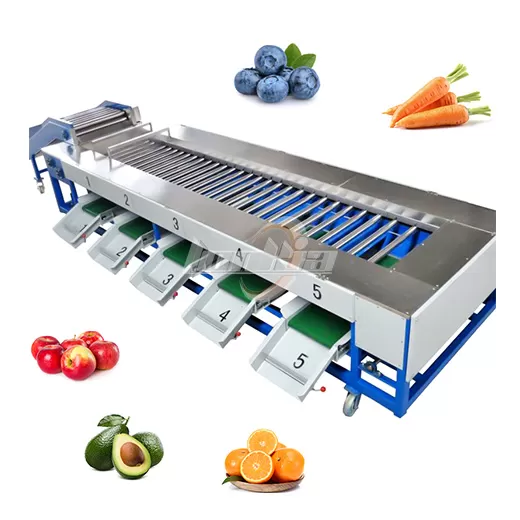
A size grading machine sorts food items based on physical dimensions such as length, diameter, or volume. It's especially useful in fruit, nut, and vegetable processing where uniform size improves packaging and consumer perception.
How It Works:
Products pass through a roller or vibrating sieve system with variable gaps.
As the product moves, it drops into different collection zones based on its size.
More advanced machines use vision systems to measure size with cameras or lasers.
Ideal For:
Potatoes, onions, carrots
Citrus fruits (lemons, oranges)
Nuts and shelled produce
Tomatoes, cherries, and berries
Benefits:
Consistent product sizing for retail packaging
Enhances visual quality and presentation
Reduces labor in packaging and sorting lines
3. Color and Optical Grading Machine
What It Is:
An optical grading machine uses cameras, sensors, and image processing algorithms to grade items based on color, surface defects, ripeness, and quality. This is a highly advanced, non-contact form of inspection.
How It Works:
The product flows through a conveyor system under high-resolution cameras or multispectral imaging systems.
The software analyzes parameters such as color uniformity, bruising, rot, or blemishes.
Items are then sorted using air jets, flippers, or robotic arms.
Ideal For:
Apples, bananas, peaches, and avocados
Coffee beans and cocoa
Dried fruits and dates
Grains, rice, lentils
Benefits:
Accurate, real-time quality detection
Eliminates subjective human judgment
Increases value by separating premium-grade produce
Reduces customer complaints due to hidden defects
4. Shape or Defect Grading Machine
What It Is:
This type of grading machine specializes in identifying irregularities in shape, cracks, deformities, or unwanted elements (e.g., insect damage or broken parts).
How It Works:
Often integrated with machine vision systems and AI-powered software.
Items pass under multiple cameras for 360° scanning.
The machine flags and separates out defective or misshapen products.
Ideal For:
Frozen nuggets or shaped products
Biscuits, cookies, and baked goods
Shellfish, nuts, and seafood
Packaged items like sausages or meat cuts
Benefits:
Enhances end-product uniformity
Automatically filters rejects before packing
Reduces the need for manual inspection
Enables higher pricing for consistent shapes

5. Multi-Function or Integrated Grading Machine
What It Is:
A multi-function grading machine combines two or more grading criteria—such as weight, size, and color—into a single integrated system. These are designed for high-volume production environments with strict quality demands.
How It Works:
Combines load cells, vision sensors, color cameras, and AI-based analytics.
Products are graded on multiple criteria simultaneously.
Flexible interfaces allow customization per batch or customer order.
Ideal For:
Export fruit packaging centers
High-throughput seafood and poultry plants
Multi-grade coffee or nut processing
Centralized fresh produce distribution centers
Benefits:
Maximum grading accuracy across multiple parameters
Saves floor space by combining multiple processes
Reduces human error and manual handling
Scalable for growing production needs
How to Choose the Right Food Grading Machine
When investing in a grading machine, it’s essential to align the technology with your product type, production volume, and business goals. Here are some key factors to consider:
1. Product Characteristics
Soft fruits require gentle handling; heavy items need reinforced conveyors. Consider:
Moisture content
Surface delicacy
Standardized shapes vs irregular forms
2. Grading Parameters
Choose machines based on whether you need to grade by:
Weight
Size
Color/defects
A combination of the above
3. Capacity and Throughput
Ensure the machine matches your line’s speed. Some machines handle up to 10,000 items/hour, while others are best for small to mid-sized operations.
4. Automation and Integration
If you’re scaling up, look for models that integrate with:
Labeling systems
Packing machines
MES/ERP data systems
5. Hygiene and Compliance
For food-grade environments, stainless steel design, IP65 water resistance, and easy-to-clean surfaces are crucial.
In today’s competitive food industry, investing in the right grading machine can make all the difference. It improves product quality, enhances efficiency, and reduces manual labor costs. Whether you need to sort apples by color, chicken by weight, or coffee beans by defect, there is a purpose-built machine to meet your exact needs.
By understanding the different types—weight, size, optical, shape-based, and multi-function systems—you can make an informed decision that supports your productivity goals and maintains consistent quality across your product line.
As food safety, traceability, and consumer expectations continue to rise, automation through smart grading machines isn’t just a nice-to-have—it’s a necessity.
FAQs About Food Grading Machines
1. What’s the difference between sorting and grading in food processing?
Sorting usually refers to basic separation (e.g., removing foreign objects), while grading involves classifying products by quality factors such as weight, size, or appearance.
2. Can one grading machine handle multiple product types?
Yes—especially multi-function grading machines. These allow quick changeovers and recipe-based settings to grade different food items on the same line.
3. How accurate are modern grading machines?
Accuracy depends on the system, but many high-end machines offer ±1–2% precision in weight, size, or color detection, thanks to advanced sensors and machine vision technology.
4. Are grading machines suitable for small businesses?
Yes. There are compact and affordable models ideal for farms, co-ops, and artisanal processors, though large-scale lines benefit most from high-capacity systems.
5. How much does a food grading machine cost?
Prices range from a few thousand to over $100,000, depending on automation level, grading complexity, and processing capacity. ROI is typically realized through labor savings and product quality improvements.