
Mangoes are one of the most consumed tropical fruits worldwide, but they also rank among the most challenging to process. Their irregular shape, varying sizes, sticky sap, and tough peel make manual processing labor-intensive and inconsistent. For businesses in the food industry—whether producing dried mango slices, purees, frozen chunks, or ready-to-eat packaged fruit—the inefficiencies of manual work can quickly add up to higher costs and lost yield.
This is where mango automatic machines play a transformative role. By integrating automation into peeling, pitting, and cutting, food processors can reduce labor reliance, minimize waste, and achieve consistent quality that meets both consumer expectations and international food safety standards. A well-designed mango peeler or a full processing line is no longer a luxury—it has become a necessity for scaling production.
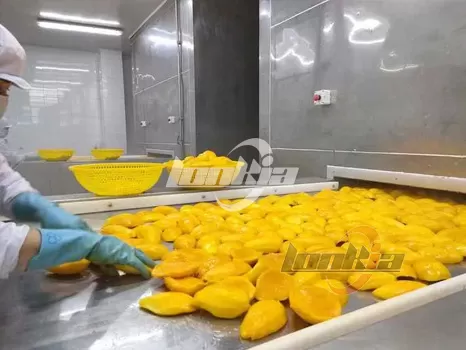
Overview of an Automatic Mango Processing Line
At a high level, a mango processing line takes raw harvested fruit and transforms it into semi-finished or finished products ready for further manufacturing or packaging. While layouts vary depending on the target product, most commercial lines follow a similar flow:
Receiving & Sorting – Fresh mangoes arrive and are visually inspected, often with grading systems for size and ripeness.
Washing – To remove dirt, pesticide residues, and sap, ensuring a clean starting point for peeling.
Peeling – The most critical stage, where automatic mango peelers replace labor-intensive hand peeling.
Pitting / Destoning – Machines separate the large seed from the pulp with precision.
Cutting (Slicing/Dicing) – Depending on the product, mango flesh is cut into cubes, strips, or slices.
Pulping / Pureeing – For juice and concentrate production, peeled mango is crushed and refined.
Preservation Steps (Blanching, Freezing, or Drying) – Product is stabilized for extended shelf life.
Packaging – Final step before distribution.
The central role of the mango peeler in this chain cannot be overstated. Its performance directly affects downstream operations: poor peeling increases peel waste, damages flesh, and complicates cutting or pulping. Similarly, a well-calibrated mango automatic peeler maximizes usable yield, ensures consistent surface quality, and reduces the risk of contamination by minimizing manual handling.
Modern automatic processing lines are designed with scalability in mind. Smaller facilities may run lines of 500–1,000 kg/hour capacity, while industrial-scale processors handle several tons per hour. The ability to add modules—such as extra peelers, high-capacity dicers, or inline quality control systems—gives processors flexibility to adapt as demand grows.
Mango Peeler Technologies: How They Work & Pros / Cons
Peeling mangoes automatically is technically challenging due to their soft pulp and fibrous peel. Over the years, manufacturers have developed several peeling methods, each with its advantages and trade-offs.
1. Mechanical Blade Peelers
These machines use sharp, contour-following blades to cut away the peel. They are fast and relatively affordable, making them popular for medium-scale facilities. However, they require fairly uniform fruit sizes to minimize flesh loss, and blade wear means regular maintenance is needed.
Pros: High speed, straightforward technology, widely available.
Cons: Higher peel loss with irregular fruit; blade sharpening required.
Best Use: Large, uniform varieties like Kent or Keitt.
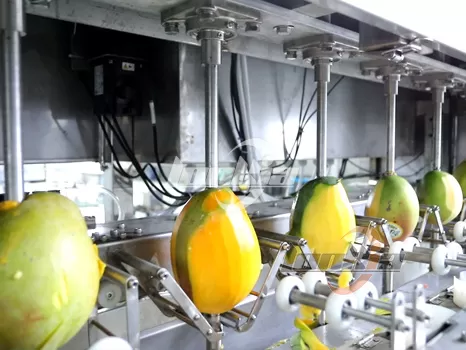
2. Abrasive Peelers
In this design, rotating rollers with abrasive surfaces gently rub off the skin. They are gentler on flesh and adaptable to varied fruit sizes. Peel loss is generally lower, but the process is slightly slower and produces slurry waste that needs handling.
Pros: Low peel loss, adaptable to irregular fruit, minimal flesh damage.
Cons: Slower throughput; requires water management.
Best Use: Softer, delicate varieties or mixed-size batches.
3. Steam or Hot-Water Peelers
These systems expose mangoes to high-temperature steam or hot water, loosening the peel before it is brushed or peeled off. They excel in minimizing mechanical damage, though they demand higher energy input and careful control of heating time to avoid cooking the flesh.
Pros: Very low peel loss, excellent surface finish, gentle handling.
Cons: Energy-intensive, may require blanching systems, larger footprint.
Best Use: Premium fresh-cut markets where visual quality is critical.
4. Hybrid Systems
Some equipment combines pre-softening (with heat) and mechanical finishing. These systems are designed to handle mixed fruit grades while reducing both peel loss and mechanical damage.
Pros: Balanced performance, adaptable to different fruit conditions.
Cons: Higher investment cost, more complex operation.
Key Evaluation Metrics for Mango Peelers:
Throughput (kg/hour) – How much fruit the machine can handle.
Peel Loss (%) – How much edible pulp is wasted.
Flesh Damage Rate (%) – Measure of how often the pulp surface is cut or bruised.
Sanitation Compatibility – Ability to run CIP (clean-in-place) systems.
Changeover Time – Speed of switching between fruit sizes or batches.
Selecting the right mango peeler requires balancing these trade-offs against product goals—whether efficiency, premium quality, or energy savings.
Cutting & Size-Reduction: Pitting (Destoner), Slicers and Dicers
After peeling, the next step is separating the seed and preparing mango flesh for the desired product form.
Pitting / Destoning
The mango seed is large and irregularly shaped, making manual pitting inconsistent. Automatic pitters use mechanical or hydraulic action to split the fruit and remove the stone while preserving pulp integrity. Advanced designs incorporate alignment systems that orient mangoes correctly, improving accuracy and reducing waste.
Key Considerations: throughput capacity, seed fragment risk, ease of cleaning.
Common Issues: misaligned fruit leading to incomplete pitting, flesh clinging to seed.
Slicers
Slicers cut peeled mango into longitudinal slices, often used for dried mango production. Blade sharpness and spacing are crucial, as dull blades crush the pulp and affect product quality.
Adjustable Thickness: Typically 4–10 mm.
Applications: dried slices, frozen strips for smoothies, dessert toppings.
Dicers
Dicers transform mango flesh into cubes for frozen products, fruit salads, or pulp processing. Machines may use grid-cutting or rotary knives to produce uniform shapes.
Uniformity: Essential for downstream freezing or packaging.
Throughput Range: 500–2,000 kg/hour depending on machine size.
Challenges: Sticky pulp buildup, which requires efficient cleaning systems.
Integration Considerations
For seamless processing, peelers, pitters, and slicers must be carefully synchronized. Misalignment in peeling can increase seed residue in cutting stages. Similarly, uneven peel removal can create blockages in dicers. Line integration ensures smoother flow, better product consistency, and reduced downtime.
By combining an effective mango peeler with precise cutting solutions, processors can achieve both high yield and premium-quality output—whether destined for fresh-cut packs, frozen cubes, or puree lines.
Integration & Line Design: Capacity, Layout, Hygiene
A mango processing line is more than just a collection of machines—it is a coordinated system that must be engineered for balance, safety, and efficiency. Poor integration can lead to bottlenecks, wasted utilities, and inconsistent output.
Balancing Capacity Across Modules
The most common mistake in line design is oversizing one module while undersizing another. For instance, a high-capacity mango peeler running 1,500 kg/h will quickly overwhelm a small dicer rated at only 700 kg/h. To avoid these mismatches, processors should calculate average and peak throughput requirements, then size each machine with at least 15–20% buffer.
Layout & Footprint
Space efficiency is critical, especially in facilities with existing constraints. Skid-mounted modules can simplify installation and relocation. Lines are typically arranged linearly for ease of fruit flow, but U-shaped or modular clusters are also common in facilities seeking compact footprints.
Material Flow: From dirty to clean zones with no backtracking.
Personnel Flow: Minimized crossings between raw and finished product areas.
Drainage: Floors must slope for proper washdown and sanitation.
Hygiene & Food Safety Compliance
Mangoes are prone to sap and sugar residues that encourage microbial growth. Processing lines must be built from food-grade stainless steel (SUS304 or SUS316 for acidic environments) with smooth welds and minimal crevices.
CIP (Clean-In-Place): Automatic wash cycles reduce downtime and improve sanitation consistency.
HACCP Compliance: Lines must support traceability and allow visual inspection points.
Utilities Management: Efficient water and steam recovery systems reduce operational costs and environmental footprint.
Automation & Digital Monitoring
Advanced lines integrate SCADA or PLC systems that track throughput, downtime, and sanitation cycles. Data-driven monitoring helps operators identify early signs of wear, optimize peel loss, and reduce labor intervention. Some modern mango automatic lines even feature AI-based vision systems to sort fruit by ripeness and detect defects before peeling.
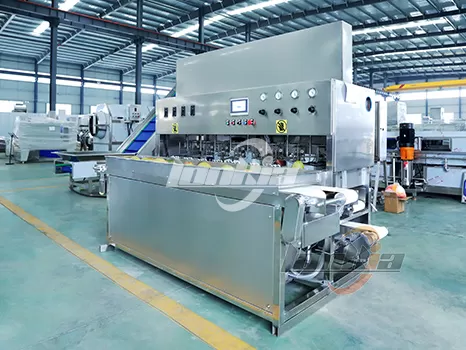
Buying Guide & Technical Specs: How to Choose the Right Mango Automatic Machine
Investing in mango automatic processing equipment requires careful evaluation, since capital expenditure is significant and the machine’s performance affects profitability for years to come.
Step 1: Match Capacity to Demand
Start by estimating your seasonal mango volume. For example, if you process 5,000 kg/day during peak season at 8 hours/day, you need a line capable of ~625 kg/hour. Adding a 20% buffer means selecting machines rated at 750 kg/h.
Step 2: Define Product Goals
Frozen chunks or IQF: Requires precise dicing and low peel loss.
Dried mango slices: Prioritizes slicing uniformity.
Puree or juice: Throughput and pulp recovery are more important than surface quality.
Each product has different requirements for peeling accuracy, cutting geometry, and waste management.
Step 3: Key Spec Checklist
When comparing suppliers, look beyond headline capacity and request detailed technical sheets:
Throughput (kg/h).
Peel loss (%). Target <8% for blade peelers, <5% for steam systems.
Flesh damage rate (%). Preferably <3%.
Footprint & weight. Critical for facility planning.
Utilities required. Steam (kg/h), water (L/h), power (kW).
CIP compatibility. Reduces cleaning downtime.
Warranty & service. Length, spare parts availability, local support.
Step 4: Supplier Selection Criteria
Field References: Ask for case studies in mango, not just generic fruit.
Factory Acceptance Test (FAT): Machines should be tested with your mango variety before shipment.
On-Site Commissioning: Ensures smooth startup and staff training.
Spare Parts Stocking: Check lead times for consumables such as blades and seals.
Step 5: ROI Evaluation
Automation is only justified if it pays for itself. Consider savings from:
Reduced labor: One machine may replace 6–10 workers.
Improved yield: Lower peel loss adds kilograms of saleable product daily.
Energy efficiency: Modern peelers can reduce water/steam use.
ROI Example:
A factory processing 1,000 kg/day saves 5% more yield with a new peeler (50 kg extra). At $1.50/kg, that’s $75/day or ~$27,000/year. Combined with labor savings, the machine can pay for itself within 2–3 years.
Operation, Maintenance, Troubleshooting + FAQs
Even the most advanced mango automatic machines need proper operation and regular maintenance to deliver consistent results.
Routine Maintenance
Daily: Wash down after each shift, inspect blades/rollers for residue.
Weekly: Lubricate bearings, check seals, verify CIP spray nozzles.
Monthly: Inspect electrical panels, calibrate sensors, sharpen or replace blades.
Annually: Full overhaul, including gearbox oil replacement and wear-part assessment.
Troubleshooting Common Issues
Uneven Peeling: Adjust blade pressure or abrasive surface wear.
High Peel Loss: Verify fruit alignment and blade sharpness.
Seed Damage in Pitters: Check calibration and feeding orientation.
Product Build-Up in Dicers: Increase CIP frequency or adjust cutting speed.
Spare Parts & Consumables
Always keep critical spares onsite to minimize downtime:
Blades and abrasive rollers.
Seals and gaskets.
Bearings and belts.
Spray nozzles and sensors.
FAQs (Schema-Ready)
Q1: What is the typical peel loss of a good mango peeler?
High-quality machines achieve 5–8% peel loss, compared to >12% with manual peeling.
Q2: Can a mango automatic peeler handle mixed fruit sizes?
Yes, but performance depends on the design. Some systems include adaptive clamps or vision systems to adjust for variability.
Q3: What utilities are needed for a mango processing line?
Power, water, and in some cases steam or compressed air. Requirements depend on machine type.
Q4: How do I prepare mangoes before peeling?
They should be washed, sorted by ripeness, and optionally pre-chilled to maintain pulp firmness.
Q5: How often should blades or rollers be replaced?
Typically every 3–6 months under continuous use, but this varies with throughput and mango variety.
Mango processing is a complex task, but automation has made it faster, cleaner, and far more consistent. From the mango peeler to the slicer and dicer, each machine plays a critical role in maximizing yield and ensuring product quality. By selecting the right equipment, balancing line capacity, and maintaining hygiene and service schedules, processors can unlock both higher profitability and long-term operational stability.
For businesses looking to expand, the next step is simple: evaluate your production needs, run sample trials with suppliers, and choose a mango automatic solution that ensures you stay competitive in a growing global mango market.