
For potato farms, packing facilities, and food processing plants, sorting and grading are essential steps for maintaining product consistency and improving production efficiency. As labor costs increase and processing volumes grow, many businesses are considering an automatic potato sorting and grading line as an alternative to manual sorting.
But is the investment worthwhile? The answer depends on your production volume, labor requirements, grading standards, and future business plans. This article explains the main benefits and factors to consider before making a decision.
What Is an Automatic Potato Sorting and Grading Line?
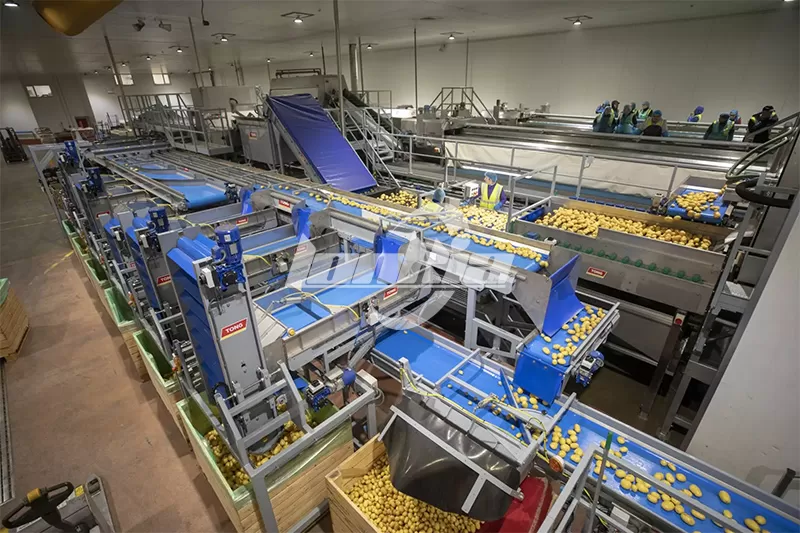
An automatic potato sorting and grading line uses mechanical, electronic, or optical systems to classify potatoes according to size, weight, or quality.
A complete system may include:
receiving hopper
feeding conveyor
potato sorting machine
grading machine
inspection conveyor
weighing equipment
packaging equipment
The equipment can be configured according to the processing capacity and requirements of different businesses.
How Can Automation Improve Potato Processing?
The main advantage of automation is the ability to process large quantities of potatoes with less manual intervention.
An automatic grading line can provide:
continuous production
faster sorting
more consistent grading
reduced manual handling
improved production flow
This is particularly valuable for businesses processing several tons of potatoes per hour.
Reduce Labor Requirements
Manual potato sorting requires workers to repeatedly inspect and separate products. As production volumes increase, the number of workers required can also increase.
An automatic potato grading line performs repetitive sorting tasks continuously, reducing the need for manual labor.
The remaining workers can focus on equipment operation, quality control, packaging, and other production tasks.
Improve Grading Consistency
Consistent grading is important for both fresh potato suppliers and food processors.
An automatic system can separate potatoes according to predefined specifications, helping produce more uniform batches.
Consistent sizing can also improve subsequent processes such as:
French fry cutting
potato chip production
packaging
retail distribution
Better consistency makes it easier to meet customer specifications.
Reduce Product Waste
Manual grading can result in inconsistent sorting and unnecessary product loss. Over time, these losses can become significant for high-volume processors.
Automatic grading provides more precise classification and can help reduce unnecessary waste.
Gentle conveying and controlled product transfer can also minimize bruising and mechanical damage.
Improve Production Capacity
A major reason businesses invest in automation is to increase throughput.
An automatic potato sorting and grading line can operate continuously and integrate with other equipment, allowing potatoes to move smoothly from receiving through grading and packaging.
For high-capacity plants, this can help eliminate bottlenecks and improve overall production efficiency.
Is an Automatic System More Expensive?
Yes, an automatic grading line generally requires a higher initial investment than a basic manual or semi-automatic system.
However, the purchase price is only one part of the total cost.
Businesses should also consider:
labor savings
production capacity
product waste
energy consumption
maintenance costs
equipment service life
For high-volume operations, these factors can make automation financially attractive over the long term.
When Is an Automatic Potato Grading Line Worth It?
An automatic system is particularly suitable when:
You Process Large Volumes
If your facility processes several tons of potatoes per hour, automation can provide significant efficiency improvements.
Labor Costs Are High
Reducing repetitive manual sorting can help control labor expenses.
Consistent Grading Is Important
Businesses supplying supermarkets, wholesalers, and food manufacturers can benefit from more consistent product classification.
You Plan to Expand
A scalable automated line can support future production increases without requiring a complete change of equipment.
When Might a Smaller System Be More Suitable?
Not every business needs a fully automatic line.
Small farms or low-volume packing operations may find a basic mechanical grading machine or semi-automatic system more appropriate.
If production volume is low, the additional investment in advanced automation may not provide sufficient benefits. In this case, a simpler system can offer the required grading performance at a lower initial cost.
What Should You Consider Before Buying?
Before investing in an automatic potato sorting and grading line, evaluate:
required processing capacity
potato size and variety
grading requirements
level of automation
factory space
labor costs
future expansion plans
It is also important to choose a manufacturer that can customize the line according to your actual production requirements.
Why Choose LONKIA Machinery?
LONKIA Machinery provides customized potato processing equipment and complete potato sorting and grading line solutions for customers worldwide.
Our solutions can be designed according to production capacity, grading requirements, factory layout, and automation level. The grading system can also be integrated with potato washing, inspection, weighing, and packaging equipment.
Whether you need a compact grading system or a fully automated industrial processing line, LONKIA Machinery can help develop a suitable solution for your business.
Conclusion
An automatic potato sorting and grading line can be a valuable investment for businesses that process large volumes of potatoes and require consistent grading results. Automation can increase production capacity, reduce labor requirements, improve product consistency, and minimize waste.
However, the right choice depends on your actual production needs. Small operations may benefit from simpler equipment, while medium and large processing plants can gain greater value from a fully automated system.
By evaluating capacity, automation, operating costs, and future growth before purchasing, you can choose a potato sorting and grading solution that provides reliable performance and long-term value.