
1. Introduction: Why Glass Bottle Washing Matters
In modern food, beverage, and pharmaceutical industries, the quality of packaging directly affects the product’s market acceptance and safety. Among various packaging materials, glass bottles remain one of the most hygienic and recyclable options. However, before being filled with beverages, sauces, or medicines, each glass bottle must go through a thorough washing and sterilization process to ensure no contaminants compromise product quality.
A glass bottle washing machine serves as a critical step in the bottling line — it removes dust, residues, labels, and microorganisms from reused or newly produced bottles. Whether in a soft drink factory or a sauce production plant, the cleanliness of each bottle is not only a matter of aesthetics but also directly tied to regulatory compliance, shelf life, and consumer safety.
With increasing focus on hygiene, sustainability, and efficiency, understanding how these machines work — and how to maintain them — has become essential for manufacturers worldwide.
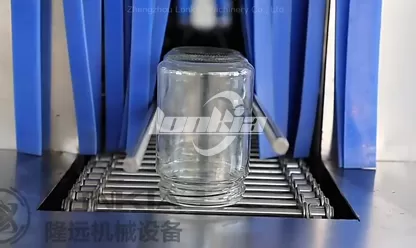
2. Understanding How Glass Bottle Washing Machines Work
A glass bottle washing machine is designed to clean bottles inside and out through a series of automated stages involving water, detergents, mechanical agitation, and temperature control. Although models vary, the typical process follows these steps:
Loading: Bottles are placed on an infeed conveyor or rotary table, where they are automatically aligned and prepared for washing.
Pre-rinse: Warm water sprays remove loose dirt or sugar residues from the inner and outer surfaces.
Detergent Wash: Bottles enter a caustic or detergent bath (often sodium hydroxide-based) to dissolve organic residues, labels, or glue.
Rinse: Multiple rinsing sections wash off detergent with progressively cleaner water.
Sterilization: In food-grade systems, bottles may undergo hot-water sterilization or chemical disinfection to ensure microbiological safety.
Final Rinse & Discharge: Clean bottles are rinsed with filtered or deionized water and then directed toward the filling line.
These machines rely on high-pressure nozzles, rotating brushes, and timed soaking tanks to achieve full contact with all bottle surfaces.
Two main structural designs exist:
Linear machines, which move bottles in a straight line, ideal for small to mid-scale operations.
Rotary machines, which wash bottles in circular motion — faster, more compact, and suitable for large-scale plants.
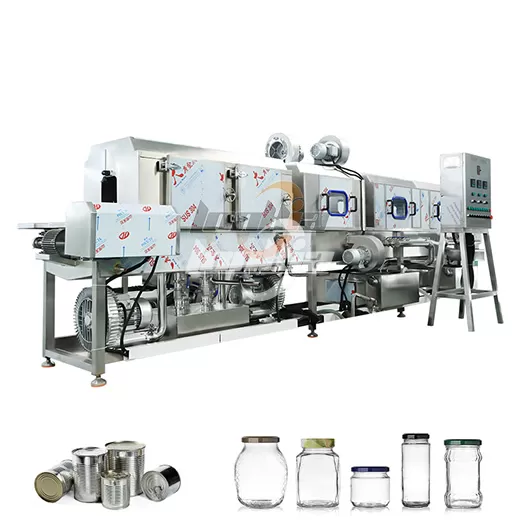
All stainless steel construction, smooth internal surfaces, and compatibility with CIP (Clean-in-Place) systems ensure the highest hygiene levels during operation.
3. Types of Glass Bottle Washing Machines
Depending on production volume and application, manufacturers can choose among several configurations:
(1) Manual and Semi-Automatic Machines
Used in small-scale or artisanal operations such as craft breweries or specialty sauce producers. Operators load and rinse bottles manually or with limited automation.
Advantages: Low cost, simple setup, easy to maintain.
Disadvantages: Labor-intensive, inconsistent results, slower throughput.
(2) Fully Automatic Rotary Washers
Common in medium and large beverage plants. These machines continuously feed bottles through multiple washing, rinsing, and sterilizing stages.
Advantages: High output, stable performance, consistent cleaning quality.
Disadvantages: Higher investment, requires regular maintenance and trained operators.
(3) Tunnel-Type Continuous Systems
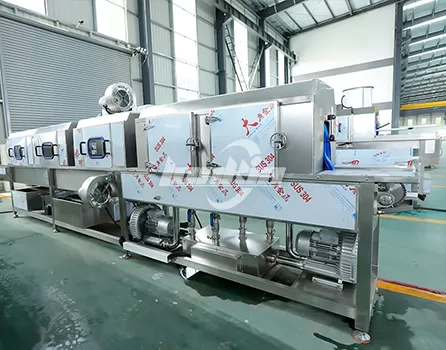
Designed for mass production lines — for instance, in carbonated drink or soy sauce factories. Bottles move through long, enclosed tunnels with multiple washing zones and heat recovery systems.
Advantages: Excellent water and energy efficiency, seamless integration with filling and labeling.
Disadvantages: Complex installation and higher space requirements.
Selecting the right model depends on bottle type, contamination level, and desired production capacity.
4. Common Problems in Glass Bottle Washing Machines
Even with proper design, bottle washers face recurring operational issues that affect efficiency and cleanliness. Below are the most common problems and their practical solutions:
(1) Bottles Not Fully Cleaned
Causes:
Clogged or misaligned spray nozzles
Low washing temperature or short washing time
Incorrect detergent concentration or pH
Solutions:
Inspect and clean nozzles daily
Maintain proper water pressure and temperature (typically 65–85°C)
Regularly check chemical dosing systems
(2) Bottle Breakage During Washing
Causes:
Misaligned grippers or holders
Excessive conveyor speed
Thermal shock from sudden temperature change
Solutions:
Adjust gripper alignment
Use preheating stages to balance temperature difference
Verify smooth transitions between wash zones
(3) Water Spots or Residue Inside Bottles
Causes:
Poor-quality rinse water with high mineral content
Inadequate final rinse or no deionized water stage
Solutions:
Use soft or deionized water for final rinse
Clean rinse tanks regularly to prevent scaling
(4) Excessive Water and Energy Consumption
Causes:
Old or inefficient system design
Lack of water recirculation or heat recovery
Solutions:
Upgrade to modern systems with closed-loop recycling
Optimize spray pressure and pump operation using variable frequency drives (VFDs)
By addressing these typical issues early, manufacturers can extend machine lifespan, reduce downtime, and improve line efficiency.
5. Essential Maintenance Tips for Reliable Operation
Preventive maintenance is the foundation of consistent bottle washing performance. A well-maintained machine not only saves water and chemicals but also reduces bottle damage and operational costs.
(1) Daily Maintenance
Inspect nozzles and filters; remove any clogs or scale.
Check for leaks in pumps, tanks, and piping.
Ensure the detergent solution is at the correct concentration and temperature.
(2) Weekly and Monthly Checks
Measure pump pressure and motor current to detect wear or blockages.
Clean and inspect conveyor belts and bottle grippers.
Calibrate temperature and flow sensors for accurate control.
Drain and flush tanks to prevent sediment buildup.
(3) Periodic Overhaul
Replace worn seals, bearings, and gaskets.
Inspect spray nozzles for erosion and replace as needed.
Descale heating elements and pipes to maintain heat transfer efficiency.
Test electrical components and control panels for faults.
(4) Staff Training and SOP Implementation
Even the most advanced machines fail without proper operation. Train staff on startup, shutdown, safety, and emergency procedures. Implement standard operating procedures (SOPs) to ensure consistent cleaning results and reduce human error.
By combining routine checks with proper training, production lines can achieve stable output and hygiene compliance with minimal downtime.
6. Hygiene, Sanitation, and Food Safety
In food and beverage production, hygiene and food safety are non-negotiable. Any contamination on bottle surfaces can compromise the entire batch. Therefore, the design and sanitation features of a glass bottle washing machine are as important as its cleaning capacity.
(1) Hygienic Design Principles
Modern glass bottle washing systems follow HACCP and GMP standards. Their internal structures are designed with smooth, sloped surfaces to avoid residue accumulation and ensure complete drainage after each cycle.
Key design principles include:
Rounded corners and welds to eliminate dirt traps
Self-draining tanks and piping to prevent stagnant water
Easy-access panels for visual inspection and cleaning
Use of food-grade stainless steel (304/316L) throughout all contact parts
(2) Sanitation Practices
To maintain consistent hygiene:
Regularly perform CIP (Clean-in-Place) cycles with hot water or sanitizing agents.
Use UV or steam sterilization for microbial control.
Implement a sanitation verification program — including visual inspection, ATP testing, and microbiological swabs.
(3) Food-Safety Monitoring
For plants producing beverages or sauces, microbial safety must be documented. Bottles should be periodically tested after washing to verify the absence of yeasts, molds, and bacteria. A well-calibrated washing and sterilization process ensures compliance with international food-safety standards.
7. Energy and Water Efficiency Solutions
One of the biggest operational costs in bottle washing is water and energy consumption. Continuous heating, rinsing, and circulation require large volumes of water and significant power. Fortunately, modern systems now integrate technologies that greatly reduce resource usage without compromising hygiene.
(1) Water Recycling Systems
Efficient machines reuse rinse water from later stages for earlier pre-rinses. Multi-stage filtration and settling tanks remove debris before recirculation.
This approach can cut water use by 30–50%, depending on the product type and contamination level.
(2) Heat Recovery
Hot rinse water exiting the machine still contains valuable thermal energy. By installing heat exchangers, plants can preheat incoming water — improving energy efficiency and shortening heating cycles.
(3) Optimized Spray Nozzles and Pumps
Low-pressure, wide-angle nozzles and variable-frequency drives (VFDs) for pumps ensure optimal spray pressure with minimal waste. Automation allows the system to adjust flow rates based on bottle load or dirt level.
(4) Chemical Optimization
Modern bottle washers can integrate automatic detergent dosing based on conductivity or pH sensors. This minimizes chemical waste while ensuring consistent cleaning quality.
(5) Example Outcome
For a medium-scale beverage factory, adopting water recycling and heat recovery technology can reduce water use by up to 40% and save 20% in energy costs, while maintaining the same cleaning standard.
8. Emerging Innovations in Glass Bottle Washing
The evolution of bottle-washing technology continues to accelerate, driven by sustainability goals and digital transformation.
(1) Automation and Smart Controls
IoT-enabled washing machines now monitor parameters such as temperature, water flow, pressure, and turbidity in real time. Data dashboards help maintenance teams quickly identify performance deviations and predict failures before they occur.
(2) Predictive Maintenance
By tracking sensor data and cleaning cycles, predictive algorithms can detect nozzle clogging, pump wear, or abnormal energy usage early, allowing maintenance before breakdowns happen.
(3) Sustainable Design Innovations
Eco-friendly detergents that minimize chemical load on wastewater systems
Closed-loop water filtration with advanced membranes
Energy-efficient insulation and heat-recovery designs
(4) Integration with Bottling Lines
Today’s glass bottle washing machines are increasingly integrated with filling, capping, and labeling systems, creating seamless, automated bottling lines. This reduces manual handling, contamination risk, and downtime between washing and filling.
(5) Visual Inspection Systems
Automated cameras and sensors can now inspect each washed bottle for residual particles, ensuring 100% quality assurance before filling.
9. Choosing the Right Machine for Your Production Scale
Selecting the correct bottle washing system depends on more than just capacity. The choice should align with your production scale, bottle type, contamination level, and hygiene requirements.
Key Considerations:
Production Capacity (BPH): Estimate your daily output and future growth to size the machine properly.
Bottle Specifications: Different shapes, neck sizes, and materials may require adjustable holders or grippers.
Contamination Level: Reused bottles demand stronger caustic treatment, while new bottles need mainly dust removal.
Water and Energy Efficiency: Look for systems with water-recirculation tanks and energy-saving heaters.
Maintenance and Spare Parts Availability: Choose designs with accessible components and strong after-sales support.
When to Upgrade
If your current washer shows persistent problems — high water usage, frequent breakdowns, or poor cleaning — upgrading to a modern automatic system can immediately enhance reliability and reduce long-term costs.
10. Frequently Asked Questions (FAQ)
1. How often should I replace nozzles or filters in a glass bottle washing machine?
Usually every 3–6 months, depending on water hardness and detergent usage. Regular inspection helps prevent uneven spraying and unclean bottles.
2. Can the same machine handle bottles of different sizes?
Yes. Many modern machines come with adjustable holders or grippers to fit multiple bottle shapes, though extremely varied sizes may require changeover parts.
3. How can I reduce water consumption without compromising cleanliness?
Install multi-stage recycling systems, use filtered rinse water for pre-rinsing, and maintain spray nozzles for consistent flow.
4. What safety features should a bottle washing machine include?
Emergency stop buttons, overload protection, water-level sensors, and safety covers for moving parts are standard.
5. What’s the main difference between glass and plastic bottle washing systems?
Glass requires higher temperature and stronger caustic solutions due to its reusability and microbial concerns, while plastic systems emphasize gentle handling and lower heat levels.