
1. Why This Decision Matters
One of the most important investment decisions food manufacturers face is whether to invest in complete carrot processing lines or to rely on standalone machines. While both options can produce high-quality carrot products, the difference lies in integration, scalability, and long-term economics.
- A carrot processing line offers end-to-end automation, connecting washing, peeling, cutting, blanching, and packaging into one seamless system.
- Standalone machines, by contrast, provide flexibility and lower upfront costs, but require more labor and careful coordination to match throughput.
Making the wrong choice can result in unnecessary downtime, higher labor costs, or limited capacity to meet customer orders. This article provides a comprehensive comparison of the two approaches—defining each system, outlining decision factors, and offering practical guidance so you can select the right fit for your factory.
2. Definitions: What Are Carrot Processing Lines and Standalone Machines?
Before diving into pros and cons, it’s essential to define what these terms mean in an industrial context.
2.1 Carrot Processing Lines
A carrot processing line is a fully integrated, automated system designed to handle carrots from raw intake to final product packaging. Depending on the product format (fresh, frozen, dehydrated, or ready-to-eat), a line typically includes:
- Receiving and Pre-Washing – Removes soil, stones, and debris.
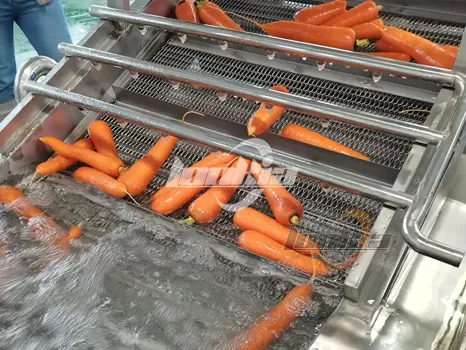
- Washing System – Bubble washers or drum washers to thoroughly clean carrots.
- Peeling – Abrasive peelers or more advanced steam peelers for higher yield.
- Cutting – Julienne slicers, dicers, shredders, or stick cutters for various formats.
- Blanching or Pasteurization – Ensures shelf life and color retention.
- Dewatering or Drying – Prepares carrots for freezing, drying, or packaging.
- Freezing / Dehydration – IQF tunnel freezers or hot-air dryers depending on final product.
- Inspection and Sorting – Optical sorters, metal detectors, or manual trimming.
- Packaging and Labeling – Automated systems for bags, trays, or cartons.
These modules are connected by conveyors and controlled by a central PLC system for synchronization, traceability, and data collection.
Key benefits: high throughput, reduced labor, consistent quality, full HACCP compliance, and scalability for industrial operations.
2.2 Standalone Machines
Standalone machines are individual pieces of equipment used to perform one specific processing step. Examples include:
- Bubble washers or brush washers.
- Abrasive peelers.
- Manual or semi-automatic slicers/dicers.
- Small-scale blanchers or cooking kettles.
- Batch freezers or dryers.
- Tabletop packaging sealers or weigh-fillers.
These machines may operate independently or be connected through manual handling and transport (e.g., plastic crates, trolleys, or conveyors added later).
Key benefits: lower upfront cost, easier installation, flexibility to process multiple products, and suitability for small or seasonal processors.
2.3 The Core Difference
The distinction lies in integration:
- A processing line ensures each module communicates with the next, minimizing product damage, downtime, and manual labor.
- Standalone machines leave integration to the operator, requiring more staff and potentially introducing inefficiencies.
3. Key Decision Factors: How to Evaluate Which Option Fits Your Factory
Choosing between a carrot processing line and standalone machines is not simply about budget—it requires evaluating multiple dimensions of your business model. Below are nine critical factors every processor should weigh before making an investment.
3.1 Capacity and Throughput Needs
- Processing Lines: Designed for high-volume operations (5–20+ tons per hour). Ideal for industrial frozen food suppliers, ready-meal producers, or major fresh-cut distributors.
- Standalone Machines: Best for lower throughput (hundreds of kilograms to a few tons per hour). Suitable for startups, niche processors, or pilot plants.
Tip: Always align equipment capacity with both current demand and projected growth. Under-sizing leads to lost sales; oversizing ties up capital unnecessarily.
3.2 Product Range and Flexibility
- Processing Lines: Highly efficient for standardized products (e.g., carrot sticks for school lunches, diced carrots for frozen mixes). Changeovers may be slower.
- Standalone Machines: Offer greater flexibility. A single dicer or peeler can be repurposed for carrots, potatoes, cucumbers, or beets. Ideal if SKUs change frequently.
Decision Rule: If your business model requires frequent recipe/product changes, standalone machines may be more practical. If you target large, repetitive contracts, a line provides better ROI.
3.3 Budget and Cash Flow
- Processing Lines: Higher CAPEX (capital expenditure). Requires significant upfront investment in machinery, utilities, and infrastructure.
- Standalone Machines: Lower entry cost, allowing gradual expansion as demand grows.
Financial Strategy: Some factories adopt a hybrid approach—start with standalone machines to build cash flow, then transition to a line when production stabilizes.
3.4 Facility Layout and Space Requirements
- Processing Lines: Require dedicated floor space, straight-line layouts, and well-planned material flow. May involve civil works such as drainage, steam supply, and reinforced floors.
- Standalone Machines: More compact and mobile. Easier to fit into small or irregular spaces, such as retrofitted warehouses or shared-use facilities.
Practical Tip: Map your plant layout carefully. In some cases, lack of space may force you to delay or modify line investment.
3.5 Labor and Automation
- Processing Lines: Minimize labor. Most steps are automated, requiring fewer operators for monitoring and quality control.
- Standalone Machines: Labor-intensive. Operators are needed for loading, unloading, transferring, and cleaning.
Impact: In regions with rising labor costs, automation becomes a major driver of long-term savings. In areas with abundant, low-cost labor, standalone machines may remain competitive.
3.6 Food Safety and Traceability
- Processing Lines: Built with CIP (clean-in-place) systems, stainless steel construction, and digital logging for compliance with HACCP, FDA, or EU regulations.
- Standalone Machines: May require more manual cleaning and separate record-keeping. Traceability is harder to automate without integration.
Risk Factor: For companies supplying to international retail chains, strict compliance often makes lines the only viable option.
3.7 Maintenance and Spare Parts
- Processing Lines: Require specialized service technicians, preventive maintenance schedules, and availability of spare parts. Downtime can affect the entire line.
- Standalone Machines: Easier to repair or replace. If one machine fails, others may continue operating independently.
Consideration: Evaluate local service networks—if your supplier has no nearby support, downtime risks may outweigh line advantages.
3.8 Scalability and Modularity
- Processing Lines: Modular lines can expand with additional units (e.g., adding another slicer or blancher). However, scaling still requires integration work and investment.
- Standalone Machines: Naturally scalable—simply add another unit when needed. But without integration, labor costs and inefficiencies grow alongside capacity.
Strategy: Small factories often scale with standalone machines first, then migrate to modular lines once throughput hits a tipping point.
3.9 Environmental and Compliance Costs
- Processing Lines: Optimized for lower water and energy use per kilogram processed. Peel waste can be collected centrally for animal feed or bioenergy.
- Standalone Machines: Often less efficient in water and energy use. Waste management may be more fragmented.
Sustainability Note: With global retailers pushing for carbon footprint reporting, integrated lines are increasingly attractive for ESG compliance.
4. Technical Comparison: Processing Line Modules vs. Standalone Equipment
To fully appreciate the difference between carrot processing lines and standalone machines, it helps to compare key modules side by side. Below is a breakdown of typical processing steps, how they function in an integrated line, and how standalone machines handle the same tasks.
4.1 Washing
- Line Integration: Carrots move directly from receiving conveyors into a tunnel washer or bubble washer. Soil, stones, and debris are separated automatically. Water is filtered and recirculated, minimizing consumption.
- Standalone Option: A single bubble washer or brush washer may be used. Workers load baskets manually, and water management depends on operator skill.
Impact: Lines save labor and water but need more infrastructure. Standalone washers are flexible but require frequent supervision.
4.2 Peeling
- Line Integration: Advanced steam peelers or abrasive peelers automatically adjust peeling intensity. Steam peeling, for instance, reduces waste by ensuring thin, uniform peel removal.
- Standalone Option: Single abrasive peelers or manual scraping machines. Lower investment but higher peel loss and inconsistent finish.
Impact: For factories focused on yield optimization, steam peelers in a line provide measurable economic benefits.
4.3 Cutting
- Line Integration: Carrots move seamlessly to dicers, shredders, or stick cutters. The system ensures consistent sizing, reducing rejects in downstream processes (e.g., freezing).
- Standalone Option: Independent dicers or slicers. Workers load and unload crates manually. Output consistency depends on machine calibration and operator care.
Impact: Integrated cutters ensure continuous throughput. Standalone units provide flexibility but risk uneven sizing.
4.4 Blanching and Pre-Treatment
- Line Integration: Continuous belt blanchers or rotary blanchers apply precise heat treatment to stabilize color and texture. Temperature and time are controlled automatically.
- Standalone Option: Batch blanchers or kettles. Operators must load, time, and unload manually.
Impact: Lines guarantee consistent blanching and faster throughput. Standalone blanching may work for niche products but risks uneven quality.
4.5 Dewatering and Drying
Line Integration: Vibratory or centrifugal dewatering systems remove surface water before freezing or drying.
Standalone Option: Smaller batch centrifuges or trays, often requiring manual transfer.
4.6 Freezing or Dehydration
- Line Integration: IQF tunnel freezers or hot-air dryers integrated directly after dewatering. Automation ensures efficiency and minimal product damage.
- Standalone Option: Batch freezers or cabinet dryers. Effective for small volumes but less efficient for high throughput.
4.7 Inspection and Packaging
- Line Integration: Optical sorters, metal detectors, and checkweighers are built into the line. Packaging is fully automated.
- Standalone Option: Manual inspection tables and semi-automatic sealers. Labor-intensive but lower investment.
4.8 Summary Table
| Step | Processing Line | Standalone Machine |
|---|---|---|
| Washing | Continuous, automated, water recycling | Manual loading, higher water use |
| Peeling | Steam/abrasive, high yield | Abrasive/manual, higher waste |
| Cutting | Continuous, uniform | Manual transfer, variable sizing |
| Blanching | Automated, consistent | Batch, operator-dependent |
| Freezing/Drying | Integrated, efficient | Batch, limited capacity |
| Packaging | Automated, traceable | Manual/semi-auto |
Conclusion: Carrot processing lines outperform in efficiency, yield, and consistency. Standalone machines excel in affordability and flexibility.
5. Economic Analysis: TCO, and Sensitivity
Investing in food processing equipment is not just about purchase price—it’s about total cost of ownership (TCO) and long-term return.
5.1 TCO Factors
- Capital Expenditure (CAPEX) – Machinery, conveyors, automation, utilities, and civil works.
- Operating Expenditure (OPEX) – Energy, water, steam, consumables, and waste management.
- Labor Costs – Operators, supervisors, maintenance staff.
- Maintenance – Spare parts, service contracts, preventive checks.
- Downtime Costs – Production delays, lost contracts, or penalties.
- Depreciation – Accounting impact over 7–10 years.
5.2 Sensitivity Analysis
- Labor Costs Increase 20% → Lines gain significant advantage.
- Raw Material Prices Drop → Both systems benefit, but line ROI less affected by waste.
- Demand Doubles → Standalone machines struggle; lines scale more easily.
Takeaway: If labor is expensive and demand is growing, lines win. If markets are uncertain or seasonal, standalone machines may be safer.
6. Procurement and Implementation Roadmap
6.1 Needs Assessment
- Define throughput goals (tons/day).
- Identify product range (sticks, cubes, shredded, puree).
- Assess compliance requirements (HACCP, FDA, EU).
6.2 RFP (Request for Proposal) Essentials
When issuing an RFP to suppliers, include:
- Target throughput and working hours.
- Raw material specs (carrot size, dirt level).
- Desired final products.
- Utilities available (steam, water, electricity).
- CIP and hygiene requirements.
- Expected service and spare parts availability.
6.3 FAT and SAT
- Factory Acceptance Test (FAT): Verify machine specs, output quality, and control systems at the supplier’s factory.
- Site Acceptance Test (SAT): Confirm installation, throughput, and safety in your own facility.
6.4 Training and Handover
- Operator training: routine operation and cleaning.
- Maintenance training: lubrication, inspections, troubleshooting.
- Documentation: manuals, spare parts lists, wiring diagrams.
6.5 Continuous Optimization
Even after commissioning, monitor KPIs:
- Yield percentage.
- Downtime frequency.
- Energy and water usage.
- Labor hours per ton.
This data will guide decisions on whether to expand capacity or automate further.
7. Practical Recommendations: Which Should You Choose?
7.1 When to Choose Carrot Processing Lines
- Annual throughput above 15,000 tons.
- Consistent contracts with retailers, foodservice, or frozen food suppliers.
- Strict compliance and traceability requirements.
- Rising labor costs or labor shortages.
7.2 When to Choose Standalone Machines
- Startups testing new products.
- Small-scale processors serving local markets.
- Seasonal or contract-based operations.
- Facilities with limited space or utilities.
7.3 Hybrid Path: Best of Both Worlds
Many factories start with standalone machines for flexibility, then transition to modular lines. Example:
- Year 1–2: Buy washer, peeler, dicer as standalone units.
- Year 3–5: Add conveyors, blancher, and freezer for partial automation.
- Year 6+: Upgrade to full line once sales stabilize.
8. Frequently Asked Questions (FAQ)
Q1. Do I need a full line if my capacity is only 2 tons/hour?
No. For small throughput, standalone machines are cost-effective. A full line would be overinvestment.
Q2. Are steam peelers worth the higher cost?
Yes, if yield is critical. Steam peeling reduces waste by 15–20% compared to abrasive peelers, saving raw material.
Q3. How long does it take to install a carrot processing line?
Typically 3–6 months including design, delivery, installation, and commissioning.
Q4. Can I integrate standalone machines later into a line?
Yes, if chosen wisely. Ensure your machines are conveyor-ready and designed for modular integration.
Q5. What about water and energy costs?
Lines are more efficient per kilogram processed. Standalone machines may waste more, which adds up over time.
Q6. What is the lifespan of carrot processing equipment?
With proper maintenance, standalone machines last 7–10 years, while lines can operate 15+ years with upgrades.
9. Conclusion
The decision between carrot processing lines and standalone machines depends on your capacity, market, and long-term vision.
- Choose a line if you operate at industrial scale, seek maximum efficiency, and want consistent, compliant output.
- Choose standalone machines if you are entering the market, focusing on niche products, or managing limited budgets.
- Consider a hybrid path for gradual expansion—standalone machines now, integrated line later.
By carefully weighing throughput, flexibility, costs, and compliance, you can make an informed choice that ensures your carrot processing investment delivers both profitability and reliability.