
In modern vegetable processing, onion peeling is far more than a simple preparatory step. It directly affects production efficiency, raw material yield, labor costs, and downstream processing quality. As demand for frozen vegetables, ready-to-cook ingredients, and large-scale food manufacturing continues to grow, manual onion peeling is increasingly unable to meet industrial requirements in terms of speed, consistency, and hygiene.
Onion peeling equipment plays a critical role in automating this process. However, not all machines deliver the same results across different processing lines. Variations in onion size, skin condition, processing capacity, and product requirements mean that selecting the wrong equipment can lead to high residual skin rates, excessive product damage, or frequent line stoppages.
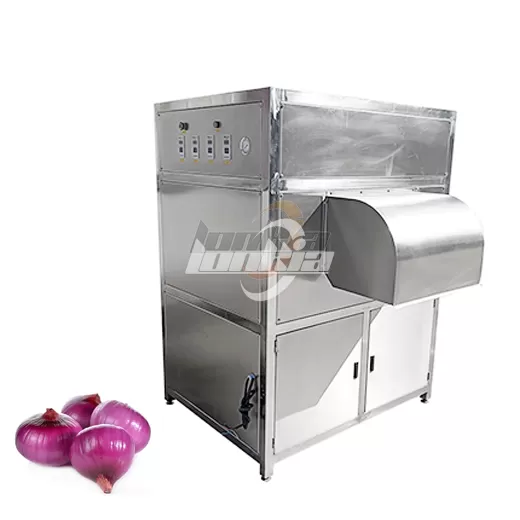
How Onion Peeling Equipment Works
Understanding how onion peeling equipment works is essential for making an informed selection. While machine designs may differ, the underlying working principles are consistent across most industrial systems.
The Basic Working Principle of Onion Peeling Equipment
At its core, onion peeling is a two-step process:
Loosening or breaking the outer skin
Separating the loosened skin from the onion body
The challenge lies in the fact that onion skins adhere tightly, vary in thickness, and respond differently depending on moisture content and storage conditions. Effective onion peeling equipment must apply controlled force that removes only the dry outer layers without damaging the edible portion.
Most industrial systems rely on a combination of trimming, mechanical interaction, and air flow to achieve this balance.
Air-Based (Pneumatic) Onion Peeling Principle
One of the most widely used methods in onion peeling equipment is pneumatic peeling. This approach uses high-velocity air jets to blow away loosened onion skins.
The process typically works as follows:
Onions enter the peeling chamber after root and top cutting
Compressed air is directed through strategically positioned nozzles
The air penetrates between the onion surface and the dry outer skin
The loosened skin is separated and expelled, while the onion remains intact
This method is particularly effective because dry onion skins are lightweight and easily displaced by air, whereas the onion flesh has sufficient mass to remain in place.
Key advantages of air-based peeling include:
Minimal mechanical contact, reducing product damage
High processing speed suitable for continuous production lines
Consistent peeling performance when onion quality is stable
However, air-based systems are sensitive to onion moisture and skin condition. Onions with overly wet or tightly adhered skins may require additional mechanical assistance to achieve acceptable peeling results.
Mechanical-Assisted Peeling Mechanisms
To improve peeling consistency, many onion peeling equipment designs incorporate mechanical-assisted elements. These mechanisms do not perform full peeling on their own but prepare the onion surface for effective air separation.
Common mechanical-assisted actions include:
Light surface scoring or abrasion
Controlled friction to lift the outer skin
Alignment and stabilization to ensure uniform exposure to air flow
By slightly loosening the outer layers, these mechanisms significantly reduce residual skin rates and improve overall peeling efficiency. When properly calibrated, mechanical assistance does not compromise onion integrity and helps standardize results across varying onion sizes.
Key Factors That Influence Peeling Performance
Even with advanced onion peeling equipment, performance is strongly affected by raw material characteristics and operating conditions.
Critical factors include:
Onion variety and skin thickness: Different cultivars respond differently to air and mechanical forces
Moisture level and storage time: Fresher onions with moist skins are harder to peel cleanly
Size uniformity: Large size variations can reduce peeling consistency
Feed stability and alignment: Irregular feeding leads to uneven exposure within the peeling chamber
For this reason, effective equipment selection must consider not only machine specifications but also the realistic characteristics of the onions being processed.
Start with Your Processing Line
Before comparing machine types or technical features, it is essential to evaluate your processing line as a whole. Onion peeling equipment does not operate in isolation; it must function as part of a coordinated system.
Key questions to define early include:
Required hourly throughput and peak production demands
Acceptable residual skin rate based on downstream processing
Product appearance requirements after peeling
Integration with existing trimming, washing, and cutting equipment
Clear answers to these questions provide the foundation for selecting onion peeling equipment that delivers stable, long-term performance rather than short-term gains.
Key Criteria for Choosing Onion Peeling Equipment
Once the working principles of onion peeling equipment are clear, the next step is translating those principles into practical selection criteria. The most reliable way to choose the right machine is to evaluate how well it matches your real production conditions rather than relying on nominal specifications alone.
Processing Capacity and Line Compatibility
Processing capacity is often the first parameter buyers consider, but it should never be viewed in isolation. The nominal throughput of onion peeling equipment must align with the slowest upstream or downstream process to avoid bottlenecks.
Important considerations include:
Actual hourly throughput under continuous operation
Stability at peak load rather than short-term maximum output
Compatibility with upstream trimming and downstream washing or cutting units
Oversized equipment may appear attractive on paper but can increase energy consumption and reduce peeling accuracy if the line cannot feed onions consistently at the required rate.
Peeling Quality and Yield Control
Peeling quality is defined not only by how completely the skin is removed but also by how much usable onion is preserved. Excessive removal of edible layers results in higher raw material loss, directly impacting operating costs.
When evaluating onion peeling equipment, focus on:
Residual skin rate after peeling
Average yield loss per batch
Consistency of peeling across different onion sizes
High-quality systems strike a balance between clean skin removal and minimal flesh damage. This balance is especially important for further processing such as dicing or slicing, where surface defects can affect cutting precision.
Adaptability to Onion Variability
In real-world production, onion size, shape, and skin condition vary from batch to batch. Equipment that performs well only under ideal raw material conditions can create instability across the processing line.
Adaptability is influenced by:
Adjustable air pressure and flow direction
Flexible mechanical assistance settings
Feed alignment mechanisms that accommodate size variation
Onion peeling equipment with adjustable parameters allows operators to fine-tune performance as raw material conditions change, reducing downtime and manual rework.
Integration into a Complete Onion Processing Line
Selecting onion peeling equipment should always be done with the entire processing line in mind. Integration challenges often determine long-term performance more than the peeling mechanism itself.
Physical and Control Integration
From a layout perspective, the machine must fit within available floor space and align with conveyor heights and product flow direction. Control integration is equally important.
Key integration aspects include:
Synchronization with upstream feeding systems
Signal communication with downstream equipment
Emergency stop and fault-handling logic
Poor integration can cause frequent line interruptions even if the peeling equipment itself performs well.
Impact on Downstream Processes
The quality of peeling directly affects washing, inspection, and cutting operations. Inconsistent peeling can overload washing systems with loose skins or lead to misalignment during cutting.
Well-matched onion peeling equipment produces:
Clean onion surfaces entering washing units
Reduced skin contamination downstream
More consistent cutting results and higher final product quality
Matching Onion Peeling Equipment to Different Production Scales
Small to Medium Processing Facilities
For small and medium-scale processors, flexibility and ease of operation often outweigh maximum throughput. Equipment that can handle varying batch sizes and onion types without extensive recalibration is usually the best choice.
Typical priorities include:
Moderate capacity with stable performance
Simple control interfaces
Lower utility and maintenance requirements
Large-Scale Industrial Operations
High-volume processors prioritize throughput, automation, and consistency. In these environments, onion peeling equipment must support continuous operation with minimal intervention.
Key requirements often include:
High-capacity air systems with stable pressure control
Automated adjustment and monitoring features
Seamless integration into fully automated lines
The focus shifts from operator convenience to system-level efficiency and yield optimization.
Common Selection Mistakes and How to Avoid Them
Despite careful evaluation, some recurring mistakes appear across many projects.
Common pitfalls include:
Choosing equipment based solely on maximum capacity
Ignoring raw material variability during trials
Underestimating cleaning and maintenance requirements
To avoid these issues, decision-makers should prioritize realistic production testing, clear performance benchmarks, and long-term operational costs rather than initial specifications alone.