
In industrial food processing, peeling is often perceived as a routine preparatory step. However, from a cost and yield perspective, it is one of the most critical operations in the entire production line. Product loss during peeling directly affects raw material utilization, production efficiency, and overall profitability.
Conventional peeling methods—such as mechanical abrasion, knife peeling, or chemical peeling—are widely used but often result in excessive removal of edible material. In contrast, steam peelers are increasingly adopted in vegetable and root crop processing due to their ability to significantly reduce product loss while maintaining high throughput.
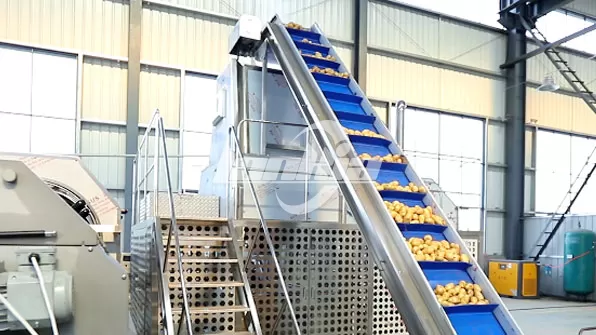
Understanding Product Loss in Conventional Peeling Methods
Mechanical Abrasion Peeling
Mechanical peelers remove skins through friction between the product and abrasive surfaces. While this method is relatively simple and versatile, it has inherent limitations:
Peeling depth is difficult to control precisely
Irregularly shaped products experience uneven abrasion
Edible flesh is often removed along with the skin
As a result, mechanical abrasion peeling typically leads to higher yield loss, especially for products with thin skins or variable geometry.
Knife and Blade-Based Peeling
Knife peeling relies on physical cutting to remove the skin layer. Although it can produce visually clean results, it presents several challenges:
Blade settings must be conservative to avoid unpeeled areas
Variations in size and shape increase trimming loss
Frequent blade wear leads to inconsistent peeling depth
In practice, knife peeling often sacrifices yield to guarantee skin removal consistency.
Chemical Peeling Limitations
Chemical peeling uses alkaline or acidic solutions to loosen skins before washing them off. While effective for certain products, this method can cause:
Uncontrolled skin penetration
Softening of surface tissue
Additional trimming losses during post-treatment
Moreover, chemical peeling introduces wastewater treatment and regulatory challenges that indirectly impact overall efficiency.
How Steam Peelers Work
Controlled Thermal Separation of Skin and Flesh
Steam peelers operate on a fundamentally different principle. Instead of mechanically removing the skin, they use high-pressure saturated steam to thermally separate the peel from the underlying flesh.
The basic process includes:
Short exposure to high-pressure steam
Rapid pressure release
Instantaneous expansion of moisture beneath the skin
This rapid pressure drop causes the skin to detach cleanly from the product surface, while the edible flesh remains largely unaffected.
Precision Through Time and Pressure Control
One of the main reasons steam peelers reduce product loss is the high level of process control they offer. Peeling performance is governed primarily by two parameters:
Steam pressure
Dwell time
By adjusting these variables, processors can target only the skin layer, avoiding deeper penetration into edible tissue. This precision is difficult to achieve with mechanical or chemical methods.
Key Mechanisms Behind Reduced Product Loss
Minimal Removal of Edible Material
Unlike abrasion or cutting, steam peeling does not rely on physical removal of material. The skin is loosened rather than shaved away, resulting in:
Cleaner separation at the natural skin–flesh interface
Significantly lower flesh removal
Higher net yield per unit of raw material
This advantage is especially pronounced for products such as potatoes, carrots, beets, and onions.
Uniform Peeling Across Irregular Shapes
Steam penetrates uniformly across the product surface, regardless of shape irregularities. This ensures consistent peeling even on:
Knobs and indentations
Size variations within a batch
Naturally uneven surfaces
Uniform exposure eliminates the need for over-peeling to compensate for difficult areas, further reducing yield loss.
Reduced Secondary Trimming
Conventional methods often require manual or mechanical trimming after peeling to remove residual skin or damaged areas. Steam peeling typically produces a cleaner surface, which reduces or eliminates the need for secondary trimming.
Lower trimming requirements directly translate into:
Higher final yield
Reduced labor input
Improved line efficiency
Quantifying Yield Improvements in Industrial Settings
In real production environments, yield improvements from steam peelers are measurable and significant. While exact figures vary by product and process, processors commonly report:
5–15% yield improvement compared to mechanical abrasion peeling
More consistent yields across seasonal raw material variations
Lower reject rates in downstream cutting and inspection
Over high-volume operations, these gains can represent substantial cost savings.
Steam Peelers vs Conventional Methods
| Aspect | Conventional Peeling | Steam Peeling |
|---|---|---|
| Peeling control | Mechanical or chemical | Thermal, parameter-driven |
| Yield consistency | Variable | High |
| Flesh removal | Moderate to high | Minimal |
| Secondary trimming | Often required | Limited or unnecessary |
| Adaptability | Limited | High |
This comparison highlights why steam peelers are increasingly preferred in yield-sensitive operations.