
A cabbage processing line is a series of machines designed to clean, trim, cut, wash, and prepare cabbage for further processing or packaging. Compared with manual processing, an automated cabbage processing line can improve production efficiency, product consistency, and hygiene while reducing labor requirements.
For food processors handling large quantities of fresh cabbage, choosing the right cabbage processing equipment is important for maintaining product quality and meeting production demands. But what exactly does a cabbage processing line include, and how does it work?
What Is a Cabbage Processing Line?
A cabbage processing line is an integrated production system that performs multiple processing steps in sequence. Depending on the final product, the line can be configured for shredded cabbage, cut cabbage, fresh-cut vegetables, fermented cabbage, prepared foods, or other cabbage-based products.
A typical commercial cabbage processing line may include:
Cabbage feeding and conveying equipment
Outer leaf and core removal equipment
Cabbage cutting or shredding machines
Vegetable washing machines
Water removal or dewatering equipment
Inspection and sorting stations
Conveyors and transfer systems
Weighing and packaging equipment
The exact configuration depends on the required capacity, cabbage variety, final product, and level of automation.
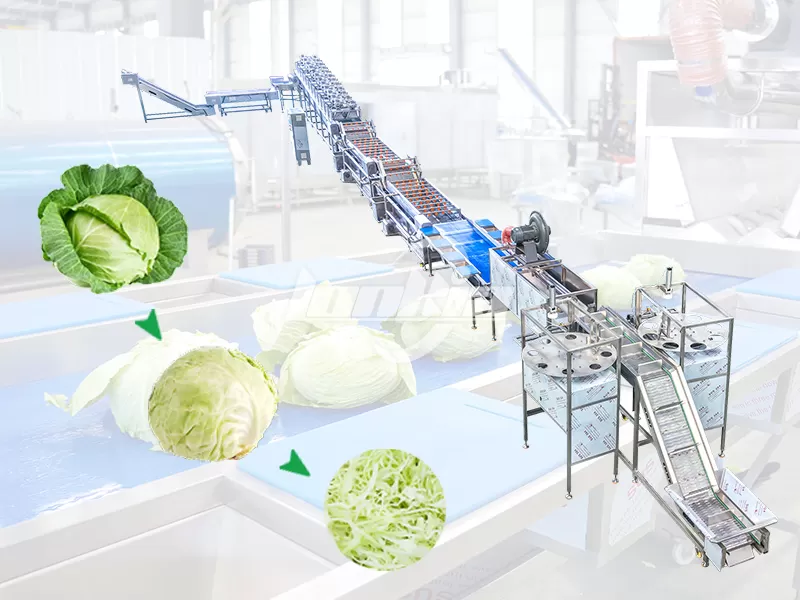
How Does a Cabbage Processing Line Work?
The processing flow normally starts with fresh cabbage being loaded onto a conveyor or feeding system. The cabbage then passes through different processing machines according to the production requirements.
1. Cabbage Feeding and Inspection
Fresh cabbage is first fed into the line and inspected to remove damaged or unsuitable vegetables. Conveyors help maintain a continuous supply of cabbage and reduce manual handling.
2. Trimming and Cutting
Unwanted outer leaves, roots, or cores can be removed before cutting. The cabbage is then cut into halves, pieces, strips, or other required shapes.
For shredded cabbage production, a cabbage shredder or cutting machine can produce more uniform pieces and improve processing speed.
3. Washing
After cutting, the cabbage is washed to remove soil, plant debris, and other surface contaminants. Industrial vegetable washing equipment provides more consistent cleaning than manual washing, especially for high-volume production.
4. Dewatering
After washing, excess water needs to be removed before further processing or packaging. Depending on the product requirements, a dewatering machine, air drying system, or centrifugal dryer can be incorporated into the line.
5. Inspection and Sorting
The processed cabbage can pass through an inspection section where operators or automated equipment check product quality. Damaged pieces, foreign materials, or pieces outside the required specifications can be removed.
6. Packaging
The finished cabbage can then be weighed and packed according to the product requirements. Packaging equipment can be integrated with the processing line to create a more continuous production process.
What Are the Benefits of an Automatic Cabbage Processing Line?
An automatic cabbage processing line provides several advantages for commercial food processors.
Higher production capacity: Automated machines can continuously process large quantities of cabbage, making them suitable for industrial production.
Lower labor requirements: Automation reduces repetitive manual operations such as cutting, washing, conveying, and handling.
Consistent processing: Mechanical cutting and washing equipment can provide more consistent results from batch to batch.
Better hygiene: Food-grade stainless steel equipment and controlled processing procedures can help maintain hygienic production conditions.
Reduced processing time: Multiple machines can be connected into one continuous workflow, reducing unnecessary product handling and transfer time.
Flexible production: A properly designed line can be configured for different cabbage products and production capacities.
What Cabbage Products Can Be Made with a Processing Line?
The configuration of a cabbage processing line depends largely on the final product. Common applications include:
Fresh-cut cabbage
Shredded cabbage
Sliced cabbage
Cabbage for salads and coleslaw
Cabbage for fermented food production
Cabbage for prepared and frozen vegetable products
Pre-processed cabbage for foodservice
For different products, the cutting, washing, drying, and packaging stages can be adjusted accordingly.
How to Choose the Right Cabbage Processing Line?
Before purchasing cabbage processing equipment, buyers should consider several important factors:
Required processing capacity
Type and size of cabbage
Desired cutting size and product shape
Required washing and drying method
Degree of automation
Available factory space
Food hygiene requirements
Packaging requirements
Future production expansion
It is usually better to design the entire processing flow according to the actual product and capacity rather than selecting individual machines separately.
How Much Does a Cabbage Processing Line Cost?
The price of a cabbage processing line depends on its configuration. A small semi-automatic system will generally require a different investment from a fully automatic commercial production line.
Important cost factors include processing capacity, number of machines, automation level, cutting and washing technology, conveyor systems, packaging equipment, stainless steel construction, and customization.
For an accurate quotation, manufacturers normally need information about the required capacity, final cabbage product, processing steps, and degree of automation.
Why Choose LONKIA Machinery?
LONKIA Machinery provides customized food processing machinery and complete processing solutions for vegetable and food manufacturers. A cabbage processing line can be configured according to production capacity, processing requirements, factory layout, and final product specifications.
By integrating conveying, cutting, washing, dewatering, inspection, and other processing equipment, LONKIA Machinery can help customers develop a continuous and efficient cabbage processing solution.
Conclusion
A cabbage processing line combines multiple processing steps into an integrated production system, from feeding and trimming to cutting, washing, dewatering, inspection, and packaging. For businesses processing cabbage on a commercial scale, automation can improve efficiency, consistency, hygiene, and production capacity.
The right cabbage processing line should be designed around the customer's specific product, capacity, and processing requirements. With the appropriate equipment configuration, cabbage processors can build a more efficient and reliable production workflow.