
In industrial garlic processing, peeling is a central transformation step that determines whether raw agricultural material can be converted into a standardized, food-grade ingredient suitable for a wide range of applications. Unlike manual peeling, which relies on individual dexterity and inconsistent force, modern garlic peeling production lines employ a sequence of engineered processes designed to separate cloves from their protective layers through controlled physical mechanisms. These systems combine cleaning, conditioning, mechanical peeling, and post-processing functions into a continuous workflow that supports high-volume operations.

1. Overall Workflow of a Garlic Peeling Production Line
A garlic peeling production line functions as a sequence of interconnected processes. Each stage prepares the garlic for the next by altering its physical condition, removing unwanted material, or exposing the clove to a different mechanical environment. The overall workflow typically includes the following stages:
1. Raw Garlic Receiving
Raw bulbs are introduced into the system. At this point, garlic may still carry soil, outer husks, field debris, or external imperfections. Receiving establishes the starting condition for all subsequent actions.
2. Initial Cleaning
The purpose of this step is to remove loose soil, dust, and external dry layers. This is often done through washing, agitation, or water-based cleaning systems that reduce contaminants on the bulb surface.
3. Root Trimming and External Impurity Removal
Some lines incorporate a trimming stage that removes the bulb base, where roots and denser husk layers accumulate. Trimming helps expose the cloves and reduces the structural integrity of the outer bulb layers.
4. Pre-conditioning Before Peeling
Before mechanical peeling begins, garlic undergoes processes designed to weaken the adhesion between the clove surface and its skin. Conditioning often involves moisture adjustment, temperature exposure, mild agitation, or vibration.
5. Mechanical Peeling
This is the core transformation. Depending on the technology used, garlic is exposed to forces such as air pressure, friction, rolling, or impact. These mechanisms cause the dry skin to separate and detach from the clove surface.
6. Husk Separation and Removal
Detached skin must be separated from the peeled cloves. Techniques such as airflow sorting, gravity separation, or screening guide husk material into different collection paths.
7. Final Cleaning and Surface Finishing
After peeling, cloves may retain residual particles or fragments. Final cleaning removes these traces to produce a clean, uniform output.
8. Inspection and Preparation for Packing
The peeled garlic passes through a final visual or mechanical check to ensure consistency. It then moves toward downstream processing or packaging steps.
Each of these stages contributes to the systematic removal of garlic skin while maintaining the physical structure of the cloves. By arranging these steps in a continuous flow, the production line achieves stable processing conditions independent of manual variation.
2. Key Process Explanations
The following sections describe the scientific and mechanical principles that allow each process stage to function. The focus is on explaining how the garlic is transformed physically at each step and why these transformations occur in an industrial environment.
2.1 Pre-cleaning and Surface Preparation
Before the peeling process begins, garlic must be cleared of soil, dust, and loose outer layers. Pre-cleaning establishes a baseline level of cleanliness and exposes the garlic surface to more predictable conditions. Industrial cleaning systems commonly rely on three mechanisms:
Water-based rinsing: The flow of water across the bulb surface removes fine particles. When directed at specific angles, water jets create shear forces sufficient to lift loose contaminants without damaging the bulb.
Agitation or tumbling: Mechanical agitation causes bulbs to rub against each other, loosening dry layers of husk. This action uses bulb-to-bulb contact rather than abrasive tools.
Bubble or air-enhanced washing: Air bubbles rising through water create localized turbulence. As they collapse, micro-jets of water strike the garlic surface, dislodging dirt from crevices.
These mechanisms prepare the garlic for subsequent steps by reducing external irregularities that may obstruct peeling or interfere with separation processes later in the line.
2.2 Garlic Conditioning Before Peeling
Conditioning modifies the physical relationship between the garlic clove and its surrounding husk. Garlic skins consist of thin, papery layers with low moisture content. Their adhesion to the clove surface is influenced by the moisture balance, temperature, and mechanical tension within the bulb.
Several physical principles govern conditioning:
Moisture interaction: When exposed to controlled humidity or mild hydration, the outer layers absorb a small amount of water. This swelling increases flexibility, making the skin more susceptible to separation under mechanical forces.
Temperature influence: Warm conditions can soften the interface between the skin and the clove surface. Conversely, slight cooling may make the husk more brittle and easier to break under impact.
Vibration and movement: Vibrational energy weakens the structural integrity of the bulb by loosening the husk at micro-contact points. This does not remove the skin directly but prepares it for detachment during peeling.
Conditioning ensures that the garlic entering the peeling chamber behaves in a predictable and consistent manner, enabling mechanical systems to separate the husk efficiently.
2.3 Mechanical Peeling Principles
Mechanical peeling is the central function of the production line. Although different systems use distinct mechanisms, they all aim to generate enough force to detach the garlic skin without damaging the clove. Below are the main technological principles behind the most common peeling methods.
1. Air-flow / Pneumatic Peeling
Pneumatic peeling relies on high-velocity air streams. When garlic enters the peeling chamber:
- Compressed air is directed toward the cloves.
- The difference in mass and surface geometry causes the lightweight skin to accelerate more quickly than the denser clove.
- Shear forces between the air and the husk cause the skin to lift and tear away.
Because garlic skin is thin and has low structural strength, it responds rapidly to directional air pressure. Detached skin particles are then carried away by the airflow.
2. Friction-based Peeling
Friction peeling exploits the differences in surface texture between garlic skin and clove flesh. Within a friction chamber:
- Cloves encounter surfaces that create controlled rubbing motions.
- The roughness of these surfaces interacts with the papery skin, which has lower tear resistance.
- As the clove moves, localized friction pulls the skin apart, causing it to flake off.
The clove, being more resilient and having a firmer interior, withstands these forces while the skin detaches.
3. Impact or Vibration-assisted Peeling
Some systems introduce impact energy:
- Garlic is subjected to rapid collisions within a chamber.
- The sudden forces cause cracks and breaks in the skin layers.
- Vibrations propagate through the clove, weakening adhesion points and making the skin detach.
Impact-based methods rely on the brittleness of the dry husk rather than continuous rubbing or airflow.
4. Roller or Mechanical Extrusion Peeling
In these systems:
- Garlic passes between rollers or surfaces that apply mild compressive force.
- This pressure disrupts the outer husk structure.
- When the bulb or clove rotates or moves through the rollers, the weakened skin loosens and breaks away.
This method uses shape deformation and mechanical leverage to achieve peeling.
2.4 Husk Separation and Cleaning
Once peeling forces have removed the skin, the mixture consists of peeled cloves, fragments of husk, and fine particles. Separation systems use physical differences—such as density, weight, and aerodynamic behavior—to classify material:
Airflow separation: Lightweight husk fragments are carried upward or sideways by controlled air currents, while heavier cloves fall or move down the line.
Screening or sieving: Mesh or perforated surfaces allow small particles to pass through while retaining larger cloves.
Gravity-based separation: Differences in falling velocity or rolling behavior help separate detached skin from intact garlic cloves.
This stage ensures that the downstream product consists primarily of peeled cloves with minimal residual skin.
2.5 Final Rinsing and Surface Treatment
After separation, small residual particles may remain on the clove surface. Final rinsing serves to:
- remove fine skin fragments,
- wash away any surface impurities,
- and produce a visibly clean clove suitable for final inspection.
Water or light spraying systems help smooth the clove surface and improve cleanliness. If drying is included, it is to remove free water from the clove exterior, preventing unwanted moisture from affecting later processing steps.
3. Industrial Equipment Used in Each Stage
A garlic peeling production line relies on four core machines, each responsible for a distinct transformation step. The following sections introduce these machines with clearer internal structure.
3.1 Garlic Washing Machine — Initial Surface Cleaning
• Function in the Processing Line
The garlic washing machine performs the first preparatory step of the production chain. It removes soil, dust, and loose outer layers from raw bulbs before deeper processing begins.
• Working Concept
Inside the washing unit, garlic is exposed to water flow, spray jets, or bubble agitation. These motions create controlled turbulence that dislodges contaminants from the garlic surface while allowing the bulbs to move steadily through the cleaning chamber.
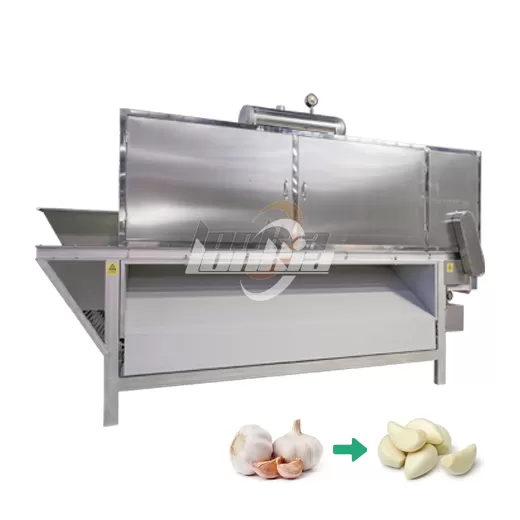
3.2 Garlic Peeling Machine — Controlled Removal of Outer Husk
• Role in the Workflow
The garlic peeling machine handles the core task of husk removal, separating the papery skin from the cloves without altering their natural shape.
• Peeling Mechanisms
Depending on its structural design, the machine may apply airflow, frictional contact, rotational motion, or impact forces. These physical actions loosen the bond between skin and clove, allowing the husk to detach and exit through designated discharge channels.
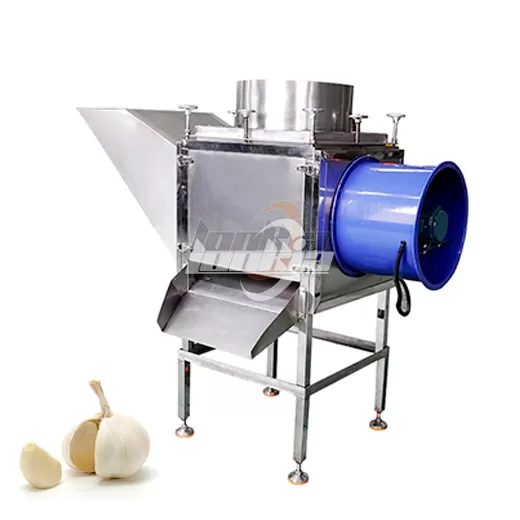
3.3 Garlic Clove Separator — Segmentation into Individual Cloves
• Purpose in the Production Line
After peeling, garlic must be divided into individual cloves to continue through inspection or packaging. The clove separator performs this segmentation step.
• Separation Method
Using vibration, guided pathways, or controlled pressure, the separator gently breaks apart the bulb’s natural structure. The process preserves clove integrity while ensuring a steady flow of uniform, separated pieces.
3.4 Garlic Packaging Machine — Preparation for Final Handling
• Position in the Line
The garlic packaging machine is the final piece of equipment in the production sequence, preparing the processed cloves for storage or distribution.
• Packaging Process
Peeled and segmented cloves enter the unit, where they are portioned and enclosed according to the production format. The machine organizes and seals the cloves into finished packages, completing the workflow from raw bulb to packaged product.
4. Quality Characteristics of Peeled Garlic
The output of a garlic peeling line is evaluated through observable quality attributes that reflect the effectiveness of the mechanical processes. These characteristics describe the physical condition of peeled cloves without addressing how to adjust or improve them.
4.1 Clove Integrity
Integrity refers to the structural completeness of the garlic clove. In industrial processing:
- A clove is considered intact when its natural form is preserved.
- Damage may occur when mechanical forces exceed the clove’s internal resistance.
Integrity is viewed as a key descriptive indicator because it reflects how the clove responded to peeling forces.
4.2 Surface Cleanliness
Cleanliness represents how free the clove surface is from residual husk or particulate matter. Factors that define cleanliness include:
- Absence of dry skin flakes
- Minimal surface debris
- Smooth, uniform clove appearance
This property is observed visually or through automated detection systems that analyze surface patterns.
4.3 Residual Husk Content
Residual husk is typically expressed as the amount or presence of skin remaining after the peeling stage. It is influenced by:
- The degree of adhesion between the husk and clove
- The physical completeness of peeling actions
High residual husk content indicates that additional separation may still occur in downstream steps.
4.4 Visual Uniformity
Uniformity describes the consistency of clove appearance within a batch. This includes color consistency and surface texture. Variations in drying, washing, or peeling conditions can lead to a non-uniform visual result, which is documented as an observable characteristic rather than an operational issue.
5. Common Technical Questions About the Process
The following questions address common curiosity about the mechanical and physical phenomena behind garlic peeling. They explain underlying principles without advising on operation or optimization.
1. Why does garlic skin detach under airflow?
Because garlic skin is lightweight, thin, and has low tensile strength, it accelerates rapidly when exposed to high-velocity air. Differences in mass and aerodynamic shape cause the skin to move differently from the clove, enabling separation.
2. Why is pre-conditioning used before peeling?
Conditioning alters moisture and temperature relationships between the husk and clove. These changes reduce husk stiffness or adhesion, making it more responsive to mechanical forces during peeling.
3. How do mechanical forces cause the husk to break?
Dry garlic skin has brittle structural properties. When subjected to impact, friction, or compression, it fractures along natural weak points, allowing it to detach in layers or flakes.
4. Why are multiple separation methods used after peeling?
Detached husk particles vary in size and density. Using airflow, gravity, and screens allows the system to classify material more accurately based on these physical differences.
5. Why is final rinsing included after peeling?
Even after husk separation, cloves may carry fine skin fragments or particulate matter. Rinsing uses water flow to remove these remaining traces, improving the cleanliness of the output.