
In the frozen and fast-food industries, French fries are a staple product—simple, beloved, and consistently in demand. However, producing high-quality fries at scale is anything but simple. Behind every perfectly cut fry is a precision machine designed to maintain size consistency, minimize waste, and support high throughput in industrial production lines.
As global consumption of French fries continues to grow, food manufacturers are under increasing pressure to improve product quality, reduce operational costs, and ensure safety compliance. One of the most crucial stages in this process is cutting—the moment where raw potatoes are transformed into uniform fry shapes.
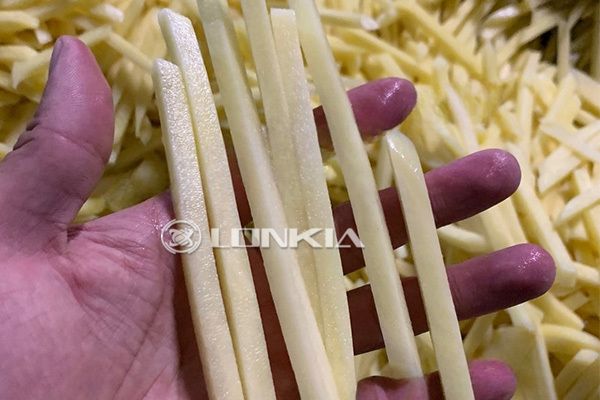
1. What Is an Industrial French Fry Cutting Machine?
An industrial French fry cutting machine is a high-capacity food processing system designed to slice whole potatoes into uniform fry shapes at commercial or industrial volumes. These machines are engineered for speed, precision, and hygiene, and often include features for automatic feeding, washing, and output handling.
Unlike manual or small-scale fry cutters, industrial models can process hundreds or thousands of kilograms of potatoes per hour. They are built with stainless steel, use automated cutting systems with interchangeable blades, and are designed to integrate seamlessly into continuous processing lines.
2. Why Precision Cutting Is Essential for French Fry Quality
Cutting may seem like a simple task, but it significantly affects:
Fry length and shape consistency
Cooking time and texture
Oil absorption during frying
Packaging efficiency
Customer satisfaction
Irregular fries cause operational problems, including inconsistent frying results, increased oil usage, and packaging difficulties. More importantly, customers—whether end consumers or foodservice buyers—expect uniformity. That’s why choosing the right cutting machine is critical for quality control and brand reputation.
3.Common Types of Industrial French Fry Cutting Machines
Industrial French fry cutting machines are essential in modern food processing lines, ensuring consistency, speed, and efficiency. While there are many variations depending on output and design, most equipment falls into the following key categories:
3.1. Manual French Fry Cutters (Low to Medium Output)
These machines are ideal for small-scale operations or as backup units in larger facilities. Operated by a lever or handle, manual cutters feature stainless steel grid blades that produce uniform fry shapes. They are most commonly mounted to a wall or worktop and are available with interchangeable blades for different cuts—straight, wedge, or crinkle.
3.2. Heavy-Duty Manual / Pneumatic Cutters
For businesses processing larger volumes but not yet ready to invest in full automation, pneumatic-assisted manual cutters offer a reliable in-between solution. These machines use air pressure to reduce manual effort while boosting throughput. They’re suitable for central kitchens, institutional foodservice, or fast-casual chains that process large batches of potatoes daily.
3.3. Automatic Electric French Fry Cutters
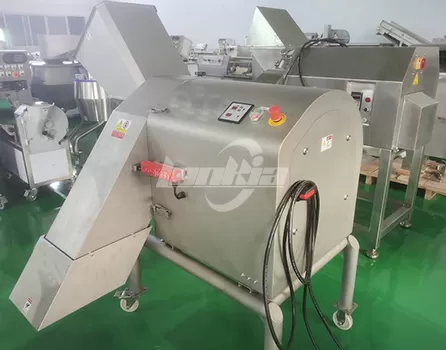
These machines are designed for high-volume production lines. Potatoes are fed continuously into the cutter, where powerful motors drive the slicing mechanism to produce uniform cuts at a rapid pace. Some models include feeding conveyors, hopper loaders, and built-in blade cleaning systems. Automatic cutters minimize labor and ensure consistent output—ideal for frozen French fry manufacturers or large-scale processors.
3.4. Specialty Cutters
These machines are engineered to produce non-traditional fry shapes, such as curly fries, waffle cuts, ribbon fries, or wedges. Specialty cutting systems often use rotating or spiral blades and are suitable for brands looking to diversify product offerings or create signature fry shapes.
4. Key Features to Look for in a French Fry Cutting Machine
When evaluating cutting machines, consider the following features to ensure optimal performance:
4.1. Cutting Uniformity
Uniform fries improve cooking consistency and product presentation. Look for machines with precision-aligned blades and adjustable settings.
4.2. Throughput Capacity
Choose a model that matches your production volume. Machines range from 300 kg/h to over 2000 kg/h depending on model and configuration.
4.3. Blade Flexibility
Interchangeable blades allow for production of different fry shapes and sizes (e.g., shoestring, crinkle-cut, steak fries).
4.4. Ease of Cleaning
Sanitary design is critical in food processing. Opt for machines made with food-grade stainless steel, tool-less disassembly, and wash-down compatibility.
4.5. Automation Integration
A good cutter should integrate smoothly with upstream and downstream processes—washing, blanching, frying, packaging.
4.6. Safety and Compliance
CE, ISO, and other safety certifications ensure the equipment meets international standards.
5. Applications Across the Food Industry
Industrial French fry cutting machines are used in various settings:
Frozen food factories: Mass production for retail and wholesale
Central kitchens: For restaurant chains or fast food franchises
Snack factories: Producing fries for potato-based snacks
Fresh-cut processors: For refrigerated fries sold in supermarkets
Fries can be cut in different thicknesses depending on application needs—thin for crispiness, thick for fast food, or wedges for gourmet dining.
6. Maintenance and Operational Tips
6.1Regular Blade Sharpening and Replacement
Blunt blades reduce cutting precision and damage potato flesh.
6.2Clean Daily
Residue build-up leads to contamination and equipment wear.
6.3Calibrate Often
Ensure blade alignment and belt tension are regularly adjusted for peak performance.
6.4Train Operators
Even the best machines require knowledgeable handling to prevent downtime or injury.
7. How to Choose the Right Machine for Your Operation
When investing in an industrial French fry cutter, here’s what to consider:
Production Capacity
Match the machine’s hourly output to your daily target volumes.
Available Space
Some machines have a larger footprint or require a straight-line layout for conveyors.
Product Variety
If you plan to make different types of fries, ensure the machine allows blade changes or shape adjustments.
Budget vs. ROI
Higher-end machines often come with energy efficiency, reduced waste, and longer lifespan—translating into faster return on investment.
After-Sales Support
Choose manufacturers offering installation, maintenance training, and spare part availability.
8. Lonkia’s Solutions for Industrial French Fry Cutting
Lonkia provides a range of industrial potato cutting machines designed for fries, strips, cubes, and custom cuts. Our machines offer:
Stainless-steel, corrosion-resistant build
Precision-cutting blades
Customizable output sizes
High throughput and automation compatibility
👉 View our French fry cutting machines
👉 Explore full French fry production lines
9. The Bigger Picture: Integrating Fry Cutting into a Full Production Line
Cutting is just one step. For maximum efficiency, it should integrate with:
Washing machines: Remove starch and debris pre-cutting
Blanchers: Soften fries and prevent discoloration
De-watering systems: Remove excess water before frying
Fryers: For precise texture and taste control
Freezers or chillers: Preserve freshness
Packaging lines: Final stage for market-ready product
By optimizing each stage, manufacturers can ensure not only high product quality but also cost-effective, high-yield operations.
FAQs
Q: Can I use the same machine for other potato shapes like wedges or cubes?
A: Yes, many machines offer blade interchangeability to switch between shapes like wedges, cubes, or strips.
Q: What’s the average lifespan of an industrial fry cutter?
A: With proper maintenance, high-quality machines can last 8–10 years or more.
Q: Do these machines handle peeled and unpeeled potatoes?
A: Most industrial cutters are compatible with both, but performance is better with peeled potatoes.
Q: Can I automate the entire line from cutting to frying?
A: Absolutely. Modern facilities integrate all steps, and Lonkia provides turnkey solutions.
Q: How fast can I switch between fry sizes?
A: Most modular machines allow for blade swaps in under 30 minutes.
Conclusion: Precision Cutting for the Perfect Fry
Investing in the right industrial French fry cutting machine is more than just a production decision—it’s a strategic move that affects product quality, brand image, and profitability.
By understanding your needs and evaluating the right features, you can choose a machine that enhances your operation and meets market demand. With the right setup, cutting is no longer a bottleneck—it becomes your competitive edge.
Ready to upgrade your French fry production line? Contact our equipment specialists for a tailored quote.