
1.Introduction
In modern food processing, the retort machine—also known as a food sterilizer or autoclave—plays a critical role in ensuring product safety, consistency, and long shelf life. However, when it comes to purchasing one, choosing the right retort manufacturer can be the difference between a reliable, efficient production line and a costly, unpredictable operation.Many factories focus only on equipment price or delivery time when sourcing retorts, but neglect to assess key aspects such as heat distribution accuracy, automation capability, after-sales service, and compliance with food safety regulations. The result? Increased maintenance costs, unstable product quality, and even regulatory non-compliance.
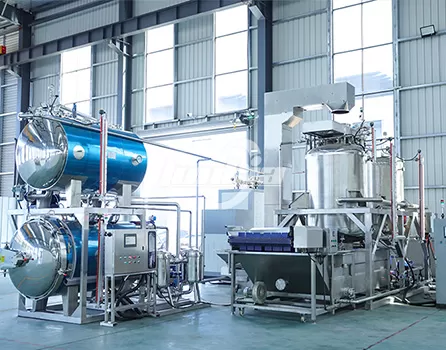
2. Why Choosing the Right Retort Manufacturer Matters
Selecting the right retort manufacturer is not just about buying a piece of equipment—it’s about ensuring food safety, production efficiency, and long-term profitability.
2.1 Food Safety and Product Consistency
Retorts are responsible for sterilizing food under high temperature and pressure, eliminating harmful bacteria such as Clostridium botulinum. If the sterilization process is inconsistent, the risk of contamination rises dramatically.
2.2 Production Stability and Downtime Prevention
Every minute of production downtime costs money. Low-quality or poorly designed retorts often suffer from leaks, uneven heating, or sensor failures. A dependable manufacturer provides reliable components, proven designs, and diagnostic systems that prevent unplanned shutdowns.
2.3 Compliance and Export Requirements
Different markets have strict sterilization standards—such as FDA (U.S.), CE (Europe), and ISO food safety certifications. The right retort manufacturer provides equipment that already meets these compliance standards, complete with documentation, calibration certificates, and validation reports—saving you time and risk during audits or product registration.
2.4 After-Sales Support and Spare Parts Availability
When something goes wrong, response time is critical. Experienced manufacturers offer remote support, on-site troubleshooting, and guaranteed spare parts supply within specific timeframes. This ensures your production never halts for long periods—a detail many buyers only realize after installation.
3. Retort Basics: Types, Configurations & How They Work
Before you evaluate suppliers, it’s important to understand the main types of retorts and how they function. This will help you match your production needs with the right system and ask more informed technical questions during your supplier evaluations.
3.1 Common Types of Retort Machines
Static (Batch) Retort
The most traditional and widely used design.
Products are loaded into baskets or crates, sealed, and heated in fixed chambers.
Ideal for solid products like canned fish, meat, or beans where movement is unnecessary.
Pros: Simple design, low maintenance, suitable for multiple packaging types (tin cans, glass jars, pouches).
Cons: Slower cycle times and less uniform heating for dense products.
Rotary Retort
The baskets rotate slowly during sterilization to ensure even heat distribution inside viscous or solid products.
Best for thick sauces, soups, ready meals, and baby food.
Helps prevent “burn spots” or texture separation, improving product quality.
Slightly higher initial cost but ensures consistent results for complex recipes.
Water Spray Retort
Uses fine water sprays and circulating steam to achieve uniform heating.
Provides faster heat transfer and more gentle handling for delicate packaging like flexible pouches or plastic containers.
Increasingly popular for modern packaging lines aiming for shorter cycles and higher throughput.
Full Water Immersion Retort
The entire load is submerged in circulating hot water during the sterilization phase.
Commonly used for glass bottles and large-sized cans, as water provides even pressure balance and avoids breakage.
Suitable for both overpressure and rotary designs.
Steam Retort
Uses pure steam to sterilize food without direct water contact.
Efficient for traditional metal cans and industrial-scale production.
Requires precise venting and pressure control for uniform temperature distribution.
Each type has its strengths, and the ideal choice depends on your product mix, packaging, and desired automation level.
3.2 Basic Working Principle
A retort sterilizes food by applying heat and pressure to eliminate microorganisms while preserving flavor, color, and texture.
Here’s a simplified overview of how it works:
Loading: Filled containers (cans, pouches, jars) are loaded into baskets and placed inside the retort.
Heating Phase: Steam or hot water is introduced, raising the temperature to around 110–135°C depending on the recipe and product type.
Holding Phase: The product is kept at a constant temperature for a specific duration to achieve the required F₀ value (a sterilization metric that ensures microbial safety).
Cooling Phase: Cold water or air-cooling systems gradually reduce the temperature while maintaining pressure to prevent container deformation.
Unloading: The sterilized products are removed and transferred to the next packaging or labeling stage.
This entire process is automatically controlled through PLC systems that record temperature, pressure, and time data—essential for traceability and regulatory audits.
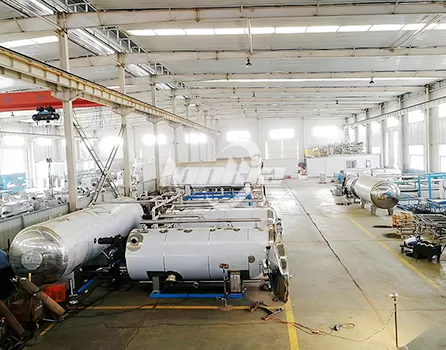
3.3 Key Components and Configurations
Modern industrial retort lines often include the following integrated systems:
Retort Vessel (Pressure Chamber): Built from high-grade stainless steel (typically SUS 304 or 316L) to withstand high pressure and corrosion.
Steam or Hot Water Circulation System: Provides rapid and uniform heat transfer.
Heat Exchanger / Boiler Connection: Supplies and recycles heat efficiently.
Cooling System: Uses pressurized water or air for safe temperature reduction.
Automation & Control Panel: PLC-based interface with recipe storage, data logging, and remote monitoring.
Safety System: Pressure relief valves, emergency stops, interlock sensors, and alarms ensure safe operation.
Conveyor or Basket Loading System: Automates the loading/unloading process for higher throughput.
Advanced lines may also integrate CIP (Clean-in-Place) systems, remote diagnostics, and energy recovery modules—features that reflect the manufacturer’s engineering strength and attention to long-term efficiency.
3.4 Matching Product Type to Retort Design
| Product Type | Recommended Retort | Key Advantage |
|---|---|---|
| Canned fish, meat, beans | Steam or Static Retort | Simple and durable |
| Ready meals, soups, sauces | Rotary or Water Spray Retort | Even heating, better texture |
| Glass bottles, jars | Full Water Immersion Retort | Balanced pressure, no breakage |
| Pouches or plastic trays | Water Spray Retort | Gentle processing, fast cycle |
| Tomato paste, condiments | Steam or Rotary Retort | Consistent sterilization and flavor retention |
Understanding these pairings helps you communicate clearly with suppliers and ensures you don’t overpay for unnecessary features or underspec your system.
4. Key Technical Specifications You Should Review
Not all retort machines are built to the same standards. When comparing suppliers, you should carefully evaluate technical specifications to ensure the equipment meets your production requirements.
4.1 Material and Build Quality
The vessel material directly determines durability and corrosion resistance. Top manufacturers use SUS 304 or 316L stainless steel, known for their resistance to high pressure, heat, and acidic food environments.
Tip: Ask for detailed welding inspection reports and vessel pressure test results—reliable manufacturers readily provide them.
4.2 Temperature and Pressure Control
Modern retort manufacturers integrate PID-controlled sensors to achieve precise heat regulation (±0.3°C). The control system should continuously monitor and log temperature, pressure, and time for each batch.
This ensures consistency, full traceability, and compliance with international sterilization standards.
4.3 Automation and PLC Interface
Automation reduces labor dependency and human error. Advanced PLC + HMI control systems allow operators to store multiple recipes, adjust parameters easily, and track batch data in real time.
If your production line handles multiple products, choose a retort manufacturer that offers recipe programming and automatic cycle switching.
4.4 Heat Distribution Uniformity
Uniform heat distribution ensures all containers—top to bottom—reach the same sterilization level. Request a heat distribution and penetration test report (usually performed during factory acceptance testing). This is an essential proof of performance.
4.5 Safety and Certification
Look for manufacturers whose retort machines comply with:
CE certification (for European market)
ASME pressure vessel standards (for North America)
ISO 9001 / ISO 22000 quality management systems
FDA compliance (for exported canned foods or ready meals)
These standards guarantee safety, performance, and international acceptance.
5. How to Evaluate a Retort Manufacturer’s Reliability
A professional-looking website doesn’t always equal manufacturing expertise. Here’s how to objectively assess whether a retort manufacturer can deliver quality and reliability.
5.1 Manufacturing Experience
Check how long the company has specialized in retort design and production. Experience in both domestic and export projects is a strong indicator of technical maturity.
Manufacturers with more than 10 years of experience typically understand diverse packaging types, product categories, and international regulations.
5.2 In-House Engineering Capability
Some suppliers simply assemble components from others. True manufacturers have in-house R&D teams, pressure vessel certification, and software development capacity for control systems.
Ask:
Do they design and fabricate pressure tanks themselves?
Do they own CNC machining or welding robots?
Can they customize automation logic or data recording software?
5.3 Project References and Case Studies
Reliable suppliers will gladly share photos, videos, and client case studies. Look for real installations in your industry—such as canned fish, baby food, sauces, or ready meals.
If possible, contact one of their existing clients for feedback on performance and after-sales service.
5.4 Factory Visit or Online Audit
Visiting the factory (or conducting a virtual video audit) is one of the best ways to verify authenticity. Observe production flow, welding quality, test benches, and assembly cleanliness.
Professional retort manufacturers maintain standardized workshops, calibration tools, and a strict quality management process.
5.5 Warranty and Service Terms
Never overlook service clauses. The best suppliers provide:
1–2 years warranty for mechanical parts
Lifetime technical support
Remote troubleshooting and software updates
Fast spare parts delivery
These policies reflect confidence in product reliability.
6. Installation, Commissioning, and After-Sales Support
Even the most advanced retort machine needs proper installation and training to perform well.
6.1 Pre-Installation Preparation
A professional retort manufacturerwill provide layout drawings, utility requirements (steam, water, air), and foundation instructions before shipment. This helps your engineering team prepare in advance, reducing onsite delays.
6.2 Onsite Installation and Testing
After arrival, the supplier’s technicians should:
Oversee installation and piping
Conduct pressure and leak tests
Perform heat distribution validation
Train operators and maintenance staff
This ensures your team understands every operational step and safety precaution.
6.3 Long-Term Maintenance
Regular maintenance keeps the system efficient. Reliable manufacturers provide a maintenance checklist, including gasket replacement intervals, valve calibration, and PLC backup routines.
Some even offer online diagnostics and spare part reminders via smart control systems.
7. Conclusion: Making the Right Choice
Choosing the right retort manufacturer is not simply a procurement task—it’s a strategic investment in product quality, food safety, and long-term success.
By understanding retort types, performance metrics, manufacturer credibility, and after-sales services, you can make a confident decision that minimizes risk and maximizes efficiency.
A trustworthy manufacturer should:
Offer complete design and certification documentation
Demonstrate real project references
Provide energy-efficient, customizable solutions
Support you through installation, training, and lifetime service
Ultimately, the best retort manufacturer LONKIA is one who acts as your long-term partner—helping your brand deliver safe, flavorful, and shelf-stable food products to consumers worldwide.