
1. What Is a Date Processing Line?
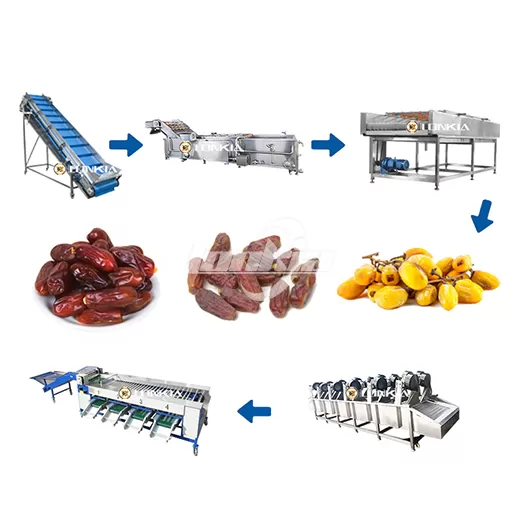
From an industrial perspective, a date processing line is an integrated workflow designed to handle raw dates in continuous or semi-continuous operation, transforming them into standardized, market-ready products.
Unlike small workshops that rely on fragmented steps and manual handling, industrial date processing lines are built around three core objectives:
Process consistency across large volumes
Controlled hygiene and food safety conditions
Stable throughput aligned with downstream operations
2. Raw Date Characteristics and Their Impact on Processing
Dates are often perceived as a uniform raw material, but in reality, they present significant variability that directly affects processing line design and operation.
Key characteristics include:
Size variation within and across batches
Moisture differences, influencing stickiness and flow
Surface contamination, such as sand or dust from harvesting
Texture sensitivity, especially in softer varieties
At large scale, even small variations can compound into operational challenges—such as product buildup, inconsistent cleaning outcomes, or uneven downstream flow.
Industrial date processing lines are therefore designed not just to “process dates,” but to absorb and stabilize raw material variability. Successful plants recognize that raw material behavior, not theoretical capacity, dictates real-world performance.
3. Key Processing Stages Explained from an Operational Perspective
Each stage in a date processing line exists to solve a specific operational problem.
Receiving and cleaning reduce variability and contamination risks
Core processing ensures uniformity across large volumes
Final handling protects product quality before packaging
What matters most is not the sophistication of any single stage, but the balance between stages. In large-scale plants, bottlenecks rarely occur where expected; they often emerge from subtle mismatches in material behavior between consecutive steps.
A well-designed date processing line treats the workflow as a continuous system rather than isolated operations.
4. Hygiene and Food Safety Logic in Date Processing Lines
Although dates are often classified as low-risk products compared to fresh meat or dairy, industrial processors understand that hygiene control remains critical—especially for export markets and long shelf-life products.
Common hygiene risks include:
Residual soil and organic matter
Microbial growth in high-moisture environments
Cross-contamination during manual handling
Industrial date processing lines address these risks primarily through process design, not reactive cleaning. Smooth material flow, controlled contact surfaces, and clear separation between raw and processed zones are central to maintaining food safety standards.
For decision-makers, the key insight is that hygiene performance is determined upstream—by line structure and flow logic—rather than downstream corrective actions.
5. Automation Levels in Modern Date Processing Plants
Automation in date processing should not be viewed solely as a labor-reduction strategy. In large-scale plants, its primary value lies in risk reduction and consistency.
Typical automation levels include:
Manual-intensive systems, common in small operations
Semi-automated lines, combining machines with manual oversight
Highly automated lines, designed for continuous, high-volume operation
Even in advanced plants, human involvement remains important for monitoring, quality checks, and exception handling. Automation works best when it supports operators rather than replaces them.
For plant owners and managers, the strategic question is not “how automated should the line be,” but where automation delivers the most operational stability.
6. Throughput, Line Balance, and Production Stability
In large-scale date processing plants, throughput is often misunderstood. Nominal capacity figures may look attractive on paper, but real-world performance depends on line balance, not individual stage speed.
A date processing line functions as a continuous system. If one stage disrupts material flow—whether due to moisture variation, temporary buildup, or inconsistent discharge—the entire line slows down. Over time, these small disruptions translate into lost production hours and unstable output.
Successful plants focus on stable, repeatable throughput rather than peak capacity. This approach allows operations teams to plan shifts accurately, align labor resources, and maintain predictable delivery schedules.
7. Water, Energy, and Resource Flow Considerations
At industrial scale, resource management becomes a strategic issue rather than a technical detail.
Date processing lines typically require:
Controlled water usage for cleaning and conditioning
Stable energy input for continuous operation
Efficient material movement to avoid unnecessary handling
Poorly coordinated resource flow can increase operating costs and create operational stress, particularly during long production runs. Well-designed processing lines treat water, energy, and material as interconnected flows, ensuring that efficiency improvements in one area do not create bottlenecks elsewhere.
8. Integration with Downstream Processes
A date processing line does not operate in isolation. Its effectiveness depends heavily on how well it integrates with downstream operations, such as:
Packaging lines
Cold storage or holding areas
Further processing for date paste, chopped dates, or fillings
Misalignment between processing and packaging is a common source of inefficiency. When downstream operations cannot absorb output smoothly, processed dates may require temporary storage or rehandling, increasing the risk of quality variation.
Large-scale plants benefit from designing processing lines as part of a broader factory ecosystem, ensuring that output characteristics match downstream requirements.