
For many people outside the processing floor, a date processing line is often imagined as a series of machines connected together. In reality, a commercial date processing line functions more like a coordinated system, where each stage influences what comes next.
Understanding what happens inside this system is important not only for technical teams, but also for managers, supervisors, and business owners who want consistent output and predictable operations. A well-designed date processing line is less about impressive performance claims and more about how smoothly dates move from one step to another, day after day.
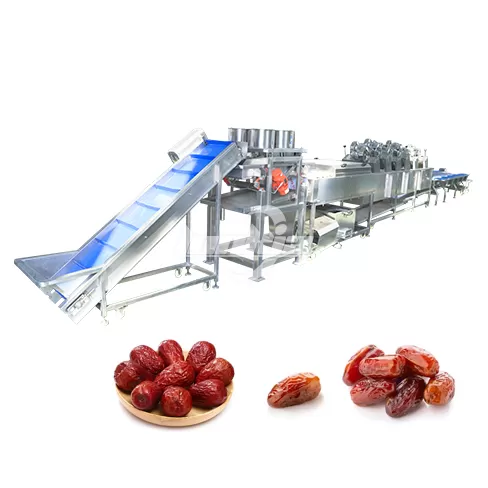
1. Overview of a Typical Commercial Date Processing Workflow
While layouts may differ from plant to plant, most commercial date processing lines follow a similar logical flow. The emphasis is not on speed, but on continuity and control.
A typical workflow includes:
Receiving and preparing raw dates
Cleaning and washing
Sorting and separation
Core processing steps
Final handling before packaging or further processing
Each stage is designed to support the next. When the workflow is balanced, dates move steadily through the line without unnecessary stops or congestion. This interconnected structure is what differentiates a true processing line from a collection of standalone machines.
2. Cleaning and Washing
Cleaning is one of the most visible steps in a date processing line, but its role goes beyond simple removal of surface contaminants. In commercial settings, washing also prepares dates for controlled handling by stabilizing surface conditions.
Effective cleaning supports:
Improved hygiene across the line
Reduced cross-contamination risk
More predictable behavior in later stages
Importantly, cleaning in a date processing line is not treated as a single isolated action. It is integrated into the overall flow, ensuring that dates leave the washing stage in a condition suitable for the processes that follow.
3. Sorting and Separation
Sorting is often misunderstood as an attempt to achieve perfection. In practice, sorting within a date processing line is about managing variation, not eliminating it entirely.
By separating dates based on basic characteristics, the line reduces stress on later processing stages. This helps maintain steady movement and prevents disruptions caused by outliers.
A well-integrated sorting stage supports efficiency indirectly. Instead of slowing down the entire line, it allows downstream processes to operate under more stable and predictable conditions.
4. Core Processing Stages Inside a Date Processing Line
The central stages of a date processing line are where transformation occurs. These steps are typically arranged in a continuous sequence, minimizing unnecessary handling and manual intervention.
Rather than focusing on individual operations, commercial lines emphasize how these stages interact. Smooth transitions, controlled movement, and clear process boundaries help maintain product integrity while keeping the line manageable for operators.
In practice, consistency at this stage matters more than speed. A line that processes dates steadily, without frequent adjustment, creates a foundation for both hygiene and efficiency across the entire operation.
5. Hygiene as a System, Not a Single Step
In a commercial date processing line, hygiene is not achieved by one powerful cleaning stage. It is the result of many small, consistent design decisions made across the entire process.
From how dates move between stages to how residues are prevented from accumulating, hygiene is embedded into the structure of the line. Smooth surfaces, controlled flow, and clear separation between wet and dry areas all contribute to maintaining a clean processing environment.
This system-level approach reduces reliance on constant corrective actions and supports more stable daily operations.
6. Managing Moisture, Residue, and Product Flow
Dates naturally contain sugars and moisture, which can create challenges during processing. If not properly managed, these characteristics can lead to buildup, sticking, or uneven movement through the line.
A well-designed date processing line guides moisture away from critical areas and ensures that residues do not accumulate in places that disrupt flow. When product movement remains smooth, hygiene improves naturally and operators spend less time addressing minor interruptions.
Efficient flow management is therefore closely linked to both cleanliness and operational stability.
7. What Efficiency Really Means in Daily Production
Efficiency in a date processing line is often misunderstood as maximum output. In practice, experienced processors define efficiency as the ability to run smoothly throughout the day with minimal disruption.
True efficiency includes:
Fewer unplanned stops
Stable product flow
Reduced need for manual correction
Predictable daily performance
A line that operates calmly and consistently often delivers better overall results than one that constantly pushes its limits.
8. Common Operational Challenges in Date Processing Lines
Over time, most processing lines encounter similar challenges. These issues rarely stem from a single component but from how processes interact.
Common challenges include:
Uneven product flow
Moisture-related buildup
Increased operator intervention
Gradual decline in cleanliness
Understanding that these challenges are systemic helps operators and managers address root causes rather than symptoms.