
Vegetables come in a wide variety of shapes, textures, and moisture levels, which means no single cutter can handle all tasks effectively. For instance, slicing delicate tomatoes requires a different mechanism compared to dicing firm carrots or shredding cabbage. Therefore, vegetable cutter machines are designed in multiple types, each optimized for a specific cutting function, capacity, and product form.
1. Classification Overview: How Vegetable Cutter Machines Are Categorized
Vegetable cutter machines can be classified in several ways, depending on their cutting mechanism, production capacity, or intended use. Understanding these categories helps users quickly identify which machine best fits their application.
(a) By Production Scale
Small-scale / Commercial machines — Compact, easy to operate, ideal for restaurants, catering, or small food processors.
Industrial machines — Built for high throughput, continuous operation, and integration into automated production lines.
Multifunctional models — Modular systems capable of changing knife sets to perform multiple cutting styles.
(b) By Cutting Method or Output Form
Slicer machines – Produce uniform slices.
Dicer machines – Create cubes or small pieces.
Strip / Julienne cutters – Cut into long thin strips.
Shredder / Grater machines – Reduce vegetables to fine shreds or pulp.
Bowl cutters / Choppers – Chop and mix at high speed.
Spiral cutters – Form decorative shapes or spirals.
Multifunction cutters – Adaptable systems combining several cutting techniques.
The table below summarizes typical use cases:
| Type | Typical Products | Cutting Form | Common Applications |
|---|---|---|---|
| Slicer | Potato, cucumber, cabbage | Round slices | Chips, salads |
| Dicer | Carrot, beetroot, radish | Cubes | Frozen mixes, soups |
| Strip / Julienne | Potato, carrot | Strips or sticks | French fries, stir-fry |
| Shredder | Cabbage, cheese | Shreds | Coleslaw, garnish |
| Bowl cutter | Mixed vegetables | Paste or fine mix | Sauces, fillings |
Each machine type serves a distinct function in the vegetable processing chain, from raw material preparation to packaging.
2. Major Types of Vegetable Cutter Machines and Their Working Principles
Industrial vegetable cutter machines come in several key types, each designed to handle specific vegetable textures, shapes, and processing goals. While their purposes overlap—to cut vegetables efficiently—their mechanical principles and ideal applications differ significantly. Understanding these differences is essential for achieving both productivity and product consistency.
1. Belt-Type Vegetable Cutter Machine
The belt-type vegetable cutter is one of the most common models used in food processing plants.
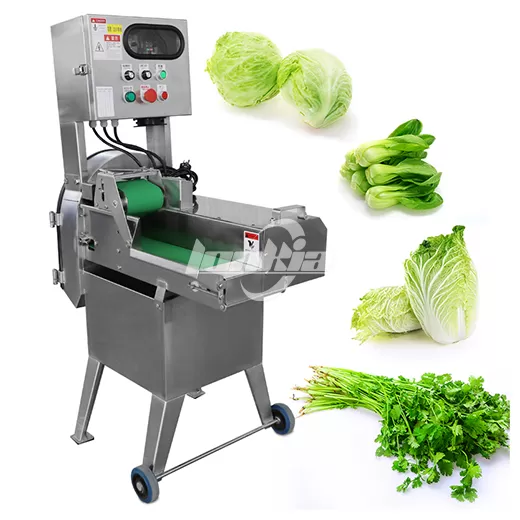
It features a conveyor belt feeding system that moves vegetables continuously toward a high-speed rotary blade.
By adjusting the belt speed and knife rotation, operators can control the cutting length and precision.
This design is especially effective for leafy vegetables—such as lettuce, cabbage, spinach, and leeks—because it minimizes damage to delicate tissues while maintaining uniform thickness.
It’s widely used in salad processing, frozen vegetable packaging, and dehydrated vegetable production.
Key Advantages: Continuous operation, high output, and easy adjustment of cutting size.
Limitations: Not ideal for hard or dense vegetables like potatoes or carrots, which may require stronger cutting pressure.
2. Rotary Disc Cutter for Root Vegetables
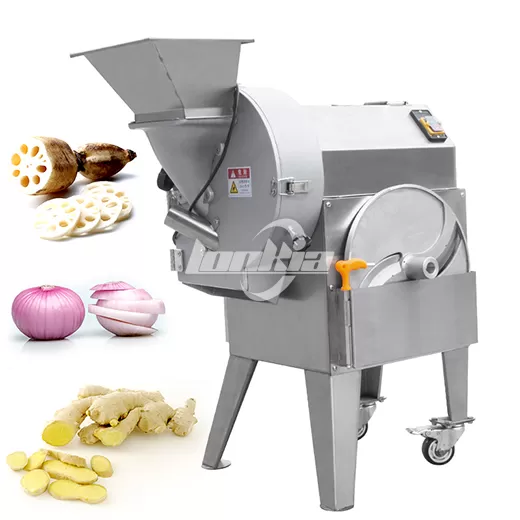
The rotary disc cutter (sometimes called a slicing machine) is built for tougher vegetables—carrots, potatoes, cucumbers, onions, and radishes.
It uses a rotating disc fitted with sharp cutting blades that slice vegetables as they are pressed against the disc surface by centrifugal force.
The thickness of each slice can be modified by changing the blade spacing or adjusting the feeding pressure.
Because of its speed and uniform slicing, it is frequently found in French fry lines, pickled vegetable plants, and snack production facilities.
Key Advantages: High precision, minimal waste, and consistent slice quality.
Limitations: Mostly restricted to one shape (slices); not suitable for irregular or soft vegetables.
3. Multi-Function Dicing and Strip-Cutting Machines
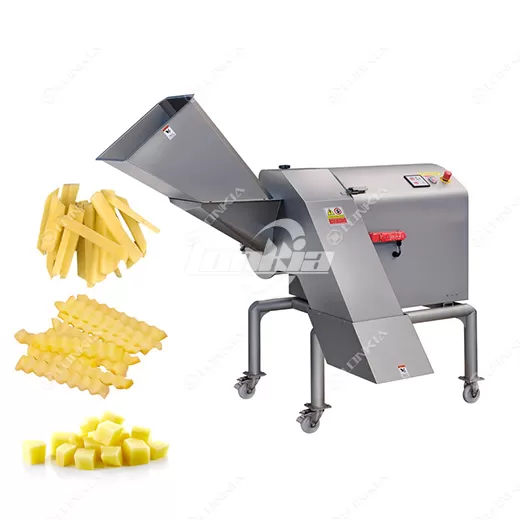
The multi-function vegetable dicer combines slicing, cross-cutting, and dicing systems into one compact design.
It can handle both root vegetables and fruits, transforming them into cubes, strips, or slices of various sizes.
The machine’s three-dimensional cutting system first slices vegetables into sheets, then cross-cuts them horizontally and vertically through rotating blades.
This model is preferred in ready-to-cook meal plants and frozen food factories, where uniform shapes and clean cuts improve packaging and cooking consistency.
Key Advantages: Flexible cutting styles, adjustable blade combinations, and reduced manual trimming.
Limitations: Slightly more complex structure, requiring regular cleaning and blade calibration.
4. Vertical High-Speed Cutter
The vertical high-speed cutter—sometimes known as a bowl cutter—is primarily used in industrial kitchens and central food preparation units.
It consists of a rotating bowl and a high-speed knife set, which rapidly chops vegetables into small pieces or pastes.
Unlike slicers or dicers, it’s designed for fine processing tasks, such as making vegetable fillings, sauces, or purees.
Key Advantages: Efficient for fine cutting, blending, and mixing.
Limitations: Not suitable for large, uniform pieces; energy consumption is relatively higher.
5. Specialized and Automated Cutting Systems
In large-scale automated plants, processors often integrate specialized cutting systems—for example:
Onion ring cutters that produce perfect circular rings,
Cucumber slicers for pickling lines, or
Modular automatic cutters linked to washing and conveying systems.
These machines combine sensor-based feeding control, pneumatic actuators, and stainless-steel construction for hygiene and automation efficiency.
They represent the current trend toward smart food processing lines, where precision and throughput are balanced with food safety.
3. Key Technical Parameters and Selection Criteria
Choosing the right vegetable cutter machine requires understanding several engineering and operational parameters. These directly affect performance, product quality, and maintenance frequency.
3.1 Capacity and Throughput
The machine’s rated capacity (measured in kg/h) should match the overall production line speed. Oversized machines waste energy, while undersized ones cause bottlenecks. Industrial slicers may handle 500–2000 kg/h, while small commercial units operate below 200 kg/h.
3.2 Blade Design and Material
Blades are the heart of every cutter. High-quality stainless steel (SUS 304 or 316) resists corrosion and maintains sharpness longer. The blade geometry—angle, edge thickness, and spacing—affects cut smoothness and texture.
3.3 Drive Power and Speed Control
Variable-speed motors allow adjustment for different vegetables. Hard materials need slower, higher-torque operation, while soft vegetables benefit from faster, cleaner cuts. Frequency converters (VFDs) are often used for fine control.
3.4 Hygiene and Cleaning Design
Food processing equipment must allow thorough cleaning. Look for smooth surfaces, sealed bearings, and removable knife assemblies. Some industrial models support Clean-In-Place (CIP) systems for automated washing and sanitation.
3.5 Safety Systems
Emergency stop buttons, safety interlocks, and overload protection are mandatory features. Blade exposure should be minimized during operation, especially in open-feed models.
3.6 Material Construction and Compliance
All food-contact parts must meet standards such as CE, FDA, or ISO 22000. Stainless steel frames and welded joints prevent contamination and corrosion.
3.7 Space and Integration
The cutter’s footprint, feeding height, and outlet position should align with upstream washers and downstream conveyors. Poor spatial planning leads to spillage and operator strain.
Summary of Key Selection Criteria
| Parameter | Typical Range / Feature | Importance |
|---|---|---|
| Capacity | 200 – 2000 kg/h | Match line speed |
| Blade material | SUS 304 / 316 | Durability, hygiene |
| Motor power | 0.75 – 5 kW | Energy balance |
| Cleaning method | Manual / CIP | Hygiene maintenance |
| Speed control | Fixed / Variable | Adaptability |
| Certification | CE / FDA | Compliance |
Through understanding these technical and operational principles, processors can make informed decisions when selecting and operating vegetable cutter machines. The right choice not only enhances productivity and product uniformity but also ensures food safety and long-term cost efficiency.
4. Frequently Asked Questions
Q1: What type of vegetable cutter machine is best for mixed vegetables?
For operations that handle various vegetable types—leafy, root, and soft materials—a multifunction or modular cutter is ideal. These machines allow you to switch cutting modules quickly, accommodating different shapes like slices, cubes, and strips without needing separate units. However, if production focuses on one product, such as diced carrots or shredded cabbage, a dedicated single-function machine ensures higher efficiency.
Q2: Can one machine handle both fruits and vegetables?
Yes, most vegetable cutters can also process fruits with similar firmness, such as apples, melons, or pineapples. However, fruits with high moisture or soft textures (e.g., tomatoes, mangos) require adjustable speed control and sharper blades to prevent crushing. When processing both fruits and vegetables on the same equipment, cleaning frequency should be increased to avoid cross-contamination and flavor transfer.
Q3: How often should the blades be replaced or sharpened?
Blade life depends on material hardness, operating time, and product type. For continuous industrial production, blades are typically sharpened every 2–4 weeks and replaced after 6–12 months of use. Always follow the manufacturer’s maintenance schedule and use proper grinding tools to maintain cutting precision. Dull blades not only reduce cutting quality but also increase power consumption and strain the motor.
Q4: Is stainless steel always required for food-grade vegetable cutters?
Yes, stainless steel (especially SUS 304 or SUS 316) is the industry standard for food contact parts. These grades resist rust, corrosion, and bacterial growth. Machines made with coated carbon steel may be cheaper initially but deteriorate quickly and risk contamination. High-end models also feature seamless welding and polished interiors to prevent residue buildup.
Q5: How can I ensure consistent cutting size and shape?
Consistency depends on blade sharpness, feed speed, and product preparation. For example, pre-trimming irregular vegetables ensures smooth feeding. Use steady input through conveyors or hoppers and avoid manual pushing during operation. Regular calibration of the feeding chute and blade distance also helps maintain dimensional accuracy, especially for diced or julienne cuts.
Q6: What are common signs of poor machine performance?
Early signs include uneven cutting, excessive vibration, overheating, or loud noise. These symptoms usually indicate blade imbalance, loose fasteners, or motor wear. Ignoring such warnings can lead to machine failure or product contamination. Preventive maintenance and daily inspection routines help avoid costly downtime.
Q7: Are vegetable cutter machines energy-efficient?
Modern models are designed for energy optimization, using variable frequency drives (VFDs) and high-efficiency motors. Compared with older fixed-speed designs, energy savings can reach 15–25% while offering better process control. Automatic load adjustment also reduces idle power consumption when the hopper is empty.
Q8: Can these machines be integrated into a full processing line?
Absolutely. Industrial vegetable cutters are often connected to washing systems, sorting conveyors, and packaging units through belt conveyors or pneumatic transfer. Integration ensures continuous flow, minimizing manual handling and contamination risk. When designing a line, always consider the height and discharge angle of the cutter’s outlet to match the next machine’s inlet position.
5. Maintenance and Hygiene Tips
Proper maintenance not only extends machine life but also ensures consistent product quality and compliance with hygiene regulations.
Daily Cleaning:
After each production shift, remove all detachable components such as blades, covers, and feeding trays. Wash them with warm water and food-grade detergent, then rinse thoroughly. Avoid high-pressure jets directly on electrical parts.Weekly Inspection:
Check blade sharpness, motor bearings, and electrical connections. Inspect seals and gaskets for cracks, which could harbor bacteria or cause leakage. Re-lubricate moving joints with food-safe grease.Monthly Maintenance:
Test safety switches, emergency stops, and overload protection devices. Clean inside the motor housing and ensure ventilation openings are not blocked by dust or vegetable residue.Blade Care:
Always handle blades with cut-resistant gloves. When removing for sharpening, label the orientation and alignment. Use manufacturer-approved grinding angles to preserve geometry. Avoid reassembling blades while still wet.Storage:
If the machine will not be used for a long period, clean it thoroughly, dry all surfaces, and apply a thin food-grade anti-rust oil. Store it in a dry, ventilated environment away from direct sunlight.CIP (Clean-in-Place) Systems:
Some large industrial models include built-in cleaning systems. Use them regularly, but confirm water temperature and chemical concentration per the user manual to avoid corrosion or gasket damage.Operator Training:
Ensure staff are trained in correct feeding techniques, safety procedures, and troubleshooting basics. Proper operation minimizes misuse and mechanical wear.
6. Safety Reminders
Vegetable cutter machines involve fast-moving blades and rotating mechanisms, so strict adherence to safety procedures is essential:
Never open covers or guards while the machine is running.
Always disconnect power before cleaning or blade replacement.
Do not feed oversized or hard materials (e.g., frozen blocks) without verification of cutter capacity.
Keep tools and jewelry away from the feed chute.
Ensure emergency stop buttons are easily accessible at all times.
7. Long-Term Benefits of Proper Maintenance
When maintained correctly, a vegetable cutter machine can operate reliably for 5–10 years or more. The long-term benefits include:
Stable product uniformity and reduced material waste.
Lower repair costs and fewer unplanned shutdowns.
Improved food hygiene and compliance with inspection standards.
Higher operator safety and equipment uptime.
Routine preventive maintenance is far more economical than emergency repair or replacement. For high-output production facilities, scheduling short daily inspections yields substantial long-term savings.