
The global mango processing industry continues to expand rapidly in 2026 due to rising consumer demand for mango purée, juices, concentrates, dried mango, frozen products, and ready-to-eat snacks. As manufacturers scale up, they are under pressure to improve product consistency, reduce waste, meet stricter food-safety standards, and lower operational costs.
Modern Mango Processing Lines are no longer simple washing-and-cutting systems. They now integrate advanced automation, hygienic design, energy-efficient technologies, real-time monitoring, and yield-optimization algorithms. Factories that adopt updated processing lines gain significant advantages:
Higher throughput with fewer operators
Better control of pulp quality, color, and Brix
Reduced fruit losses during peeling and destoning
Improved food-safety compliance
Lower water and energy consumption
This article provides a detailed and practical guide to help manufacturers, investors, and factory managers understand what a modern mango processing line includes, how each module works, and how to choose the most suitable configuration for their product type and production scale.
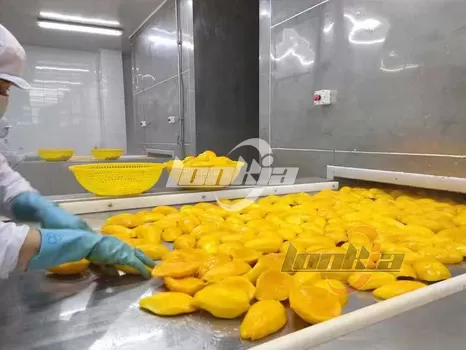
1. Products That Can Be Made Using a Mango Processing Line
A modern mango processing line is versatile, supporting multiple product formats. This makes it suitable not only for mango-specialized factories but also for tropical fruit processors looking for multi-functional equipment.
Mango Pulp / Mango Purée:Used for beverages, baby food, desserts, and yogurt. Requires gentle processing to preserve natural color and flavor.
Mango Concentrate (Single or Double Strength):Reduced-water format for export, offering longer shelf life and reduced shipping weight.
Mango Juice / Nectar:Produced through extraction, blending, pasteurization, and sterile filling.
Mango Dice / Chunks / Slices:Used in frozen products, bakery items, ready-meals, and fruit salads. Quality depends heavily on precision cutting and minimal damage to fruit tissue.
IQF Mango (Individual Quick Freezing):Retains color, flavor, nutrients, and texture. Requires specialized freezing tunnels.
Dried Mango / Mango Leather:Increasingly popular as a healthy snack. Requires controlled dehydration and uniform slicing.
Canned Mango:A classic format for export markets and retail distribution.
Mango Powder (Spray-Dried or Freeze-Dried):Used in instant beverages, bakery mixes, and functional foods.
Understanding the target product is essential, as it determines the required configuration, automation level, and processing technologies.
2. Full Processing Flow: How Mangoes Are Turned into High-Quality Finished Products
Below is a complete overview of a modern mango processing flow.
Note: Not every factory requires all steps—actual configuration depends on final product type.
2.1 Mango Reception and Inspection
Fresh mangoes arrive in crates or bulk bins. Quality checks include:
Variety and maturity grade
Brix level
Visual defects
Bruising and over-ripeness
Foreign materials
A well-designed reception area prevents cross-contamination and keeps workflow organized.
2.2 Mango Washing and Sorting
a. Pre-Washing
Removes surface dirt, leaves, and residues using bubble washers or drum washers.
b. High-Pressure Washing
Ensures removal of stubborn impurities and improves food-safety compliance.
c. Manual or Optical Sorting
Sorting removes:
Overripe mangoes
Damaged or rotten fruits
Undersized fruit
Foreign matter
Optical sorters (AI + cameras) are increasingly common in 2026, improving consistency and reducing labor.
2.3 Destoning and Peeling
This is one of the most critical steps in mango processing. Yield depends heavily on how efficiently the stone (seed) and peel are removed.
Modern destoning machines use rotating blades or compression force to:
Separate seed and flesh cleanly
Minimize loss of usable pulp
Handle different fruit shapes and ripeness levels
Some lines include automatic peeling systems—especially for diced or sliced mango.
2.4 Pulping and Refining
After removing stones and peel, the mango flesh is pulped.
Refiners ensure:
Smooth purée texture
Removal of fibers
Consistent particle size
Factories producing baby food or beverages may require multiple refining stages.
2.5 Thermal Treatment (Heating, Pasteurizing, or Blanching)
Thermal treatment reduces microbial load and extends product shelf life.
Depending on product goals, factories may use:
Tubular pasteurizers
Plate heat exchangers
Scraped-surface heat exchangers
Automation ensures precise temperature control to avoid flavor degradation or browning.
2.6 Evaporation (for Concentrate Production)
Falling-film or forced-circulation evaporators remove water while preserving flavor and color.
This step is essential for producing mango concentrate at different Brix levels.
2.7 Homogenization, Blending, and Formulation
For products like juice, nectar, and beverage bases, the line can include:
Sugar syrup mixing
Vitamin fortification
Stabilizer addition
Color and flavor adjustments
Homogenization for uniform texture
2.8 Aseptic or Hot-Fill Packaging
Finished products are packaged using:
Aseptic bags
Sterile drums
Bottles
Cans
Pouches
Aseptic filling ensures long shelf life without preservatives.
2.9 IQF Freezing or Dehydration
For frozen or dried mango processing:
IQF freezing keeps pieces separate
Dehydrators reduce moisture to ideal levels for snacks
These require precise airflow and temperature control.
3. Key Machines Used in a Modern Mango Processing Line
Below is an overview of essential equipment, explaining how each contributes to product quality, yield optimization, and hygiene control.
3.1 Mango Washing Machines
Types include:
Bubble washer
Drum washer
Brush washer
High-pressure spray washer
Key selection factors:
Fruit delicacy
Required hygiene level
Processing capacity
3.2 Mango Sorting Systems
Options include:
Manual sorting conveyors
AI optical sorters
Weight-based grading machines
Optical sorters significantly reduce labor and improve consistency.
3.3 Mango Destoning Machines
Critical for pulp yield.
High-end models automatically adjust to different mango sizes and ripeness levels.
3.4 Mango Peeling and Cutting Machines
Used for diced, sliced, or IQF mango.
Consider:
Cutting precision
Minimal tissue damage
Output size options
Safety and ease of sanitation
3.5 Pulpers and Refiners
Used to produce purée with consistent texture and color.
Multiple mesh sizes allow greater control of fiber content.
3.6 Pasteurizers and Heat Exchangers
These ensure microbial safety while maintaining flavor.
Key factors include:
Heating uniformity
Energy efficiency
Automation level
3.7 Evaporators (for Concentrate)
Falling-film systems are widely used due to gentle heating and high efficiency.
Automation ensures precise Brix control.
3.8 Aseptic Filling Machines
Used for purée, concentrate, and juice.
Features in 2026 include:
CIP/SIP automatic cleaning
Touch-free filling environment
Real-time temperature and pressure monitoring
3.9 IQF Freezers or Dehydrators
For frozen or dried products.
Selection depends on:
Target final moisture level
Texture requirements
Capacity and airflow design
4. Capacity Planning: Choosing the Right Mango Processing Line Size
Selecting a processing line capacity is one of the most important decisions for any factory. The wrong size can lead to excessive costs or production bottlenecks.
Below are common capacity categories:
4.1 Small-Scale Lines (0.5–2 tons/hour)
Suitable for:
Startups
Regional processing units
Specialty products such as cold-pressed purée
Pilot-scale R&D facilities
Advantages:
Lower investment
Compact footprint
Easier maintenance
4.2 Medium-Scale Lines (2–10 tons/hour)
Ideal for most commercial mango processors.
This capacity provides the best balance between throughput, energy efficiency, and product quality.
Suitable for:
Beverage factories
Purée exporters
Frozen mango producers
4.3 Large-Scale Lines (10–30+ tons/hour)
Used by major exporters and industrial manufacturers.
Features include:
Full automation
High-speed sorting and destoning
Multiple parallel evaporator units
Fully integrated CIP/SIP systems
These lines deliver the lowest per-ton processing cost.
4.4 How to Calculate Required Capacity
Key factors include:
Daily production goal
Mango season length
Variety availability
Labor availability
Final product yield ratio
Export demand
Manufacturers often plan 20–30% extra capacity to accommodate seasonal peaks.
5. Cost Analysis: What Affects the Price of a Mango Processing Line?
Prices vary significantly depending on the configuration.
Understanding the major cost drivers helps manufacturers plan their investments more effectively.
1. Automation Level:Full automation increases investment but reduces long-term labor costs.
2. Capacity (tons/hour):Higher capacity → larger machines → more stainless steel → higher costs.
3. Final Product Type:Concentrate and IQF lines cost more due to evaporators or freezers.
4. Energy Sources
Choices include:
Steam boilers
Electricity
Gas heating
Heat pumps
Energy efficiency can significantly impact lifetime cost.
5. Material of Construction (304 vs 316L):316L is preferred for high-acidity mango purée but increases cost.
6. CIP/SIP Integration:Automated cleaning systems add cost but reduce downtime and chemical use.
7. Export Compliance Requirements
If serving EU/US markets, factories may require:
CE certification
FDA-grade tubing
Traceability systems
6. How to Choose the Best Mango Processing Line in 2026
This section provides a practical decision-making framework based on factory requirements, product goals, and budget considerations.
6.1 Define Your Product Requirements
Start by clarifying:
Exact final product (purée, juice, concentrate, IQF, dried, diced)
Target Brix level
Packaging format
Intended markets (domestic or export)
Every decision downstream depends on this.
6.2 Analyze Your Raw Material Supply
Consider:
Mango varieties available
Harvest season length
Fruit maturity variability
Logistics and storage costs
Stable supply ensures higher overall efficiency.
6.3 Determine the Automation Level
Automation is essential if:
Labor costs are high
QC requirements are strict
Output volume is large
Line consistency is critical
Manual or semi-automatic options may suit small processors.
6.4 Choose Reliable Machinery and Materials
Key considerations include:
Stainless steel grade
Food-contact certifications
Hygiene-oriented structural design
A robust design reduces contamination risks and extends lifespan.
6.5 Evaluate After-Sales Service and Spare Parts Availability
Critical factors:
Installation and commissioning support
Operator training
Availability of consumables and spare parts
Remote troubleshooting
Strong after-sales support minimizes downtime.
6.6 Check Energy Consumption and Water Use
Energy-efficient design lowers long-term operating costs and improves sustainability.
6.7 Consider Future Expansion
Choose a modular system
FAQ About Mango Processing Lines
1. How can I reduce fruit loss during mango processing?
Fruit loss is one of the biggest concerns for processors. Modern mango processing lines minimize loss through:
Gentle conveying and washing systems that avoid bruising
High-efficiency destoners and pulpers that increase extraction yield
Adjustable peelers suitable for different mango varieties
Automatic sorting systems that remove damaged fruit upfront
A well-optimized line can reduce fruit loss by 5–12%, directly improving profit margins.
2. What is the best type of mango processing line for seasonal production?
Since mango production is highly seasonal, many buyers worry about ROI. The best solution is a multi-fruit compatible processing line that can handle:
Mango
Papaya
Guava
Pineapple
Banana puree
This allows the factory to run year-round, improving equipment utilization and reducing financial risk.
3. How do I ensure consistent mango puree quality despite varying fruit ripeness?
Inconsistent ripeness leads to unstable Brix, color, and texture. Leading processing lines solve this through:
Ripeness-grading and soft-handling sorting systems
Precision temperature control during preheating and pulping
Inline Brix monitoring with automatic adjustment
Aseptic processing to prevent flavor degradation
These features help maintain a stable product quality that meets export standards.
that allows:
Additional evaporators
Extra pulping stations
New product capabilities
This ensures scalability as market demand grows.