
So…How Long Do U Deep Fry French Fries?
French fries are one of the most universally loved foods. Crispy on the outside, fluffy on the inside—when done right, they feel deceptively simple. But for anyone who has ever asked “how long do u deep fry french fries?”, the answer isn’t as straightforward as giving a single number of minutes. Frying time depends on many factors: the type of potato, the thickness of the cut, whether they’re fresh or frozen, oil temperature, and even your cooking equipment.
Still, you probably came here looking for numbers—so let’s start with a Quick Answer Box for reference:
Fresh potatoes, standard cut (¼-inch / 6–7 mm) using double-fry method:
First fry (blanch): 300–325°F (150–163°C) for 4–6 minutes until flexible but not browned.
Rest: Drain on a rack for at least 10 minutes (or chill/freeze up to 2 hours for best results).
Second fry (finish): 375–385°F (190–196°C) for 2–4 minutes until golden and crisp.
Frozen fries (par-fried at the factory):
Fry once at 350–375°F (177–190°C) for 2–3½ minutes.
Shoestring fries (thin, ~3 mm): Shorter time per stage (see matrix below).
Steak fries (thick, ~10–12 mm): Longer blanch and final fry.
That’s the basic framework. But to achieve consistent golden, crunchy results, you need to understand why frying times vary—and how to control them. Let’s dig into the science and practical details.
What Actually Determines Frying Time
When cooks say “fry until golden,” that can mean 2 minutes in one kitchen and 5 minutes in another. Why? Because several variables influence how long it really takes for French fries to reach the ideal crispness.
1. Heat Transfer and Moisture
The goal of deep frying is to remove enough water from the potato so the outer layer hardens into a crust while the interior stays tender. Thicker fries contain more water, so it takes longer to steam out. Shoestring fries crisp fast but risk drying out; steak fries need more time for moisture to escape from the center.
2. Oil Temperature Stability
Oil temperature isn’t static. The moment you drop potatoes into hot oil, the temperature drops. In a home kitchen, a small pot might plummet by 30–40°F, extending cook time dramatically. In contrast, commercial fryers are designed with rapid recovery, so they maintain stable temps and consistent fry times.
3. Potato Temperature
Room-temperature potatoes fry faster than fridge-cold ones. Frozen fries behave differently still: because they’re partially pre-cooked and frozen solid, they drop oil temperature sharply but require less total cook time.
4. Load Size
Overloading the fryer is one of the most common home mistakes. Too many fries at once overwhelm the oil, reducing temperature and increasing total cooking time—often resulting in limp, greasy fries.
5. Altitude and Boiling Point
At high altitudes, water boils at a lower temperature, which affects how quickly moisture escapes. This can slightly lengthen fry times, especially during the blanch stage.
6. Defining “Done”
Time is only part of the equation. Fries are ready when:
They are golden brown (not pale or overly dark).
They make an audible crunch when snapped.
Their interior reaches ~205–210°F (96–99°C).
Understanding these variables is crucial, because the same fry recipe may take 2 minutes longer in your kitchen than in someone else’s.
Potato Science That Affects Time and Texture
Not all potatoes are equal when it comes to frying. The variety and storage conditions of your potatoes significantly change frying time and final texture.
1. Potato Varieties
High-starch potatoes (e.g., Russet Burbank, Maris Piper, Agria):
Ideal for fries. Their higher dry matter means less moisture to drive off, which shortens fry times and leads to crispier results.Waxy potatoes (e.g., Red Bliss, Yukon Gold):
Contain more moisture and less starch, so they take longer to fry and often produce softer fries.
2. Sugar Management
When potatoes are stored at cold temperatures (<45°F / 7°C), their starches convert into sugars. These sugars brown quickly in hot oil, causing fries to darken before the interior is fully cooked. That means you may think your fries are “done” earlier than they really are. The fix: store potatoes around 50°F (10°C) if possible, or soak cut fries in water to remove excess sugars.
3. Starch and Surface Gel
Potato starch forms a gel when heated. Too much surface starch causes fries to clump together and can make the oil dirty faster, which influences fry time. Rinsing cut potatoes under cold water—or soaking for 30 minutes—washes off excess starch, leading to more even color and predictable cook times.
4. Pre-treatments
Some professionals use quick vinegar or saltwater blanches before frying. The acid strengthens potato cell walls, reducing breakage, while the salt helps balance moisture loss. These steps can add 1–2 minutes to prep time but shorten the final fry slightly.
5. Age of Potatoes
Old potatoes: Drier, fry faster, brown more quickly.
New potatoes: Higher moisture, require longer frying times and may stay pale.
By understanding potato science, you’ll better predict why the same cut size might fry in 3 minutes one day and 5 minutes another.
Prep Decisions That Change the Clock
Your preparation steps before frying directly influence how long French fries take to reach crispy perfection. Here’s how:
1. Cut Size and Geometry
This is the single biggest factor in determining frying time:
Shoestring (3–4 mm): Very short cook time, easy to over-crisp.
Standard/Classic (6–7 mm): Balanced; the most common fast-food style.
Crinkle cut: Slightly thicker effective size; adds 30–60 seconds.
Steak fries (10–12 mm): Need longer blanching and finishing.
Thicker fries mean longer blanch and finish times.
2. Rinse and Soak
Rinsing cut fries under running water removes loose starch that would cause uneven browning. Soaking for 30–60 minutes does even more: it leaches out extra starch and surface sugars, preventing over-browning and making fry times more predictable.
3. Par-boil vs. Oil Blanch
Some chefs par-boil potatoes in water before frying. This partially cooks the interior, allowing shorter oil fry times. However, most prefer the oil blanch method—the first stage of double frying at a lower temperature—because it also starts developing the crust. Both approaches shorten the final fry.
4. Drying Matters
Wet potatoes cool the oil rapidly, extending fry times and causing greasy results. Pat fries dry with towels or air-dry before frying. Even a thin layer of surface moisture can add a minute or more to total cooking time.
5. Chill or Freeze Between Fries
Resting fries after the blanch stage isn’t just for convenience. Cooling lets starches retrograde (reform into a stronger network), which creates a firmer crust during the final fry. This step can reduce finish-fry time by 30–60 seconds while improving texture.
6. Seasoning Timing
Salt draws out moisture. If you salt fries too early, they may steam instead of crisp, subtly extending fry times. For best results, season immediately after the final fry, while fries are still hot and the oil on the surface helps salt stick.
7. Sweet Potato Fries (Special Case)
Sweet potatoes contain more sugars than white potatoes. They brown faster, which can trick you into pulling them early. To compensate, lower oil temperature slightly (360–370°F) and extend time by 30–60 seconds for even doneness.
Oil Choices and Frying Equipment
Even if you have perfect potatoes and prep, your oil and equipment can make or break frying time and quality. Here’s why:
1. Choosing the Right Oil
Different oils have different smoke points, stability, and flavors. These factors influence how long you can fry and whether oil stays consistent between batches.
Peanut oil (smoke point ~450°F / 232°C): Classic choice, stable, slightly nutty flavor.
Canola oil (~400°F / 204°C): Neutral, widely available, budget-friendly.
Sunflower oil (~440°F / 227°C): Clean flavor, popular in Europe.
Blended frying oils: Many restaurants use proprietary blends to balance cost and stability.
Why it matters for time: oils that break down faster (low smoke point) produce burnt flavors and slower frying because degraded oil doesn’t transfer heat as efficiently.
2. Oil Quality Management
Filter regularly to remove crumbs and carbonized starch that darken oil and slow frying.
Top up oil frequently—low oil volume = slower recovery = longer fry times.
Discard at the right time: if fries come out greasy despite correct time/temp, oil may be spent.
3. Fryer Size and Design
Home deep fryer or pot: Small oil volume → large temp swings → inconsistent times.
Countertop electric fryer: More stable but limited batch size.
Commercial gas or electric fryers: Large oil capacity and rapid recovery keep times consistent.
Pressure fryers: Rare for fries, but can shorten time by cooking at higher boiling point.
The rule: the better the fryer maintains temp stability, the more reliable your “X minutes at Y°F” frying time will be.
Time Matrices: Frying Times by Cut, Method, and Potato
Now let’s put everything into practical numbers. Here’s a reference matrix for common fry cuts and prep methods.
Table 1: Fresh-Cut Fries (Double Fry)
| Cut Type | First Fry (300–325°F) | Rest | Second Fry (375–385°F) |
|---|---|---|---|
| Shoestring (3–4 mm) | 2–3 min | 10–20 min | 1–2 min |
| Standard (6–7 mm) | 4–6 min | 10–30 min (or chill) | 2–4 min |
| Crinkle (7–8 mm) | 5–6 min | 15–30 min | 3–4 min |
| Steak Fries (10–12 mm) | 6–8 min | 20–60 min (chill ideal) | 4–6 min |
Table 2: Frozen Fries (Single Fry)
| Cut Type | Fry Temp | Time |
|---|---|---|
| Shoestring | 350–360°F | 2–2.5 min |
| Standard | 350–375°F | 2.5–3.5 min |
| Crinkle | 360–370°F | 3–4 min |
| Steak Fries | 370°F | 4–5 min |
Notes:
Always check visual and textural cues, not just the clock.
Times assume proper oil volume and not overcrowding.
Frozen French Fries Production Line: How It Impacts Frying Time
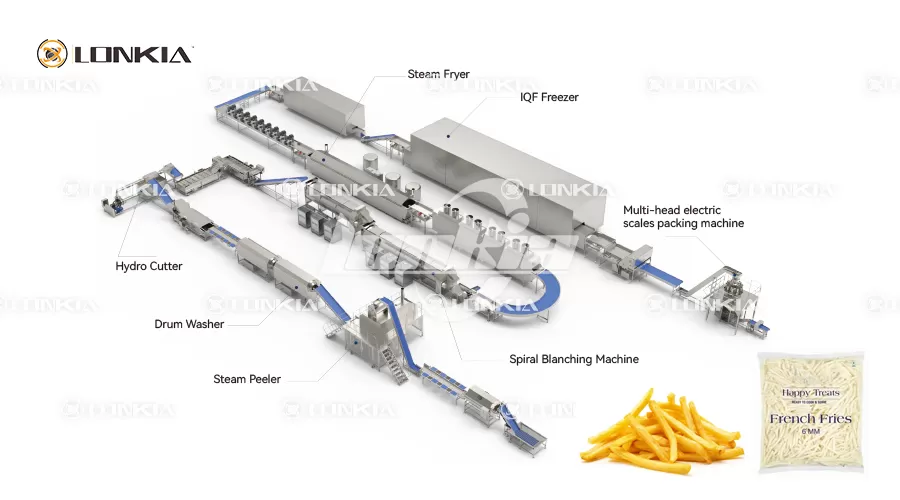
When discussing how long to deep fry French fries, it’s important to understand how frozen fries are made on an industrial scale. A frozen French fries production line prepares potatoes in a way that directly affects frying time for end users.
Key Steps in the Frozen French Fries Production Line
Sorting & Washing: Fresh potatoes are cleaned and sorted for uniformity.
Peeling & Cutting: Industrial cutting machines slice potatoes into standardized sizes (shoestring, crinkle, steak fries, etc.).
Blanching: Fries are briefly boiled or steamed to remove excess sugars and stabilize texture. This ensures even frying later.
Par-Frying: Fries are partially fried in hot oil (usually 1–2 minutes) to set the exterior crust.
Freezing: The par-fried fries are quick-frozen at -18°C or lower to lock in freshness and allow long storage.
Packaging: Frozen fries are sealed for transport to foodservice providers or retailers.
Why This Matters for Fry Time
Because frozen fries are already blanched and par-fried, the consumer or restaurant only needs to perform the final fry. That’s why frozen fries take just 2–4 minutes in hot oil, compared to 6–10 minutes total for fresh-cut potatoes.
Equipment Behind the Line
Modern frozen French fries production lines include:
Washing & peeling machines
Potato cutting machines
Blanching units
Industrial fryers with oil filtration
Spiral or tunnel freezers
By standardizing size, oil absorption, and moisture levels, these lines make frying times predictable, ensuring crispy results even for large-scale fast-food chains.
For manufacturers, investing in a complete French fries production line ensures product consistency and reduces frying variability for end users.
Step-by-Step Frying Method (Fresh Potatoes)
Here’s a professional workflow for consistent, golden fries:
Select potatoes: High-starch, uniform size.
Cut: Desired shape—keep size consistent.
Rinse & soak: Wash off excess starch. Optional 30–60 min soak.
Dry thoroughly: Prevents splattering and soggy fries.
First fry (blanch):
Oil temp: 300–325°F (150–163°C).
Fry 4–6 min (standard cut).
Fries should be soft, pale, and flexible.
Rest: Drain and cool 10+ min (chill or freeze for best results).
Second fry (finish):
Oil temp: 375–385°F (190–196°C).
Fry 2–4 min until golden brown and crisp.
Drain & season: Salt immediately while hot.
This two-stage process balances interior doneness with exterior crunch.
Advanced Tips for Consistent Golden Fries
Professional kitchens rely on these additional methods:
Use a thermometer or fryer display: Don’t guess oil temp.
Small batches: Keep oil temp stable; never crowd the basket.
Preheat oil fully before each batch: Partial heat = longer fry times.
Par-freeze after blanching: Creates micro-cracks in potato cells that boost crunch.
Use timers—but verify visually: Clocks help, but color and texture tell the truth.
Rotate oil regularly: Fresh oil restores normal times and color.
Flavor after frying: Toss with herbs, cheese, or spices while hot, after frying is done.
Troubleshooting: When Fry Times Go Wrong
Sometimes fries don’t turn out even if you followed the “minutes.” Here’s why:
Too dark too fast: Oil too hot, or sugar content in potatoes too high.
Too pale, too long: Oil too cool, or high-moisture potatoes.
Greasy fries: Overloaded fryer, oil not hot enough, or oil is old.
Crunchy outside, raw inside: Cut too thick for time/temp used, or insufficient blanch stage.
Uneven color: Poor starch removal or oil not filtered.
Fix: Adjust prep or fryer management rather than just extending fry time.
Time Is a Guide, Not a Rule
So, how long do u deep fry French fries?
Fresh-cut, double fry: 4–6 minutes + 2–4 minutes.
Frozen: 2–3½ minutes.
But more important than numbers are the conditions: potato type, cut size, oil quality, and fryer stability. By understanding these factors and adjusting accordingly, you’ll consistently produce fries that are golden, crunchy, and irresistible.
FAQs
Q1: Can I fry fries only once?
Yes, but they’ll be less crisp. A single fry at 350°F for 6–8 min works for thin cuts, but the double-fry method is superior.
Q2: Do frozen fries need blanching?
No. They’re pre-blanched and par-fried at the factory. Just fry once.
Q3: What’s the best oil for frying fries?
Peanut, canola, or sunflower oil—stable, high smoke point, neutral or clean flavor.
Q4: Why do my fries take longer than recipes say?
Likely due to oil temp drop, overloading, or potato moisture content.
Q5: Can I air-fry instead of deep-frying?
Yes, but cooking time increases (15–25 minutes at 400°F). Results differ—less oil, less crispness.