
In operations where large quantities of trays, plates, containers, or racks must be cleaned repeatedly and consistently, manual washing and batch-style dishwashers quickly become bottlenecks. Variability in cleaning quality, high labor dependence, and limited throughput make these methods unsuitable for modern high-volume food and catering environments.
Conveyor dishwashers address these challenges by introducing continuous, automated cleaning. Instead of processing items in batches, they move wares through defined washing stages on a conveyor, delivering predictable performance and stable hygiene standards. As a result, conveyor dishwashers have become a core component in many industrial and institutional sanitation systems.
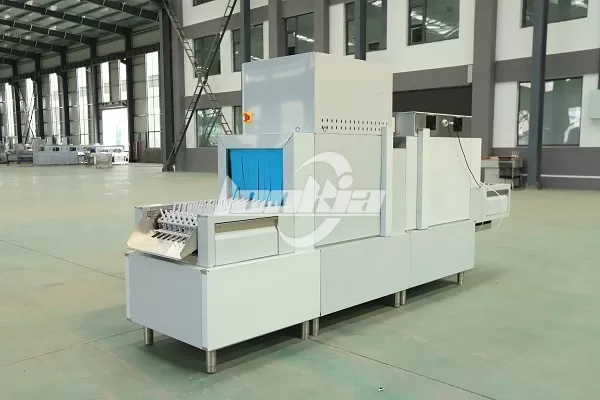
What Is a Conveyor Dishwasher?
A conveyor dishwasher is an industrial washing system designed for continuous cleaning of dishes, trays, food containers, and similar wares. Items are loaded onto a conveyor belt or chain system and transported through multiple washing zones in a single, uninterrupted process.
Unlike undercounter, hood-type, or batch dishwashers—which rely on discrete wash cycles—a conveyor dishwasher operates continuously. This design allows it to handle significantly higher volumes with consistent cleaning results.
Key characteristics of a conveyor dishwasher include:
Continuous material flow rather than cyclic operation
Multiple dedicated cleaning stages
Fixed exposure time controlled by conveyor speed
Designed integration with upstream and downstream handling systems
Typical items processed by conveyor dishwashers include serving trays, GN pans, bakery racks, plastic crates, and food-contact containers used in production and catering environments.
How a Conveyor Dishwasher Works
Although configurations vary by application, most conveyor dishwashers follow the same fundamental operating principle: controlled exposure to water, chemistry, temperature, and mechanical action over a fixed residence time.
1. Loading and Conveying
Items are placed manually or automatically onto the infeed section. The conveyor system ensures stable positioning and spacing as items move through the machine. Conveyor speed is adjustable to match soil level and required cleaning time.
2. Pre-Wash Section
In many systems, a pre-wash zone removes loose food residues using recycled water. This stage reduces contamination load in subsequent wash zones and improves overall efficiency.
3. Main Wash Section
The main wash zone applies heated water mixed with detergent through high-pressure spray nozzles. Mechanical impact, combined with chemical action and temperature, breaks down fats, proteins, and starch residues.
4. Rinse and Sanitizing Section
After washing, items pass through a rinse stage using clean water. In food and institutional applications, this stage often includes thermal or chemical sanitization to meet hygiene regulations.
5. Optional Drying Section
Some conveyor dishwashers include air knives or heated blowers to remove surface moisture, supporting automated handling and stacking downstream.
Each section is physically separated, allowing precise control over water quality, temperature, and pressure throughout the process.
Key Design Characteristics of Conveyor Dishwashers
Conveyor dishwashers are engineered for reliability, hygiene, and high throughput. Several design features distinguish them from smaller-scale washing equipment:
Modular zone layout, enabling customization based on cleaning requirements
High-capacity filtration systems to protect pumps and nozzles
Hygienic construction, with sloped surfaces and accessible interiors
Integrated controls, allowing operators to adjust speed, temperature, and water usage
These characteristics make conveyor dishwashers suitable for continuous-duty environments where downtime and variability cannot be tolerated.
Where Are Conveyor Dishwashers Commonly Used?
Conveyor dishwashers are primarily used in environments where cleaning demand is continuous, volumes are high, and hygiene consistency is critical. Their design aligns closely with industrial and institutional workflows.
Central Kitchens and Catering Facilities
In central kitchens serving schools, hospitals, corporate campuses, or airline catering, thousands of trays and dishes must be cleaned daily within limited time windows. Conveyor dishwashers support peak demand periods by maintaining constant throughput while reducing reliance on manual labor.
Food Processing Plants
In food manufacturing facilities, conveyor dishwashers are widely used for cleaning:
Processing trays and carriers
GN pans and food-contact containers
Bakery racks and frames
Here, the dishwasher functions as part of the production line rather than a standalone appliance, helping maintain hygienic transfer between processing steps.
Institutional and Healthcare Facilities
Hospitals and care facilities require validated sanitation processes. Conveyor dishwashers provide repeatable cleaning and sanitizing cycles that support compliance with hygiene and safety standards.
Industrial Container and Tray Washing
Beyond foodservice, conveyor dishwashers are used to clean reusable containers and crates in logistics and packaging operations, especially where standardized items circulate continuously.
Benefits of Using a Conveyor Dishwasher
The adoption of conveyor dishwashers is driven by several operational advantages:
High and predictable throughput due to continuous operation
Consistent cleaning quality independent of operator variability
Reduced labor intensity, enabling staff redeployment
Improved hygiene control, supporting regulatory compliance
Scalability, allowing capacity increases through speed adjustment or modular expansion
For operations with stable, repeatable washing requirements, these benefits often outweigh higher initial investment.
Limitations and Practical Considerations
Despite their advantages, conveyor dishwashers are not universally suitable.
Space and Layout Requirements
Conveyor dishwashers typically require more floor space than batch systems. Adequate room is needed for infeed, outfeed, and service access.
Dependency on Standardization
They perform best when washing items of consistent size and shape. Mixed loads or irregular items can reduce efficiency or require frequent adjustments.
Utility Infrastructure
Reliable access to water, electricity, and often hot water or steam is essential. Facilities with limited utilities may face integration challenges.
Understanding these limitations helps avoid over-specification or misapplication.
How to Choose the Right Conveyor Dishwasher for Your Application
Selecting the right conveyor dishwasher requires a system-level approach rather than focusing on individual components.
Key evaluation criteria include:
Required throughput (items per hour)
Type, size, and material of items to be washed
Soil characteristics (grease, protein, starch, dry residues)
Available utilities and energy constraints
Integration with upstream loading and downstream handling systems
A well-matched system delivers stable performance over years of operation, while a poorly matched one can become a persistent bottleneck.