
In the fruit and vegetable processing industry, large-scale cherry tomato washing is not only a fundamental issue but also directly impacts product quality, production efficiency, and overall costs. For processing plants, traditional manual washing can no longer meet the demands of continuous production, making it crucial to find a washing method that is efficient, consistent, and minimizes waste.
Why Is Large-Scale Cherry Tomato Washing More Challenging?
Cherry tomatoes are a type of produce with thin skins that are easily damaged. When processed in large batches, they face the following main challenges:
- Uneven cleaning, affecting appearance and quality
- Low efficiency and high costs associated with manual labor
- Susceptibility to bruising and damage during handling
- Difficulty in thoroughly removing surface dirt and impurities
Therefore, companies need a solution that ensures cleanliness without damaging the fruit.
How Bubble Washers Solve Cleaning Challenges?
To meet the industrial demand for how to wash cherry tomatoes, bubble washers have become the mainstream equipment. Their core lies in the synergistic effect of "bubbles + water flow."
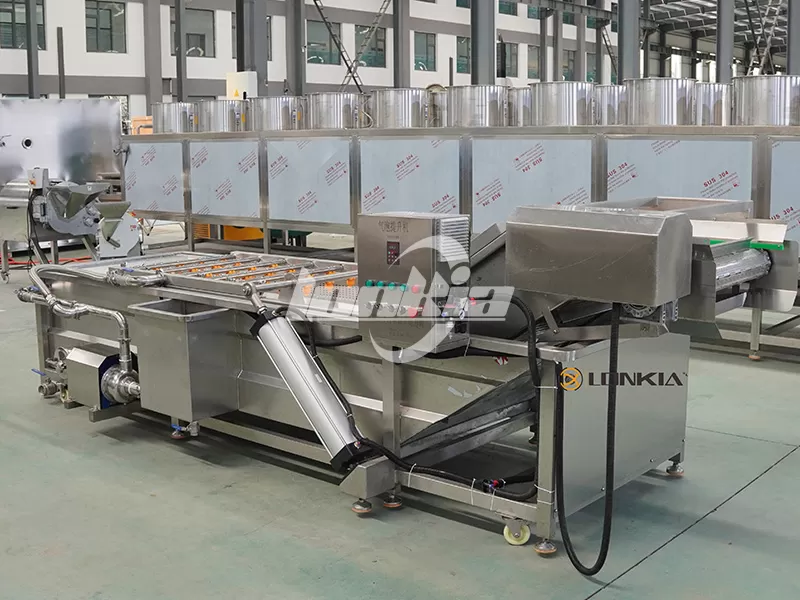
The fruit and vegetable washer uses a blower system to continuously generate a large number of bubbles in the water, causing the cherry tomatoes to tumble. This is combined with high-pressure water jets for rinsing. The instantaneous impact force generated when the bubbles burst effectively strips away surface dirt and impurities.
This cleaning method offers two key advantages:
- More thorough cleaning: Bubbles penetrate the crevices of the fruit, improving cleaning uniformity.
- Gentler cleaning: Water turbulence replaces mechanical friction, reducing damage.
The Working Process of Bubble Washing Machines
In actual production lines, cherry tomato washing typically follows this process:
- Automatic feeding: Raw materials are continuously fed into the washing tank via a conveyor system, reducing manual intervention.
- Bubble agitation cleaning: The bubble system causes the produce to tumble in the water, ensuring comprehensive contact with the water flow and achieving thorough, dead-spot-free cleaning.
- High-pressure spray assistance: Spray nozzles perform a secondary rinse on the surface to enhance cleanliness.
- Impurity separation: Light impurities are discharged via overflow, while heavy impurities settle to the bottom and are discharged, enabling automatic separation.
- Automatic Discharge: Washed cherry tomatoes are conveyed via a mesh belt to the next process.
Core Advantages in Large-Scale Production
In practical applications, the bubble washing machine significantly enhances production efficiency:
- Strong continuous operation capability: Suitable for long-term, stable operation
- Adjustable throughput: Conveyor speed can be adjusted according to production capacity requirements
- Reduced reliance on manual labor: Lowers labor costs
- Improved product consistency: Ensures consistent cleaning results for every batch of fruit
Compared to traditional methods, this vegetable cleaner machine significantly improves overall cleaning efficiency and reduces instability caused by manual operations.
Bubble Washers Are Suitable for Complete Processing Lines
In modern food processing, washing is typically not a standalone step but part of a production line:
Washing → Air-drying → Grading → Packaging
Bubble washers can seamlessly integrate with subsequent equipment, enabling automated assembly-line operations and improving overall production efficiency.
Key Considerations for Selecting the Right Equipment
When evaluating fruit and vegetable washing equipment solutions for washing cherry tomatoes, customers typically focus on:
- Whether the fruit will be damaged
- Whether the wash is uniform and thorough
- Whether continuous production is supported
- Whether maintenance and operation are user-friendly
Bubble washers like those provided by Lonkia combine robust structural design with proven technology. They ensure effective cleaning while prioritizing equipment durability and operational stability, making them ideal for long-term production needs.
Conclusion
For large-scale manufacturers, the core of how to wash cherry tomatoes lies in achieving "efficient, stable, and low-waste washing." By combining gentle cleaning with continuous operation, bubble washers have become one of the key pieces of equipment in modern fruit and vegetable processing.
If your production line is facing efficiency or quality issues, optimizing the washing process is often the first step toward enhancing overall competitiveness.